Digging beyond the history of your direct ancestors and extended blood relatives can lead to the most incredible discoveries and unearth connections that can really brighten your day. That's exactly what happened to me just recently when I stumbled upon a connection to one of Australia's well-known and loved female artists.
After grabbing an interesting looking calendar for the 2022 year from a display in a bookstore, I scanned the information on the back cover and a name jumped out at me.
I was sure the name 'Proctor' was in my family tree, but I couldn't recall the exact details at that moment.
Of course, I had to buy the calendar, that was a given!
Upon returning home and searching my family tree, up popped the name of my great grandaunt's husband - William Consett Proctor.
I took a closer look at William and did a little more research.
Before William had married my paternal great grand aunt, Julia Cusack, he was married to Kathleen Roberts. William and Kathleen had two children together, daughter Alethea (called Thea) and son Frederick. The artist listed on the back of my 2022 Australian Women in Art calendar, was William's first-born child from his first marriage.
What a find to start off the new year! I have a connection to this well-known Australian artist through William's second marriage. Alethea (Thea) Proctor was the stepdaughter of my great grand aunt.
Thea Proctor aged 21 Photo shared by Joan Cucchiaro
Alethea Mary Proctor (known as Thea Proctor) was a highly regarded and prolific Australian painter, print maker and designer.
Born in 1879 in Armidale, New South Wales, she was the eldest child of William Consort Proctor and Kathleen Janet Louisa Roberts.
Alethea's father was an English-born solicitor and member of the Legislative Assembly.
Her mother was Queensland born, and was a cousin of the Australian impressionist artist John Peter Russell (1858-1930).
Alethea's parents had married in 1878 and lived a very comfortable life in the suburb of Hunters Hill during the 1880s.
Sadly, the happy family life did not last. Less than 15 years later, in 1892, when Alethea was 13 years old, her parents separated.
This was when Alethea, her mother and her brother went to live with her maternal grandparents at Bowral.
Her grandparents continued the encouragement of her artistic pursuits as her mother had done for quite some time. Alethea later recalled that her mother had been very ambitious for both her children, teaching them the violin from an early age and also ensuring they had lessons in singing, piano and painting. At Bowral, Alethea attended Lynthorpe Ladies' College where her artistic tendencies and talents were directed into painting and drawing studies.
In 1896, when she was only 16, Alethea (Thea) moved to Sydney to attend Julian Ashton's Sydney Art School. By this time her father, William Consett Proctor, was living with my paternal great grandaunt Julia Cusack and they already had one son together. One year later, in 1897, Alethea's parents were divorced, in a very public proceeding, just before her 18th birthday.
Alethea's father and my great grand aunt went on to have four more children. They finally married in 1903, a couple of months before the birth of their last child. I am not sure if Alethea ever had any contact with her stepbrothers or stepsisters, my first cousins twice removed! I doubt it very much.
Alethea's earliest work, 1897-1899, included bookplates, black and white studies, posters and some watercolours. Most of her exhibited work at this time depicted mainly women in decorative compositions. Her mother's ambitions for her though resulted in them both setting sail for England in 1903.
When she first moved to London, she was attending the St. John's Wood School in the company of her close friend George Lambert. She then studied privately with George. Their friendship was to be lifelong and intimate.
In London, between 1903 and 1912, and then between 1914 and 1921, she exhibited with the Royal Society, the New English Art Club, the International Society, and the Senefelder Club. Her work also received exposure in Venice, Rome, Paris, Berlin and Ghent.
Self portrait, 1921 - lithograph by Thea Proctor (aged 42). In the collection of the National Portrait Gallery, Canberra, ACT.
When Alethea (Thea) returned to Melbourne, Australia, in 1921, she generated support for modernism and became an intrinsic figure in the development of the Sydney Contemporary Group, established in 1926.
According to a short biographical piece published by the Australian National Portrait Gallery:
"When she returned permanently to Sydney in 1921, her art and ideas were at the forefront of contemporary art and design in Australia; her authoritative opinions on decoration, colour, interior design, flower arrangement, ballet and fashion were widely published in new journals such as The Home (for which she designed many covers) and Art in Australia. An exhibitor in the watershed Burdekin House exhibition in 1929, she was a mentor and champion for young interior designers including Marion Hall Best. Although she maintained a large and varied circle of friends (and adversaries), she was a lifelong singleton, living very frugally in rented accommodation, making a slender living from drawing classes, periodic exhibitions at the Macquarie Galleries and commissioned drawings of Eastern Suburbs children."
In 2005, the National Portrait Gallery held its second only exhibition that followed the life of a single person. The first was titled: Rarely Everage: The lives of Barry Humphries. The second was titled: The World of Thea Proctor.
If only I'd known about the connection back then!!! I would have made every effort to view that exhibition.
Alethea (Thea) Proctor worked right up until her death in 1966, at the age of 86.
If you follow this link: Thea Proctor: In Their Own Words, you will hear Alethea (Thea) herself speaking as she talks about her work.
Alethea (Thea) worked tirelessly to promote John Peter Russell's art. You may remember I had mentioned that John was a cousin of Althea's mother.
His life story is also quite fascinating. After the death of his father and inheriting a sizeable fortune, John had moved to Europe in his late teenage years where he was to become a close personal friend of Vincent Van Gogh and Auguste Rodin, and is widely recognised as having had a significant influence on the young artist Matisse.
John Peter Russell also has an entry in the Australian Dictionary of Biography: Russell, John Peter
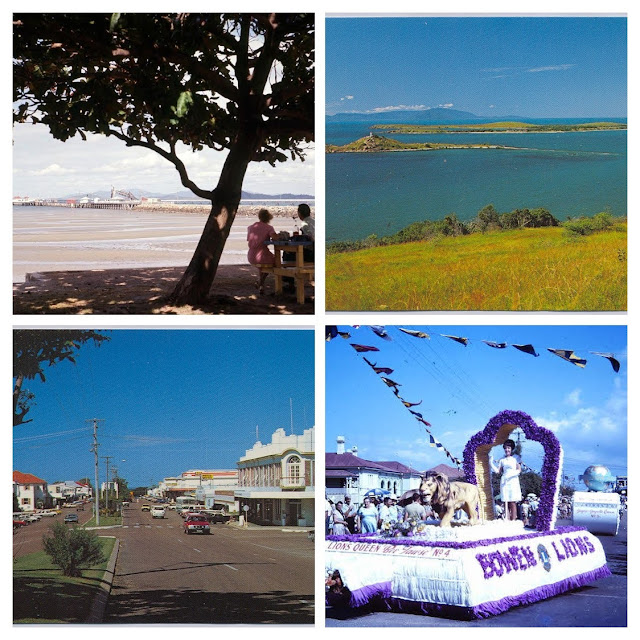
I'm a small town girl, born and bred in the coastal town of Bowen, north Queensland, and even though I only spent the first sixteen years of my life there, I still feel a deep connection to that place.
Memories of Bowen from the 1960s-1970s (the Bowen I remember from my youth)
Until recently, I had thought my family connection to Bowen only went back as far as my maternal Grandfather James O'Donnell and Grandmother Sarah McCane. Both my grandparents were the children of immigrants. James O'Donnell was the son of Irish born Edmond O'Donnell and Bridget Burke. Sarah McCane was the daughter of Irish born Owen McCane (Muckian) and English born Margaret Farrell.
My grandfather James was born in Toowoomba and initially moved to Kyburra (near Armstrong Creek), outside Bowen, where he established a small farm.
My grandmother Sarah was born in Charters Towers and then moved with her parents and siblings to Molongle Creek, outside Bowen, where her parents also established a small farm.
My grandparents spent around the first 21 years of their marriage living on Grandad's farm at Kyburra, before moving into the town of Bowen. That is where my mother and father married and began their married life, and where my brother and I were born.
I therefore grew up with that history of our family's connection with Bowen, and no inkling of anything different.
Throughout my childhood I became increasingly aware of the history of the town itself of course, and there were names I became familiar with -
Henry Daniel Sinclair, who discovered the harbour in 1859 and named it Port Denison, after the Governor of New South Wales at the time.
George Elphinstone Dalrymple, who founded a settlement at the harbour just two years later, and named it Bowen after the first Governor of the newly declared state of Queensland, Sir George Bowen.
I've only just recently found that there is a connection that links my grandmother's brother to the man who is referred to as the "father of Bowen" - Captain Henry Daniel Sinclair.
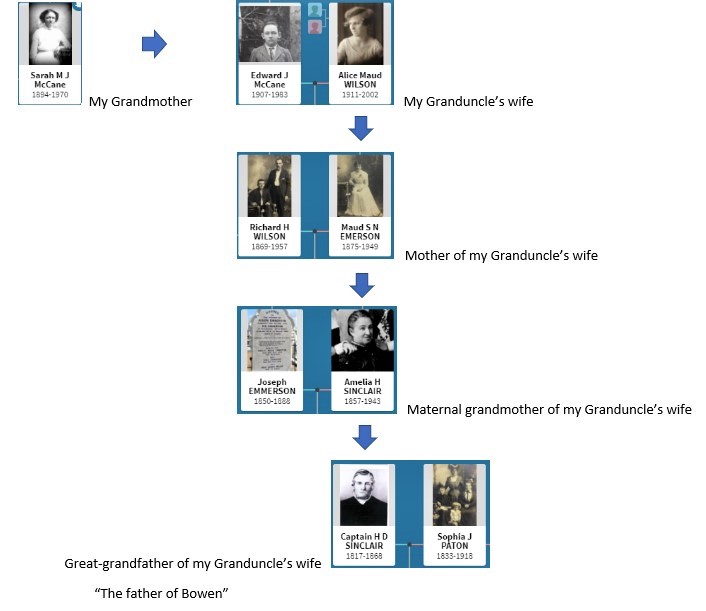
Starting with my grandmother I'll explain this connection:
My grandmother Sarah O'Donnell nee McCane was one of six siblings - one sister and five brothers. Her youngest brother was Edward Joseph McCane, my Grand Uncle.
When Edward Joseph McCane married, a family connection was created to an ancestral line that leads directly back to Henry Daniel Sinclair.
My Grand Uncle's wife, Alice Maud Wilson was Captain Sinclair's great granddaughter.
From Alice Maud McCane nee Wilson, the ancestral connection to Captain Sinclair is through her female line -
great granddaughter Alice Maud Wilson > Alice's mother, Maud Sophia Nash Emmerson > Alice's grandmother, Amelia Hollis Sinclair > and then Alice's great grandfather, Captain Henry Daniel Thomas Sinclair.
Alice Maud McCane nee Wilson (photos sourced from Jessica Watters)
Captain Sinclair's great granddaughter, Alice Maud Wilson, was born in 1911 in Bowen, Queensland. She had a half-sister and two brothers, although one of her brothers died when he was only 2 years old. Alice married my grand Uncle when she was 22 years old. Their married life began close to the McCane family farm at Broadlands outside Bowen, but they made the move to Bowen just a couple of years later. They lived on Thomas Street where they raised their two children.
Maud Sophia Nash Wilson nee Emmerson (photo sourced from Jessica Watters)
Captain Sinclair's granddaughter (Alice's mother) was Maud Sophia Nash Emmerson. She was born in 1875 on Pretty Bend Station, near Bowen, and was the oldest of eight children born to Joseph Emmerson and Amelia Hollis Sinclair. She spent her childhood and many of her adult years living on her family's property, Amelia Vale Station, near Proserpine in Queensland.
Maud married Richard Hugh Wilson in 1909 when she was 34 years old and they lived for many years either on their farm near Eurie Creek, Merinda, or at Gumlu, before moving to Bowen in their latter years.
When Maud passed away in 1949, mention was made in her obituary that she was the "granddaughter of Captain H.D. Sinclair, the discoverer of Port Denison."
Transcript:
Bowen Independent (Qld.: 1911 - 1954),
OBITUARY
MAUD SOPHIA NASH WILSON
"Another link with the past was severed when Mrs. Maud Sophia
Nash Wilson died on May 27th at Bowen. The late Mrs. Wilson was a member of the
well-known Emerson family of Amelia Vale, who were noted throughout the
district for their hospitality.
Deceased was the eldest daughter of Joseph and Amelia
Emerson, and a granddaughter of Captain H. D. Sinclair, the discoverer of Port
Denison. Mrs. Wilson was born in Bowen on 22nd January 1875, and spent her girlhood
in Bowen, Proserpine and Amelia Vale. Her father died when she was 13 years
old, and as a young woman for some time she conducted an agency for the old tea
firm of Atcherley & Dawson.
In December 1909 she married Mr. Hugh Wilson, and then lived
at Euri Creek for a couple of years, until they moved to Gumlu. There they
remained until 1944, when they took up residence in Bowen. They had three
children, two daughters and a son, Joseph, who passed away at an early age. The
daughters, who survive, are Allee (Mrs. E. McCune, Bowen) and Hollis (Mrs. D.
Romano, Innisfail).
Besides her husband and daughters, she has left to mourn her
loss, four sisters and one brother, the sisters being Mrs. F. A. C. Smith,
Bowen, Mrs. C. Spencer, Bowen, Mrs. F. Watts, Amelia Vale, Proserpine, and Mrs.
A. Thompson, Norman Park, Brisbane. The brother is Mr. Canty Emerson, Goorganga
Creek, Proserpine. One brother, Joseph, predeceased her. Mrs. Wilson also
leaves a step-daughter, Mrs. E. Flecher, Gumlu, and eleven grandchildren. The last
sad rites were conducted by Rev. A. D. Thorpe, Holy Trinity Church, and another
of the old band of pioneers laid to rest."
Amelia Hollis Emmerson nee Sinclair (seated with two of her youngest daughters behind her, Ethel Hollis Gertrude, on the left and Lilly Mabel Patience on the right) (photos sourced from Dinah Souter)
Captain Sinclair's daughter (Maud's mother) was Amelia Hollis Sinclair. Amelia had been born at Cook's River, Petersham in New South Wales in the mid 1850s and was one of eight children born to Captain Henry Daniel Thomas Sinclair and his wife, Sophia Jane Paton.
Amelia was 4 yeas old when she and her mother, the wife of Captain Sinclair, arrived at Port Denison aboard her father's ship, the Santa Barbara, making her one of the first white children to live in the area.
Amelia married Joseph Emmerson in 1874, when she was 16 years old. They went on to have a family of ten children, and lived for many years on Joseph's father's property Pretty Bend Station, before moving to a property that Joseph had taken up under the first Land Act. He named it 'Amelia Vale', after his wife. Amelia continued living at Amelia Vale Station until her death in 1943.
I found this account, given by Amelia in the 1930s, particularly fascinating. She recounts her childhood and early married life in the Bowen area and her interactions with the indigenous people living there.
PIONEER CHILD AT BOWEN. DAUGHTER OF CAPTAIN SINCLAIR.
"I was four years of age, when my mother (the wife of Captain Sinclair) landed at Port Denison in the 'Jeannie Dove' 1859, writes Mrs. Emmerson, so I must be a pioneer child of Bowen, a town I loved as a child and do so still. My life has been spent in its vicinity. At that time the water for settlers was got from native wells on the beach. Where Bowen is now was then all wattle scrub. Back of Zimmerman's is where the native police camp was formed to protect the arrivals on the 'Jeannie Dove' from attacks by the wild blacks, who were not allowed in the township for some years. Later they were allowed to camp at Miller's Lagoon. It was part of our Sunday outings to go and see the tribes, and watch the gins digging up bigaroes around the lagoons.
Mr. D. R. Emmerson, my father-in-law, had cattle properties, Eagle Vale and Pretty Bird, where I went to live when I married his son, and where six of my children were born. We had not so much attention as wives and mothers have nowadays, so we appreciated the help of black gins who became friendly to us. One blackfellow was made king of Pretty Bend by having his name and title inscribed on a big brass plate to hang on his chest. His gin Maggie, was always with me, and was delighted when my little ones came into the world. As well as being a splendid help, she was a great protection. When any mischief was brewing amongst the blacks, she always came secretly and warned be about their plans. Her son, who took the name of Willie Emmerson, became a famous horseman, well known throughout the district. I hold him in great respect, as I have found him sincere and good.
I look back to those times as the brightest and happiest days of my life. When my husband sold Pretty Bend, we travelled in a bullock dray with a tilt or cover over it, and driven by Jack Gill, then only a boy in years, to Amelia Vale, country my husband had taken up under the first Land Act and given it that name. From then till now it has been my home. I am the mother of seven living children, and 22 grand children. After over 50 years in the bush, I can look back with pleasure to the grand old pioneering days."
(photo sourced from Jessica Watters)
This Sinclair family portrait shows Amelia, seated on the right, with her mother Sophia Jane Sinclair nee Paton (the wife of Captain Sinclair), her daughter Florence Amelia Constance Smith nee Emmerson, and her grandson Hector Smith.
Captain Henry Daniel Thomas Sinclair
Captain Sinclair was born Henry Daniel Thomas Sinclair, in 1817 in Shoreham-by-Sea, Sussex, England. He was the son of Thomas Sinclair and Amelia Hollis. Sent to sea at the age of 12, Henry finally earned his Master's Certificate of Service in England, in 1851 at the age of 32. He emigrated to Australia soon after, and married Sophia Jane Paton in Sydney in 1855, when he was 37 years old. They went on to have eight children over ten years.
When Captain Henry Sinclair was aged 42, he led the first British expedition to find a port north of what is now known as Rockhampton, in response to a reward offered by the Colony of New South Wales. The then Governor of New South Wales had offered a sizeable bounty for the discovery of a suitable harbour that could be easily accessible by northern settlers.
Captain Sinclair departed Sydney in August of 1859 on his nine-tonne ketch named the 'Santa Barbara'. He met up with two other partners and a seaman in Rockhampton and the party set sail from Port Alma at Rockhampton, heading northwards.
There is a fascinating account of Sinclair's discovery that can be viewed on the Trove website: How Bowen Was Discovered by James Gordon It tells the tale of a hastily arranged voyage plagued by poor planning and Sinclair's erratic leadership and calls the sighting of Port Denison an 'accidental discovery'.
Gordon, James. 1859, How Bowen was discovered : the cruise of the Santa Barbara, 9 tons, in search of a northern port in the year 1859
Information cited on the ABC television program 'Lateline', aired in 2003, gives a very clear picture of this time in Captain Henry Sinclair's life.
"The New South Wales Government in 1859 has posted a reward of 2000 pounds to anyone who discovered a suitable harbour north of Port Alma (near Rockhampton).
Spurred on by the prospect of the reward, Captain Henry Daniel Sinclair, his partners James Gordon and Benjamin Poole and seaman William Thomas set sail from Rockhampton in a nine-ton ketch, the Santa Barbara on September 1, 1859.
By September 29, they had sailed as far as Upstart Bay (in the area now known as the Burdekin region) and checked out the shoreline. Heading southwards for the return journey they encountered severe headwinds as they rounded Cape Upstart forcing them to sail through the Gloucester Passage to Edgecumbe Bay, areas previously named by James Cook when he passed by on his epic voyage nearly 90 years earlier.
The Santa Barbara sailed across Edgecumbe Bay on the morning of October 15 passing a couple of islands. Two of them were subsequently named after Poole and Thomas. Behind a third island, later named Stone Island, Sinclair and his crew found what amateur historian Peter Delamothe later described as "a splendid harbour…where ships could remain in perfect safety". They named the harbour Port Denison in honour of the Governor of N.S.W.
The Santa Barbara returned to Rockhampton on October 31 and the three partners then travelled to Sydney to claim the reward. They were interviewed by the N.S.W. Governor, Sir William Denison. At the same time, they were introduced to Sir George Ferguson Bowen, the Governor of Queensland, the name of the new colony approved by Queen Victoria on June 6 of that year.
Both governors confirmed the statement by the N.S.W. Premier Sir Charles Cowper that they were entitled to the reward if the harbour was suitable.
Governor Bowen was to proclaim a separation of Queensland from N.S.W. on December 10, 1959. On August 11, 1860, Governor Bowen instructed Joseph W. Smith RN to command the schooner Spitfire to go to Port Denison and confirm Sinclair's reports on the suitability of the harbour. Smith was accompanied by George Elphinstone Dalrymple (who had previously trekked the area by land and had been appointed Lands Commissioner for the proposed Kennedy Pastoral District), surveyor R.P. Stone and botanist Fitzalan.
On September 29, 1860, they entered Port Denison and found the harbour ideal for a port and the site on the coast ideal for a township. According to Delamothe they advised Governor Bowen that "Port Denison among harbours of eastern Australia was only second in beauty to Port Jackson and as the site most suitable for a first settlement and port for the new Kennedy District".
The Kennedy District was opened for pastoral occupation in January 1, 1861, and Port Denison was proclaimed a port of entry in March that year. The town was officially named Bowen.
As Queensland had separated from N.S.W., the N.S.W. Government reneged on its promise to reward Sinclair. Governor Bowen believed the reward should have been paid, but the new colony did not have the money to pay it. Sinclair and Gordon pressed their claim for the reward but without success. Instead Sinclair was offered the job as Harbour Master and Chief Constable at Bowen, while Gordon was fobbed off with the job of Collector Customs.
Bowen, as North Queensland's first settlement and port, was surveyed with a view to it becoming the major centre for the North. Its wide, symmetrically designed streets, as surveyed by Clarendon Stuart, were to accommodate a fast growing town, perhaps a city. But with the opening up of the goldfields in Ravenswood and Charters Towers, as well as the powerful political lobby that favoured the port of Townsville in Cleveland Bay, Bowen's aspirations went unfulfilled.
Ironically, the discoverer of Port Denison, Captain Henry Daniel Sinclair, accidentally drowned in Cleveland Bay in March 1868 and was buried in the old West End cemetery in Bowen's rival town of Townsville."
So it was to be that, unfortunately, Captain Sinclair was never able to claim the reward offered. The first British settlers began arriving at Port Denison in March of 1861 and Sinclair assisted with the transport of these people on board the Santa Barbara. The settlement was officially proclaimed on April 11th, 1861 and named Bowen. Sinclair stayed on in Bowen, and lived out the remainder of his life there.
He served as the harbourmaster for a number of years but grew disgruntled with the place, took to drink, and was dismissed. Tragically, and rather ironically, Captain Sinclair accidentally drowned in Cleveland Bay, at Bowen's rival town of Townsville, just a few years later!!!
Captain Henry Daniel Thomas Sinclair died in March of 1868 at the age of 50. Sadly, earlier that same year, Sinclair's brother and twelve-year old son drowned during an excursion on Bowen Harbour, and Sinclair followed them to a watery grave in a sailing accident at the St. Patrick's Day Regatta on Townsville's Cleveland Bay. He was quickly buried in the Townsville Cemetery, which seems like a rather unworthy ending for such a man.
Newspaper Article - Death of Captain Sinclair - Brisbane Courier Mon 13 April 1868 p3.
In 1934, a cairn was unveiled in Santa Barbara Park in Bowen, commemorating the 75th anniversary of Captain Sinclair's discovery.
It still stands, loud and proud, today.
In 2009, another Captain Henry Sinclair monument was erected, commemorating 150 years since Captain Sinclair landed in Port Denison.
Interestingly, the Sinclair line was the topic of a newspaper article published in the Townsville Daily Bulletin in 1951, on the occasion of the Jubilee of the Federation of Australia. There was to be a re-enactment of Captain Sinclair's landing as a major part of the events planned in Bowen. My Grand Uncle's wife, Mrs. Alice McCane is mentioned, along with her two children (my first cousins 1x removed) Mervyn and Merle McCane.
On a side note ... During my childhood, I lived on a street named Denison Street in Bowen. I went to a school named Santa Barbara Infant School which was on Sinclair Street. My grandparents lived on Dalrymple Street. Small town living! At the time I was unaware of the significance of any of these names.
The subject of this post was sparked by a very recent discovery linked to my maternal line and to one of Australia's worst peacetime maritime disasters - the sinking of the SS Yongala - near my home town of Townsville in Queensland.
The reference to the Titanic was used in the title of a book about the sinking of the SS Yongala. Author: Max Gleeson Published: 2000
The mysterious disappearance of the SS Yongala happened a year before the sinking of the Titanic, but in the decade or so after the tragic event, newspapers dubbed the disaster, "Townsville's Titanic", and turned the whole tragic story into a homemade version of that famous disastrous sinking.
The wreck of the SS Yongala is not far from where I live, and is now considered one of Australia's best wreck dives. The sinking of this ship is a familiar story to all who live here in the city of Townsville, north Queensland, and whilst I have heard the stories over and over again since I moved here many moons ago, I had no idea of any personal connection to that event until just a couple of days ago. This is exactly why I love my time spent on family tree research ... you can uncover the most amazing stories!
SS Yongala Creator unknown., Public domain, via Wikimedia Commons
One hundred and ten years ago, the steam ship SS Yongala sank in a cyclone off Cape Bowling Green, near Townsville. The Yongala was a passenger and cargo ship that was en route from Melbourne to Cairns when she steamed straight into a cyclone and sank off the coast south of Townsville. All lives were lost and the wreck of the ship lay undiscovered for nearly 50 years!
The Yongala was named after a tiny pastoral town in South Australia, and its name meant "broad water" in the local Ngadjuri language. The ship had spent its lifetime ferrying cargo and travellers around Australia. Its last fateful voyage was its 99th run, begun on March 14th, 1911, at the port of Melbourne, in Victoria. By the time it left Mackay central Queensland, it was carrying 49 passengers, 73 crew members and a race horse named Moonshine, and was headed to Townsville.
One of the passengers aboard that fateful voyage was the husband of my maternal great grand-aunt, Helen Ann Davies nee Farrell (my Grandmother Sarah McCane nee Farrell's aunty). Helen Ann (known as Annie most of her life) had married David Davies in Charters Towers in 1890. She was aged 19 and David (who had been born in Victoria) was 28 years old.
David Davies had been born in 1861, the son of David Davies and Catherine Jones. At the age of 21, he had moved to New South Wales, presumably in search of work, and then when he was about 25 years old he moved to Charters Towers in Queensland. He was an iron moulder by trade, like his father before him, but had moved to Charters Towers to work in the gold mining industry which was booming at that time.
After their marriage in August of 1890, Helen Ann and David went on to have 9 children over a period of 18 years. By the time their 7th child was born however, they were living in Cairns, north Queensland, presumably because David found work that could better support his large family. Unfortunately David had to move once more for work, but this time, he was on his own. By early 1911, then aged 49, David was living and working in Brisbane, whilst his wife Helen Ann (Annie) and their eight children remained in Cairns. Sadly their 7th child had died soon after her birth, back in 1903.
Argus, Saturday, March 18, 1911 p19.
According to a newspaper article (written a month or so after the tragic event and included at the bottom of this post), it seems that David had likely read newspaper reports, such as this one on the left, of a severe cyclone that had hit Cairns earlier, on March 16th.
The cyclone had actually made landfall at Port Douglas, to the north of Cairns, but had impacted the coastal area including Mossman and Cairns.
David would have read that it had caused widespread damage, leaving around 100 people homeless in Cairns and two fatalities and it seems that David had also read a statement containing a spelling error, which resulted in a catastrophic change to the life of his family.
It appears that David had read that the house the 'Davies' family lived in had been completely destroyed. He was likely convinced this was the house of his own family. Instead, it was actually the house of the 'Davis' family and there had been an error in the spelling of the published family name.
As a result of this error, David decided to purchase a ticket and make the trip home to Cairns from Brisbane, instead of just sending his pay cheque, which is what should have happened. He boarded the ship, intending to go home and check on his family, but he never arrived in Cairns.
The SS Yongala left Mackay for Townsville on the afternoon of March the 23rd. Other ships had sighted flag signals or received wireless signals from a signal station just outside Mackay about a cyclone that was brewing between Mackay and Townsville, and took shelter at Mackay or nearby. Unfortunately, the Yongala did not see the signal flags and had no wireless equipment. It was last sighted by the lighthouse keeper at Dent Island, five hours after departing Mackay, still heading north into badly deteriorating weather. It never reached Townsville, let alone Cairns.
The lack of Yongala's arrival in Townsville did not immediately cause concern,with the assumption that the ship had taken shelter from the cyclone.After three other ships arrived in Townsville, Yongala was listed as missing on 26 March, with the note that she may have been lost as early as 23 March.
Queensland Premier Digby Denham turned all of the state's resources over to search efforts, including seven vessels operated by the public service, police and shipping.Wreckage was found washed up on beaches from Hinchinbrook Island to Bowen, but there was no sign of the ship or those aboard.The only body found was of the racehorse Moonshine, which washed up at the mouth of Gordon Creek. A £1,000 reward for information leading to the discovery of the ship was offered by the Queensland government, but this was withdrawn after no useful information came forward.
Several theories were offered for the ship's disappearance. Somespeculated that Yongala had fallen victim to the cyclone; the high winds would have come from perpendicular to the ship's course and overpowered the vessel.Othersthought she had grounded on a submerged reef between Flinders Passage and Keeper Reef, run into Nares Rock or struck Cape Upstart.
SS Yongala at Fremantle in the 1900s
The Marine Board of Queensland investigated the loss of Yongala from 8 to 20 June 1911. With no witnesses to the ship's fate, the inquiry considered the ship's stability, equipment and seaworthiness, together with consideration of Captain William Knight's capabilities as a ship's master.
After finding no fault with the condition of the ship (based on design specifications supplied by the Adelaide Steamship Company, along with data from sea trials and seven years of uneventful operation) or with Knight's abilities (his reputation as one of Adelaide Steamship Company's most capable men, and 14 years' service without incident) the Board concluded that "the fate of the Yongala passes beyond human ken into the realms of conjecture, to add one more to the mysteries of the sea".
The Board did note the increased risk of navigating the Great Barrier Reef during tropical cyclone season was risky, and that the safest option was to secure the best anchorage available and ride the storm out.
A "Yongala distress fund" was set up in March 1911, with money raised used for the relief of families of those aboard.The fund was closed on 30 September 1914, with the £900 remaining credited to the Queensland Shipwreck Society.
The ship's disappearance remained a mystery for decades. I can't imagine how this uncertainty played on my great aunt Helen Ann or her children. How do you live with never knowing what happened to your husband / father? No body was ever found or buried. No answers were found until after Helen Ann (Annie) had died, and seven of her children were well into their 50s or 60s.
Interestingly, mention was made of Helen Ann and her children in a newspaper article in the Cairns Post, related to the "Yongala distress fund", dated April 10th, 1911. Previously, I mentioned this article because it had provided some detail about why David was on the Yongala. Whether or not the information is totally correct is of course almost impossible to prove, but I am hopeful that the reporter had indeed respectfully spoken to Helen Ann and published a true account of the details of the final day or so of David's life.
Ironically, the family name Davies was misspelt in this article as Davis!
Cairns Post, Monday April 10, 1911 p4.
Transcript of that article:
Cairns Post (Qld.: 1909 - 1954), Monday 10 April 1911, page 4
THE POST
MONDAY, APRIL 10, 1910.
FOR the Widow and Orphans
Cairns Yongala Fund.
It is an old saying that charity should begin at home, and it will be
admitted that the community should consider it a paramount duty to relieve,
primarily, the distress existing in its midst, without in any way interfering
with wider or more general movements of a similar nature. This is the opinion
of several residents of Cairns, business men and others, who have been
considering the case of Mrs. David Davis (surname misspelt!), whose husband was lost on the
Yongala, and who has been made a widow and her children orphans by that
terrible tragedy of the sea. The matter was mentioned to the "Post"
last week, and this Paper has made full inquiries into the circumstances, with
the result that it today, with the approbation of the residents above
mentioned and the consent of Mrs. Davis and her children; opens a special
subscription list in order to provide a sum which will in some measure help to
compensate the bereaved ones for the loss of their -------(print was unreadable)------- relieve them, and ensure them against
suffering and destitution in the future.
Personal inquiries made by the editor of this paper revealed the following
facts - Mrs. Davis resides with her family in a small cottage, which she rents,
in Lumley Street. She has eight children, two of whom, a boy and a girl, are
apprenticed, earning between them £2 per week. The boy is not in robust health,
and the sudden shock following the loss of his father, to whom he was devotedly
attached, has not tended to mend matters. The remaining six children are of
tender years, the youngest being a little toddler. The husband and father who
by trade an iron-moulder. Not being able to get constant work here, he left
some little time ago for Brisbane, and his family were delighted to know that
he was at last earning good money. He told them he was forwarding a remittance
by the mail that would have come probably by the Yongala, but to their surprise
he wired them that he was returning to Cairns by that steamer. It is surmised
that he read the account of the Cairns cyclone in the Brisbane papers, and as
it was mentioned that the house of a Mr. Davis had been blown down in Lumley Street,
be naturally thought it was the house in which his family resided, whereas it was
the house of another person of the same name.
So that poor David Davis was hurrying back to the relief of his family
when he met his death. His arrival was expected on the Sunday and the family
dinner was prepared with extra care, the mother and children looking forward to
the return of the husband and father with affectionate and pleasurable anticipations.
Then came the news that the Yongala was missing, and later the list of the
second-class passengers, which included the name of Mr. David Davis.
The sad circumstances surrounding the loss sustained by Mrs. Davis and
her family have appealed to many; and after consulting with some of those who
sympathise with the widow and orphans, the "Post" today makes an
appeal for contributions and opens a subscription list, apart altogether from,
and entirely independent of, any movement that may be decided upon in regard to
a general relief fund—which will be drawn from the whole of Australia. After
personal investigation of the circumstances, the "Post," to whom Mrs.
Davis and her family, previously were strangers, assures the public that the
object for which this fund is opened is, in the truest sense, deserving. It may
be mentioned that already a number of subscriptions are promised but in order
that the response may be truly spontaneous and voluntary; these amounts are not
mentioned today, the "Post" simply opening the list formally.
Subscriptions will be received at this office and the full list will be
published daily until it is finally closed, when it is hoped a sufficient sum
will be obtained to provide a permanent and comfortable home for Mrs. Davis and
her children, the total amount being vested in trustees to be used to the best
advantage on behalf of the widow and orphans.
The SS Yongala lay undiscovered until it was finally positively identified in 1958.
It has since become a world famous dive site, now covered in coral and home to hundreds of species of marine animals. It is the largest, at 110 metres in length, and one of the most intact historic shipwrecks in Australian waters.
David Davies' death was registered by his wife Helen Ann two months after the tragic sinking, and his date of death was recorded as the 23rd of March, 1911.
Details on his death certificate state that he died "in wreck of S.S. Yongala near Townsville", aged 49 years and 5 months, and his body was "not recovered" for burial.
Acknowledgement given to the Townsville Maritime Museum for this list of all passengers and crew, from SS Yongala who died on the 23rd, of March 1911. No one survived.
First class saloon for Townsville.
1. Mr Matthew Rooney 2. Mrs Katherine Rooney 3. Miss Lizzie Rooney 4. Miss Ethel Amy Uhr, Matron, Townsville hospital 5. Miss Jean Buxton, Nurse, Townsville hospital 6. Mr John James Elsdale 7. Mrs Annie Eileen Elsdale 8. Mr Rudolph August Stach 9. Mr Francis Fothergill Viney 10. Miss Mary Josephine Carroll 11. Miss Mona Kathleen Shannon 12. Mr Willie Lin 13. Ms Emily Ada Davis 14. Mr John Campbell 15. Mr Ernest Greenfield 16. Mr Clifford James Hardin O'Brien
For Cairns
17. Mrs Charlotte Louisa Davids 18. Mrs Alice Minna Murray 19. Master Ian Sheppard Murray 20. Miss Alister Sheppard Murray 21. Miss Jean Alexander Murray 22. Miss Ailsa Mary Murray (Infant) 23. Mrs Mary Ann Linedale (Maid) 24. Mr Stephen Symons Reath 25. Mrs Margaret Frances Reath 26. Mr William James Fulton 27. Mr Albert Sutherland Dette 28. Mr T Parton 29. Mr S Manwaring 30. Miss Mary Annie Woodward 31. Mrs Hanora Gertrude Magee
Second class for Townsville
32. Mr O F Thompson 33. Mr Charles Manbey 34. Mrs Mary Ann Manbey 35. Mr W Barklay 36. Mr Octagavina Carrasco 37. Mr Jose Sareras 38. Mr Walter Francis Breckenridge 39. Mr Ernst Schneider 40. Mr Richard Thomas Coade 41. Mr Walter George Coade 42. Mr James John Sutherland 43. Mr Fraser Sutherland 44. Mr William Smith
For Cairns
45. Mr James Dempsey Jolly 46.Mr David Davies 47. Mr Pianta, Antonia 48. Mr W H Griffiths 49. Mr E E Parkhurst
CREW
50. Mr William Knight 51. Mr Richard Williams 52. Mr Harry Harden 53. Mr D Cameron 54. Mr George H Jarvis 55. Mr A F Hamilton 56. Mr John Donaldson 57. Mr Claude Miller 58. Mr A Lawrance 59. Mr E Mawby 60. Mr G A Harris 61. Mr W D Millar 62. Mr E McKenzie 63. Mr J Roberts 64. Mr S W H Emerson 65. Ms A S English 66. Ms M Lambrick 67. Ms S Andrew 68. Ms A Rentoul 69. Mr J H Shipton 70. Mr G H Reid 71. Mr J Elliott 72. Mr V Cross 73. Mr D Morrison 74. Mr J W Sullivan 75. Mr J Ward 76. Mr J Craig 77. Mr J Finlay 78. Mr A O Armstrong 79. Mr J E Costello 80. Mr F J Wingrove 81. Mr R W Cooks 82. Mr A P W Gordon 83. Mr G H Fox 84. Mr J West 85. Mr R Robertson 86. Mr W H McPherson 87. Mr J Gemmell 88. Mr P McAdle 89. Mr P Rankin 90. Mr T Howard 91. Mr W Houston 92. Mr W D Murray 93. Mr F E Voight 94. Mr A Uggddahl 95. Mr H Todd 96. Mr F Medcalf 97. Mr J Diamond 98. Mr J Grumbledon 99. Mr J Narrie 100. Mr C A Davison 101. Mr A Lillico 102. Mr J F Gallagher 103. Mr E A Rickson 104. Mr J A Reich 105. Mr G Goldsmith 106. Mr J Calvin 107. Mr O V Nelson 108. Mr J McGinnis 109. Mr E O Jones 110. Mr W Boylan 111. Mr R Woods 112. Mr H C Gale 113. Mr E H Freeston 114. Mr P Walsh 115. Mr J Johnston 116. Mr J MacDonald 117. Mr V R McDougall 118. Mr W Paton 119. Mr J L McNamara 120. Mr C S Doyle 121 Mr H Lewis 122 Mr S Donachie
In my last post, I started recording the stories of people from my family tree who belong on my 'Lonely First Names Club' list. The list includes all those people (whether they are born into or married into the family) whose first names don't commonly appear in any of the branches of my family.
The first name 'Bede' is quite rare on my family tree and is one of my favourites. In fact, there are only two family members who had that name. One was my father - Bede William Connors - and the other was my paternal 1st cousin twice removed - Bede Anthony (Dick) Connors. Their common ancestors were William Connor (Connors) and Eleanor Hickey.
Bede is, what I would consider to be, quite an old-fashioned name, and not a name most people would have heard before or be familiar with. It's a boy's name of old English origin, apparently meaning 'prayer'.
The original uploader was Timsj at English Wikipedia. - Transferred from en.wikipedia to Commons., Public Domain, https://commons.wikimedia.org/w/index.php?curid=2259187
There was a famous 7th century saint and church historian known as 'Venerable Bede' who was the saint my Catholic grandparents chose to name my father after.
'Venerable Bede' was a Benedictine monk, considered to be the first known writer of English prose, and highly influential because of his work 'Ecclesiastical History of the English People', a history of the Church in England.
(The photo to the right is "a faithful photographic reproduction of a two-dimensional, public domain work of art" known as "The Venerable Bede Translates John" by James Doyle Penrose 1862-1932).
In my family tree, 'Bede' was not chosen very often as a first name, and both men named Bede were not known by that name throughout most of their lives! Indeed, they were better known by either a shortened version (such as Bernie or Bern in my Dad's case) or by a nickname instead (such as Dick in Bede Anthony's case).
Despite the fact that Bede Anthony was my father's 1st cousin once removed, I don't believe they ever met or actually knew anything about each other. I wonder if they even knew there was another Bede in the family?
Bede William Connors (1924 - 2016).
Bede William (my Dad) was born in the southern part of Queensland, in Maleny, but he lived most of his life in the small town of Bowen, in northern Queensland.
Very few people called him by his first name, apart from some of his close family. I do remember hearing him being called Bede by his two older sisters when I was growing up!
He was mostly known as 'Bernie' though, and is fondly remembered as a bit of a prankster, a man with a wicked, rather irreverent sense of humour. That didn't seem to match his Christian name Bede at all, since that was most commonly associated with a saint!
I've told Dad's story before in one of my first posts on this blog, so instead of repeating exactly what I've previously written, I will just mention a few of the more salient events of his life.
Bede (known as Bernie) lived an ordinary working man's life. He and his twin brother Reginald (Reggie) were born into a large family in 1924. Their childhood was spent mostly in Gympie Queensland, with their three older brothers, three older sisters, and their younger sister, who was born when the twins were 5 years old.
Bede started work at the young age of 16 in 1940, and worked for Queensland Railways his entire life, up unto retirement at the age of 65. He married Margaret Brigid O'Donnell (my Mum) in his early 30s, and they went on to have two children during their short marriage.
Sadly, Margaret passed away after nine years of marriage, leaving Bede widowed at the age of 43 with two children aged 8 and 6. Not long after losing his wife, Bede's older sister Chris came to live with the family until both children had reached adulthood. Bede would continue to live in the family home in Bowen until he died in 2016, at the age of 91. He was survived by his two children, two grandchildren, four great grandchildren, and his youngest sister.
For anyone who has not read my previous post about my Dad, please follow this link: The Story of ... Bede William Connors. For those who have read the post before, I should mention I've updated it with more accurate information, a few more photos and extra newspaper clippings, so you might want to have another read.
Bede Anthony Connors (1914 - 1994).
Bede Anthony (known as Dick) was born in August of 1914 in the town of Tumut, New South Wales. His father, James Connors, was 55 at the time and his mother, Margaret Jane Mulvihill, was aged 44.
Bede was the youngest child in the family, with five older siblings living at the time of his birth. One other sibling had passed away soon after birth.
Margaret / Marie Constance (known as Connie) had been born in 1894.
Malcolm had come along in 1897, but sadly died that same year.
Maurice Edward (known as Bob) had been born in 1898.
Thomas John (known as Tom) was born in 1901.
Eileen Joan (known as Joan) was born in 1905.
Frederick Archibald (known as Archie) came along in 1910.
The following family photo was taken around 1920 and shows Bede Anthony sitting on the mat, in front of his father James.
Back row L-R: Maurice Edward Connors, Thomas John Connors, and Tom O'Connor, the husband of Margaret Constance Connors.
Middle row, seated L-R: Eileen Joan Connors, father James Connors, mother Margaret Mulvihill, Margaret Constance with her daughter on her lap.
Front row, seated L-R: Bede Anthony Connors and Frederick Archibald Connors.
At the time this family photo was taken, Bede Anthony would have been around 5 years old.
Sadly, when Bede Anthony was 8 years old, his father James died. It occurred to me whilst I was writing this post, that this fact is yet another parallel to my own story. Not only was my father named Bede, like Bede Anthony, but my mother died when I was aged 8, the same age as Bede Anthony lost his father. I feel I have a little understanding of what his childhood may have been like after the loss of one of his parents at such a young age.
James Connors' obituary stated that he had been ill for many years and had gone to Sydney for treatment around 1920, but little could be done. That would have been the same year the photo was taken, so I wonder if Bede Anthony knew at that time his father was very ill.
It sounds as if Bede's father might have had cancer, but that's an unsubstantiated guess on my part. According to the obituary, James returned home to his family in Tumut after treatment, and returned to work. When he died in 1923 I'm sure Bede Anthony felt the loss of his father very keenly, especially given that Bede was still only a child.
I only have a limited amount of knowledge about Bede Anthony's life after the death of his father, gleaned mostly from electoral records and his military record.
In the years 1936 and 1937, Bede Anthony was living in the Connors family home on Fitzroy Street in Tumut, with his mother and brother Thomas. Bede's occupation was listed as 'electrician'. He was aged in his early 20s at that time.
His cousin Donald and wife Edith were living close by, just one block over, on Russell Street; and brother Maurice Edward and wife Muriel were also living nearby, two blocks over, on Capper Street. It's likely that the Connors clan was a tightly knit family.
In 1938, Bede Anthony's mother Margaret died, and from information stated in her obituary, it seems she had been ill for quite a while.
Apparently, she had been suffering "heart trouble" for many months and had been hospitalised for a while before Christmas in 1937.
Margaret chose to leave the hospital to be with her family at over Christmas time however, showing just how important the family was to her.
Two months before her death, her second youngest son Archie had taken her to Sydney to seek the advice of a specialist, but in a similar fashion to her husband (Bede Anthony's father), it was "to no avail." Nothing could be done.
The week before her death, the obituary states that "a wire was received in Tumut on Thursday that she had taken a bad turn, so son Dick (Bede Anthony) went away by that day's train to be with her." Margaret passed away on the Saturday night. Bede Anthony was 23 years old.
It seems that Bede Anthony and his younger brother Archie were quite well-known in the wider Tumut community, and their social life appears to have been of some importance, given that it made the social pages in the newspaper during the Christmas break of 1939-1940.
I'm not sure what "a busy time meeting their Tumut pals" means, but it sounds as if the brothers had lots of good mates, and were great company.
Two years later in 1942, at the age of 28, Bede Anthony enlisted in the 2nd AIF at Wahroonga, naming his oldest sister Connie as his next of kin. He had in fact joined the CMF (Citizen Military Force) back in 1941, but then went on to enlist with the AIF (Australian Imperial Force) in late 1942.
He had two service numbers - NX138268,whilst serving with the CMF; and N238818, whilst serving for the AIF.
Upon enlistment in 1942, Bede Anthony joined the 26th Field Company of the RAE (Royal Australian Engineers), 1st Division. His occupation at that time was recorded as 'plumber', so it seems Bede Anthony had learned a new trade. His rank was listed as 'Lance Corporal (L/CPL)'.
I'm not entirely sure what the role of the 26th Field Company would have been during WW2, but obviously they were an Engineer Company. It seems that Bede was still on Australian soil in April of 1943, as it was noted in the social pages of the Tumut & Adelong Times, that he was "back in Tumut on leave".
In mid 1943 however, Bede Anthony (Dick) was shipped up to Thursday Island in the Torres Strait, between New Guinea and Australia. He remained there with his unit until September of 1944.
The Tumut & Adelong Times noted that he was home on leave in October of 1944. By May of 1945, Bede Anthony was on Morotai Island, Indonesia, and served there until the end of 1945. He was discharged in January of 1946 and at that time was listed as a 'Sapper' in the '9 Aust. Wksp. & Pk. Company, R.A.E. (A.I.F.)' Bede Anthony was 31 years old.
By the time Bede Anthony's name pops up again in the electoral records of 1949, he is no longer living in Tumut. He had moved to Bexley, a southern suburb of Sydney. His occupation was listed as 'plumber'. It appears that he had moved to be close to his widowed eldest sister, Margaret (known as Connie) O'Connor nee Connors, his other sister Eileen Joan (known as Joan) and her husband Robert O'Neill; and their families, Bede's nieces and nephews.
Bede Anthony's (Dick's) name had appeared once again in the Tumut & Adelong Times the year before, in 1948. He had been the best man at "one of the most spectacular weddings ever held in Bexley, Sydney" according to the newspaper item. Mr. B. A. (Dick) Connors was acting as best man to the groom, Alan McGrath, who was marrying Bede's niece Constance Frances O'Connor, the daughter of Bede's eldest sister Margaret (Connie).
Yet again, Bede is mentioned in the Tumut & Adelong Times in 1950.
This time he was attending the wedding of his niece Lorna Connors, the daughter of Bede's brother Maurice.
At this wedding, Bede was toasting the bride's maternal grandparents, the Simmons, and her Uncle Bill Connors.
It sounds very much like Bede was a most favoured uncle, close to many of his extended family, and a man who regarded family as one of the most important things in life.
It seems that Bede Anthony had moved to West Kogarah by 1958, as the electoral record for that year listed his address as Queen Victoria Street. He was living with Eileen Elma Connors, nee Burrows, whom he had married in 1953.
By this time Bede Anthony had lost his brother Thomas John who had died in 1953.
The 1963 electoral record shows Bede still living on Queen Victoria Street, but there was no Eileen with him. Bede's sister Eileen Joan (known as Joan) died that same year.
The 1968, 1972, 1977 and 1980 electoral records show Bede living on the same street, but over these years he was living with Gloria Frances Connors, nee Slattery. So it looks like either Bede had divorced Eileen, or had she died? Bede married Gloria in 1966 when he was aged 52. All the electoral records show that Bede worked as a plumber for all of his adult life after the war.
Bede's oldest brother, Maurice Edward (Bob) had died in 1973.
Bede Anthony (Dick) Connors died on the 13th of April in 1994, aged 79, after a long illness. He had died just four months before his 80th birthday. He had apparently passed away in Cronulla, Sydney, but was buried in the cemetery at Tumut, his birthplace.
Special Note to any family members: If you have memories to add, photos or information to share, can I graciously ask that you do so. Please use the comments box below or email me. It may prove to be invaluable to the story and provide future generations with something to truly treasure.