Showing posts with label Dad. Show all posts

Monday, 12 January 2026

Memories ... January

Remembering a Wedding Anniversary

(For my 'Family Anniversaries' page)


Like many people piecing together their family story, I began with only the basics about my parents - names, dates, and a few well-worn facts repeated over the years. Birth certificates, electoral roll records, old family photos and memories shared by an ever-decreasing family circle certainly helped with getting to know them not just as parents, but as people.  Even a marriage certificate, valuable as it is, can feel surprisingly spare: it confirms that a wedding happened, but it doesn’t always tell you much about the lived story behind it. It can’t show you how they met, what their world looked like, or what the day actually felt like for the families who gathered to witness it.


That’s why the recent finding of a newspaper notice of their marriage, with the support of a local historical society, was such a gift. Suddenly the wedding steps out of the formal record and into real life. A local newspaper item adds the colour and context that official documents rarely capture - where the families were living, who stood beside the bride and groom, what hymns were sung, the dress fabrics and flower colours, the small traditions borrowed from relatives, and even who made the cake. It turns a date on a timeline into a vivid community moment - and it helps me see my parents not just as “mother and father,” but as a young couple surrounded by faith, family, friends, and all the careful effort that went into a 1959 wedding in Bowen.


Here are the "black and white" facts I knew about before the newspaper notice arrived in my mail box:

“A Summer Wedding in Bowen”

In January of 1959, Margaret Brigid O’Donnell and Bede William Connors were married at St Mary’s Catholic Church, Bowen, Queensland - a mid-summer wedding that brought together two large, close families and the strong communities that shaped their lives: Queensland Railways, local sport and social clubs, and - most importantly for them - the Catholic Church.


For Margaret and Bede, Catholic faith wasn’t simply a backdrop to life. It was a foundation. Both were raised in families where the Church was central, and their belief remained strong, deep, and unwavering throughout their lives. Their faith shaped how they lived: with integrity, hard work, compassion, and a steady sense of responsibility to others. The Catholic community mattered too - friendships formed through parish life, shared traditions, and the familiar rhythm of Mass and sacraments. Choosing marriage within the rites of their Catholic faith was deeply important to them and to their families.


Bede William Connors: a Queensland Railways man

At the time of his wedding, Bede was 34 years old.

He was born, along with his twin brother, at the Memorial Hospital in Maleny, Queensland, the son of George Thomas Connors and Grace Olive Brown. The family was living at Wootha, just outside Maleny at the time. His father George was working as a "milker" on various dairy farms, placing the family in the practical, hands-on rhythm of dairy farm life.

Shortly after the birth of Bede and his twin brother, Reginald, the Connors family moved south to the Beaudesert district where father George managed dairy farms for a prominent land-owning family.  This was a step into more structured, supervisory farm work while still rooted in the dairy industry. When Bede was around 10 years old, the family moved again - this time to the town of Gympie, where Bede spent the rest of his childhood and teenage years during the 1930s. 

He was one of eleven children born to George and Grace. While only nine survived infancy, Bede still grew up in a bustling household with four sisters and four brothers, including his twin. In large families like this, faith and family life often worked hand-in-hand: shared values, shared responsibilities, and a sense of steady care for one another.

Around 1940, Bede began work with the Queensland Railways, starting as a trainee fireman and working his way up through the ranks to become a train driver. His career carried him across the state, from Yandina in the south, all the way up to Bowen in the north and out to the west - work that shaped not just his career, but the networks of friends and community life that came with railway towns.


Margaret Brigid O’Donnell: from Armstrong Creek to the Railways

On her wedding day, Margaret was 35 years old.

She had been born at home on the family farm near Armstrong Creek, close to the Kyburra railway siding between Ayr and Bowen. Margaret was the daughter of James O’Donnell and Sarah Mary Josephine McCane, and she grew up in a lively household with seven siblings: six brothers and one sister.

Margaret's family home was nestled amid sugarcane fields, vegetable plots and sparse bushland. Farm cycles, seasonal changes and harvest times anchored the everyday life for Margaret in the the rural community where she grew up during her childhood and teenage years.

Like Bede, Margaret  was raised in a world where Catholic faith was lived, not just spoken - with the Church at the centre of family life, and parish community offering friendship, support, and shared tradition. Those values stayed with her as she moved into working life.

Around 1940, when Margaret was around 18 years old, the O’Donnell family re-located to Bowen, and Margaret began working in the Queensland Railways Refreshment Rooms and was posted to places including Ingham, Charleville, and Bowen.  In those years of travel and work, the Catholic community - Mass, familiar rituals, and fellow parishioners - often provided a sense of continuity and belonging.


Aerial photograph of Bowen 1954


Bowen, 1948: how a posting became a partnership

It was during Bede’s first posting to Bowen in 1948 - when he was 24 - that he met Margaret - who turned 25 that year.

Bede was a keen sportsman, active in cricket and table tennis, and through local teams he mixed with Margaret’s world: her brothers and cousins. In a place like Bowen, sport wasn’t just recreation - it was social glue, a way families and friendship groups overlapped until introductions became inevitable.

Margaret was introduced to Bede through her brothers, and soon they were part of the same Bowen social world: Railway Institute Balls, social dances, and community gatherings.

For a Catholic couple in a regional town, relationships often unfolded within overlapping circles - family, work, and church community where reputation mattered and people paid attention to character. Margaret and Bede’s story has that steady, grounded feel: a friendship that grew slowly, shaped by shared values, and supported by the communities around them.

And then - beautifully, and not at all unusually for the era - they took their time. After knowing each other for ten years, they decided to marry.


Why marry in the middle of summer?

A mid-summer wedding can sound unusual now, but in regional Queensland in 1959, it made complete sense - especially for a working community built around rosters and leave.

  • Right in the summer holiday window: The period from mid December to the end of January was when many workplaces slowed down or shut for a stretch. Families who lived out of town could travel more easily, and kids were already on school holidays (handy when you’ve got flower girls).

  • Families could gather more easily: Relatives spread across the district (in Margaret's case) or the state (in Bede's case) could roll the wedding into the holiday break.

  • A little symbolism, too: “New year, new start” isn’t subtle - but it’s lovely.


St. Mary's Catholic Church in Bowen during the 1950s.
Sadly, the church was destroyed by fire in 2003.


Wedding Day Photographs: who’s who, and what the details tell us

The wedding photographs captured not only a family milestone, but also the look and feel of a late-1950s Catholic wedding in regional North Queensland - formal, beautifully arranged, and grounded in close family and community ties.

The bridal party portrait (formal line-up)

The first photograph is a classic late-1950s “official arrangement”: a symmetrical line-up, with bride and groom centred, flanked by attendants and family. Everyone faces forward, composed and still, reflecting the studio portrait style of the time. The panelled, wood-grain background suggests a studio setting where formal group portraits could be arranged efficiently after the ceremony.

Back row (left to right):

  • Henry Allan — Best Man and Bede’s close friend

  • Marcella O’Donnell — Bridesmaid and Margaret’s sister

  • Bede Connors — Groom

  • Margaret O’Donnell — Bride

  • James O’Donnell — Father of the bride

  • Margaret Pilcher — Matron of Honour and Margaret’s best friend

  • James “Jim” O’Donnell — Groomsman and Margaret’s brother

Front row (left to right):

  • Sandra — Flower girl and niece of the groom

  • Carmel — Flower girl and niece of the groom


These photographs speak in the visual language of the late 1950s:

  • The bride wears a full-skirted gown with long lace sleeves, a fitted bodice, and a veil attached to a floral/lace headpiece, typical of the late 1950s. Her multi-strand pearl necklace is a timeless bridal choice and photographs beautifully in black and white. The bouquet is dramatic and cascading, strongly resembling orchids - well suited to Queensland conditions and chosen for elegance and photographic impact.

  • The groom and groomsmen are dressed in a dark suits with boutonnières and holding white gloves - a small but very period-perfect sign of formality and “best suit” tradition.

  • The father of the bride is placed close to the couple, wearing a dark suit with a boutonnière, visually marking his honoured role on the day.

  • The bridesmaid and maid of honour are both wearing tea-length dresses, extremely common and practical for daytime weddings.

  • The flower girls hold folding fans, both charming and practical - quiet evidence of the January heat and humidity in North Queensland.


The bride and groom portrait (closer view)


The wedding notice that brings the day to life


The local newspaper wedding notice adds vivid detail, colour and context:

Bowen Independent, 6 February 1959, p. 5 — wedding notice for the marriage at St Mary’s Church, Bowen, in January.


The notice confirms the setting and family details, describing Margaret as the elder daughter of Mr and Mrs J. O’Donnell of Dalrymple Street, Bowen, and Bede as Bede William (“Bernie”), son of Mr and Mrs G. Connors of Gympie. 


It also names the officiant: Rev. Father O. Rush, P.P. - a small detail, but one that anchors the wedding in the lived parish history of St Mary’s.


It paints a moving picture of a full Catholic wedding day: as Margaret entered on her father’s arm, the choir sang “On This Day, O Beautiful Mother”, and the notice tells us there was singing throughout the Nuptial Mass - a reminder that this wasn’t only a ceremony, but worship, tradition, and community participation.


Dress details: a perfect snapshot of 1959 style

The notice gives a wonderfully specific description of Margaret’s bridal outfit:

  • a frock of flock nylon tulle over heavy satin  (flock nylon is a soft, sheer, fine net-like fabric bonded with velvet-like dots / patterns)

  • an elbow-length veil in three tiers

  • a scalloped headdress trimmed with daisies and seed pearls

  • and a bouquet of mauve and white orchids with lily-of-the-valley

It even includes details about treasured borrowed items: a white satin horseshoe and slipper, owned by her sister-in-law - exactly the kind of family tradition detail that rarely survives unless someone wrote it down at the time.

Pastels, full skirts, and coordinated elegance

The same notice describes the bridesmaids' fashion in a way that perfectly matches the late-1950s look:

  • Marcella (bridesmaid) and Mrs. Noel Pilcher (matron of honour) wore frocks in lemon and pink, with round necklines, full skirts, pleated taffeta drapings, and large bows at the back.

  • Their headpieces were curvettes made from the frock material, and both carried fans trimmed with lily-of-the-valley.


The two flower girls - Sandra and Carmel - wore miniature replicas of the bridesmaids' dresses in mauve and green, with circlets of tiny white flowers and matching lily-of-the-valley-trimmed fans.


One beautiful unifying detail: all the women and girls wore single strands of pearls, gifts from the bridegroom. That’s not just fashion - it’s a tangible expression of care and tradition.


Using the information from the wedding notice, it was an absolute joy to add colour (using AI) to the original black and white photos.  It may not be an exact match, but it does bring the photo to life.


Music, community talent, and family work behind the scenes

The wedding notice also captures and confirms the “who did what” that makes a wedding feel real:

  • Henry Allan was best man, and James “Jim” O’Donnell was groomsman.

  • During the register signing, “Ave Maria” was sung by Mrs. Jim O’Donnell (the bride’s sister-in-law, the wife of her brother Jim) - a lovely example of family talent being part of the day.

  • The reception was held at the Railway Institute Hall, and the mothers hosted together:

    • the bride’s mother - Sarah O'Donnell nee McCane - in pink floral nylon with pink and black accessories

    • the groom’s mother - Grace Connors nee Brown - in mauve floral sheen with grey and mauve tonings.


Even the cake has a story: a three-tier cake made by the bride’s mother, and beautifully iced by cousin Miss Jean McCane and sister Marcella - a perfect snapshot of women’s work and pride behind the scenes, and the kind of detail families love to remember.


To finish, the notice mentions congratulatory telegrams arriving from as far away as New Zealand, and a honeymoon at South Molle Island - a romantic ending that places the couple right in their North Queensland world.


What the wedding notice tells us (and why it matters)


Newspaper wedding notices are little time capsules. Unlike official records, they preserve the human details that families most want to remember - and that genealogists rarely get anywhere else:

  • Addresses and local identity: naming Dalrymple Street, Bowen, places the O’Donnell family on the town map, not just in a certificate index.

  • Catholic life in action: the mention of the Nuptial Mass, hymns, choir, and “Ave Maria” shows how central faith and parish community were to the day.

  • Relationships and roles: it confirms who stood with the couple - family, close friends, and the way those roles were honoured publicly.

  • Fashion and colour: it records the exact pastel shades (lemon, pink, mauve, green) and the signature 1950s silhouettes - details that bring black-and-white photos to life.

  • Behind-the-scenes family work: the cake made by the bride’s mother, iced by the bride's cousin and sister, reveals the shared effort and pride that went into the celebration.

  • Wider connections: telegrams from as far as New Zealand and a honeymoon at South Molle Island hint at the couple’s broader network and the scale of the occasion.


In short, this notice doesn’t just tell us that Margaret and Bede married - it shows us how the day felt, who gathered around them, and what their community valued in 1959.


Monday, 8 December 2025

Spotlight On ... Some "Heirloom" China

How Part Of Our Family’s Story Lives On In Two Dinner Sets

The history of my family tree has been growing and branching in all directions as my research has continued. But so far, not a single titled lord, lady, baron or baroness has emerged from the leaves of my lineage.


Instead, what I keep finding are generations of hard-working, stoic, resilient people who spent their lives putting in long hours of toil to support and care for their families. Their days were filled with shift work, farm work, house work—whatever it took. Meals were sometimes meagre, and the finer things in life never miraculously appeared along their paths.


If there is a single thread running through our family stories, it isn’t wealth. It’s hard times, hard luck, and hard work - stitched through with a lot of heart.


Thin on the Ground: Heirlooms from Ordinary Lives

Because of this, heirlooms in our family are thin on the ground. Most of my forebears simply could not afford items of great monetary value. Life was about putting food on the table and clothes on the children’s backs, not about amassing silverware and antiques.


So as I document my family tree, I don’t have boxes full of jewels or trunks filled with portraits in gilt frames to help tell our story. Instead, I have to look more closely, to notice the quieter objects that have travelled from hand to hand.


In my own close family line, it has been china that has carried meaning and been deemed “special” enough to pass down. Plates, cups, saucers — fragile, everyday objects that somehow survived the decades when so much else was used, broken, or thrown away.


Two dinnerware sets in particular have become small but powerful anchors in our family story.


The “Too Good for Everyday” Set: Royal Doulton Orchids


When my parents married 66 years ago, my mother's family (the O'Donnells and McCanes) gifted them a rather special dinnerware set as a wedding gift: a 54-piece Royal Doulton “Orchids” set, with a lovely floral pattern, soft pastel colours, and elegant black edging (probably made in the 1930s or 1940s).


For a young couple starting out, it must have felt incredibly precious — something a little bit luxurious amid the practical pots and pans of everyday life.


This was not the kind of china you stacked in the kitchen cupboard next to the chipped mugs. This was “best.”  As soon as my parents received it, the set went straight into the china cabinet.   


In many homes of that era, the china cabinet was more than a piece of furniture; it was a stage. Everything inside it—wedding gifts, crystal bowls, decorative plates — was proudly displayed like a badge of honour. 


These were the things that said, “We have something nice. We’ve made it just that little bit further than our parents did.”


The Orchids set was “too good for everyday use” and was carefully “kept for best.”


The funny thing is, in many working families of that era, “best” never quite arrived. There is always some reason not to risk the good china: children are too young, life is too busy, there’s always a chance something might get broken and replacement was not affordable option.


And so, year after year, my parent's wedding gift dinnerware set stayed inside the cabinet, unused. For at least forty years it sat there untouched, gathering stories but not crumbs. It became less an everyday object and more a symbol of hope, pride, and possibility — quietly overlooking the ordinary meals eaten just a few steps away.


When the time came and the Orchids set was passed on to me by my father, I did exactly what tradition dictated: I put it straight into my own china cabinet. But I have also tried to break the pattern just a little.


I still treat it with care, but I do use it — for special celebratory dinners, for morning teas, or family lunches. Each time I set the table with those delicate plates and cups, I feel I’m honouring both the people who gifted it and the ones who carefully guarded it for decades.


It’s a privilege to use these beautiful objects, to let them do the job they were made for, while sharing the story behind them with whoever is sitting around the table.


A First Pay Packet and an Art Deco Treasure

The second heirloom set in my care has an even older story stitched into its rims and bands.


About 85 years ago, a young man — my father — received his first few pays. Instead of spending them all on himself, he decided to buy a special gift for his mother (my grandmother Grace Connors nee Brown). With that hard-earned money he purchased a 42-piece Art Deco style dinnerware set.


This set has a cream base colour, with distinct brown and green bands and fine gold-line detailing. The pieces are stamped "Made in England" and were likely made in the 1930s — sturdy, well-regarded dinnerware for families who wanted something nice for their table, but didn't cost the earth.


I imagine my grandmother unwrapping that gift: her son’s first wages transformed into something beautiful for her home. For a woman used to stretching every shilling, it must have felt like a small miracle. That dinner set wasn’t just china; it was love, pride, and gratitude glazed and fired into something she could touch every day.


Decades passed. Families shifted, households broke up and formed again, and that set travelled through time without tarnish or breakage. Eventually, it came into the hands of a close cousin of mine.


Last year, after we reconnected following nearly 40 years of limited contact, she made a generous decision. She told me that she wanted to pass the set on to me, trusting that I would care for it and, in time, pass it on to the next generation of my father's descendants.


That moment felt like a quiet, full-circle turning of the wheel. The gift my father once chose for his mother with his very first pay packets had come back into my branch of the family tree. It had travelled from grandmother to cousin (via a couple of my aunts) to me, carrying within it all the ordinary days and special celebrations of at least three generations.


More Than Plates and Cups

When people think of heirlooms, they often imagine jewels, grand paintings, or antique furniture. My close family’s treasures are humbler: two dinnerware sets — one Royal Doulton Orchids from my parents’ wedding, and one Art Deco set my father bought for his mother.


They may not fetch a high price at auction, but their value is not measured in money.

They speak of:

  • Hard work: first pay packets turned into a gift, not a treat for oneself.

  • Hope and pride: china “kept for best,” displayed as a sign of having something to show for years of labour.

  • Connection: a cousin choosing to pass an heirloom along the family line, trusting it will be cherished and carried forward.


In a family tree full of people who rarely had spare coins, these fragile, beautiful objects are proof that they still sought beauty and celebration where they could.


When I set the table with these plates today, the past is suddenly very close. My parents, my grandmother, my father as a young man with his first wages, my cousin thinking about the future — they all seem to be gathered quietly around the table with us.


We may not have aristocrats in our branches or castles in our past, but we do have stories, love, and resilience fired into porcelain and edged in gold. And in the end, those are the heirlooms that matter most to me.


Friday, 18 August 2023

Spotlight On ... Twins!

Do twins run in families?   I've made a recent discovery about twins in my family tree and it certainly does seem that twins do indeed run in my family.


I am the daughter of a twin.  My Dad had a twin brother and both were born in the early 1920s to George Thomas Connors and Grace Olive Brown.


This photo shows those twin brothers, my Uncle Reggie and my Dad, when they were quite young.   


While some have said they were similar in looks when they were young, I did not see that when, as a child/teenager/young adult, I knew them as men in their 40s and 50s.  They had their own quite distinctive looks, personalities and traits.


I also have twin grandchildren, who are not at all similar in looks and most definitely have their very own personality and traits.    


Over the last year, I've become quite interested in finding out just how many sets of twins there are in my family tree.


Of course, the extent of my family tree research so far means I will not get to a definitive answer to this question.  I haven't gone down all the various branches and twigs of my family tree, so there could still be more twin discoveries to stumble upon.

So far though, I have found 22 pairs of twins.

In this post however, I'm going to leave out my grandchildren and only list the other 21 sets of twins, starting with those of my own generation and then going back 4 more generations.

The majority are definitely on my paternal side, but I have found a few sets on my mother's side as well.  Interestingly, I've found twins in every generation on my Dad's side going back four generations so far.  On my Mum's side, I've found twins in all but one of the generations as I went back four generations from my own.  

One really noticeable fact as I went back through the generations was the decreasing survival rate the further back I went.  As I looked back into twins born in the early to mid 1800s, there were sadly a number of twins that appear to have been stillborn or at least only survived a couple of hours or weeks.  Of course, in those days the mothers would have been giving birth at home, with no assistance from any medical professional, and complications no doubt arose with heartbreaking consequences.  

So, here is the record of twin births in my family tree at this point in my research: 

Paternal:

My own generation -  

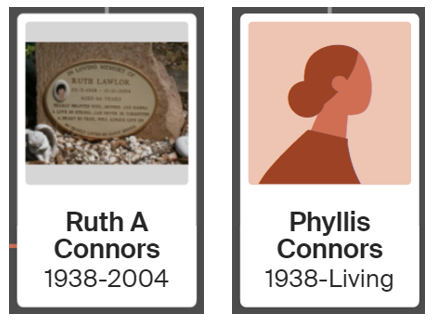
My 1st cousins, Ruth Adeline and Phyllis Connors, daughters of my father's brother Colin Connors and his wife Ruth May.

They are granddaughters of my grandparents, George Connors and Grace Brown (common ancestors).


1 Generation Back - 

My father, Bede William, and his brother, my Uncle Reginald Frederick (known as Reggie) Connors.

They were sons of George Connors and Grace Brown, my grandparents (common ancestors).


My 2nd cousins once removed, Joan Margaret and John William Connors - children of Edward Thomas Connors and his wife Lily Emily Insull.

They are great grandchildren of 2x great grandparents, William Connor (Connors) and Eleanor (Ellen) Hickey (common ancestors), through their son Michael.


2 Generations Back - 
My 1st cousins 2x removed, Harold John Charles and Eliza Violet Cusack, children of James Cusack and Mary Ann Catherine Davies.

They were grandchildren of my 2x great grandparents, Patrick Cusack and Eliza Exton (common ancestors), through their son James.


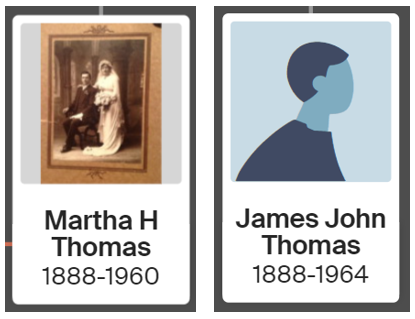
My 2nd cousins 2x removed, Martha Hannah and James John Thomas, children of Andrew Thomas and his wife Harriett Matilda Wright.

Great grandchildren of my 3x great grandparents, William Henry Browning and Anne Littlejohns (common ancestors), through their daughter Hannah Browning.


My 2nd cousins 2x removed, Hector Patrick and Harold Michael Cusack, children of James Cusack and his wife Hannah Sutton.

Great grandchildren of my 3x great grandparents, Michael Cusask and Mary Green (common ancestors), through their son John Cusack.


3 Generations Back - 

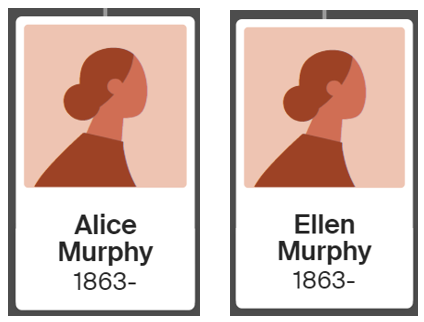
My 1st cousins 3x removed, Alice and Ellen Murphy, children of Patrick Murphy (aka Maguire) and Bridgit Hickey.

They were grandchildren of my 3x great grandparents, James Hickey and Margaret McNamara (common ancestors), through their daughter Bridgit Hickey.

I have not done much research about either Alice or Ellen as yet, hence the lack of a date for their death.


My 1st cousins 3x removed,  James, Jane Caroline, Francis, Joseph, Matthew, Thomas, Arthur George and Sarah Wright, children of James Wright and Hannah Browning.

Yes, you're seeing correctly ... 4 sets of twins born to the same parents!

They were grandchildren of my 3x great grandparents, William Henry Browning and Anne Littlejohns (common ancestors), through their daughter Hannah Browning.

It's quite confronting when you realise that two sets of these twins did not survive their birth.  How heartbreaking that would have been for their parents.


My 1st cousins 3x removed, George Henry and Peter Browning, children of John Thomas Browning and Margaret Redmond.

They were grandchildren of my 3x great grandparents, William Henry Browning and Anne Littlejohns (common ancestors), through their son John Thomas.


My 1st cousins 3x removed, Mary Ann and William Matthew Browning, children of James Francis Browning and Eliza Kennewell.

They were grandchildren of my 3x great grandparents, William Henry Browning and Anne Littlejohns (common ancestors), through their son James Francis.


My Great Grandaunts, Eleanor Sabina and Cassandra Elizabeth Hukins, children of Adolphus Hukins and Mary Ann Farley.

They were daughters of my 2x great grandparents, Adolphus Hukins and Mary Ann Farley (common ancestors).


My 1st cousins 3x removed John and Thomas Hickey, children of Patrick Hickey and Julia Hawley.

They were grandchildren of 3x great grandparents, James Hickey and Margaret McNamara (common ancestors), through their son Patrick.

Sadly, one of the twins died at birth and the other died before he reached his second birthday.


4 Generations Back

My 2x great granduncles, Thomas and John Hickey, children of James Hickey and Margaret McNamara.

They were the sons of 3x great grandparents, James Hickey and Margaret McNamara (common ancestors).

You might notice the match in names between these twin sons of my 3x great grandparents and their twin grandsons (listed above)!


Maternal

1 Generation Back -

My 2nd cousins once removed, David (Davey) and Robert Edward (Bobby) O'Donnell, children of John O'Donnell and Catherine O'Connor.

They were the great grandchildren of my 2x great grandparents, John O'Donnell and Catherine Joy (common ancestors), through their son Michael.


2 Generations Back - 


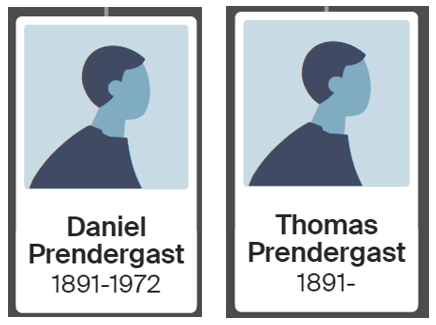
My 2nd cousins 2x removed, Daniel and Thomas Prendergast, children of Thomas Prendergast and Mary Shea.

They were the great grandchildren of my 3x great grandparents, Patrick O'Donnell and Margaret Rafter (common ancestors), through their daughter Brigid.


My 1st cousins 2x removed, Helen Ann and Margaret Lillian (Madge) Davies, children of David Davies and Helen Ann Farrell.  Helen Ann Davies was also known as Sister Mary Francis as she became a Sister of Mercy in her adult years.

They were grandchildren of my 2x great grandparents, Michael Farrell and Susan Downey (common ancestors), through their daughter Helen Ann.


My 1st cousins 2x removed, Myreen Catherine and Laurine Florence Farrell, children of Michael Farrell and Hannah Hynes.

They were the grandchildren of my 2x great grandparents Michael Farrell and Susan Downey (common ancestors), through their son Michael.


4 Generations Back

My 2nd Great Grand Aunt and Uncle, John and Mary O'Donnell, children of Patrick O'Donnell and Mary Rafter.

They were children of 3x great grandparents, Patrick O'Donnell and Margaret Rafter (common ancestors).


The twins I've known in my family - my father and my uncle, and my grandchildren - were/are not identical, and are therefore known as fraternal (dizygotic) twins.  

It's a known fact that fraternal twins are the most common type of twin and they run in families. I think I'm probably correct in assuming that the majority of the twins in my family tree are fraternal.  

Some interesting facts about fraternal twins to finish off this post:

- fraternal twins come from two different eggs

- they each have their own placenta

- they can be either the same gender or a combination genders

- the highest rate of fraternal twins occurs in Africa

- fraternal twins are the result of hyperovulation

- they share half of their genes just like their brothers and sisters.


Friday, 30 July 2021

The Story of The Two Bedes - Bede William Connors and Bede Anthony Connors

In my last post, I started recording the stories of people from my family tree who belong on my 'Lonely First Names Club' list.  The list includes all those people (whether they are born into or married into the family) whose first names don't commonly appear in any of the branches of my family.

The first name 'Bede' is quite rare on my family tree and is one of my favourites. In fact, there are only two family members who had that name. One was my father - Bede William Connors - and the other was my paternal 1st cousin twice removed - Bede Anthony (Dick) Connors.  Their common ancestors were William Connor (Connors) and Eleanor Hickey.

Bede is, what I would consider to be, quite an old-fashioned name, and not a name most people would have heard before or be familiar with.  It's a boy's name of old English origin, apparently meaning 'prayer'.  

The original uploader was Timsj at English Wikipedia. -
Transferred from en.wikipedia to Commons.,
Public Domain,
https://commons.wikimedia.org/w/index.php?curid=2259187


There was a famous 7th century saint and church historian known as 'Venerable Bede' who was the saint my Catholic grandparents chose to name my father after.  


'Venerable Bede' was a Benedictine monk, considered to be the first known writer of English prose, and highly influential because of his work 'Ecclesiastical History of the English People', a history of the Church in England.


(The photo to the right is "a faithful photographic reproduction of a two-dimensional, public domain work of art" known as "The Venerable Bede Translates John" by James Doyle Penrose 1862-1932).


In my family tree, 'Bede' was not chosen very often as a first name, and both men named Bede were not known by that name throughout most of their lives!  Indeed, they were better known by either a shortened version (such as Bernie or Bern in my Dad's case) or by a nickname instead (such as Dick in Bede Anthony's case).


Despite the fact that Bede Anthony was my father's 1st cousin once removed, I don't believe they ever met or actually knew anything about each other.  I wonder if they even knew there was another Bede in the family?


Bede William Connors  (1924 - 2016).


Bede William (my Dad) was born in the southern part of Queensland, in Maleny, but he lived most of his life in the small town of Bowen, in northern Queensland.  

Very few people called him by his first name, apart from some of his close family.  I do remember hearing him being called Bede by his two older sisters when I was growing up!

He was mostly known as 'Bernie' though, and is fondly remembered as a bit of a prankster, a man with a wicked, rather irreverent sense of humour. That didn't seem to match his Christian name Bede at all, since that was most commonly associated with a saint!

I've told Dad's story before in one of my first posts on this blog, so instead of repeating exactly what I've previously written, I will just mention a few of the more salient events of his life. 

Bede (known as Bernie) lived an ordinary working man's life.  He and his twin brother Reginald (Reggie) were born into a large family in 1924. Their childhood was spent mostly in Gympie Queensland, with their three older brothers, three older sisters, and their younger sister, who was born when the twins were 5 years old. 

Bede started work at the young age of 16 in 1940, and worked for Queensland Railways his entire life, up unto retirement at the age of 65.  He married Margaret Brigid O'Donnell (my Mum) in his early 30s, and they went on to have two children during their short marriage.

Sadly, Margaret passed away after nine years of marriage, leaving Bede widowed at the age of 43 with two children aged 8 and 6.  Not long after losing his wife, Bede's older sister Chris came to live with the family until both children had reached adulthood.  Bede would continue to live in the family home in Bowen until he died in 2016, at the age of 91.  He was survived by his two children, two grandchildren, four great grandchildren, and his youngest sister. 

For anyone who has not read my previous post about my Dad, please follow this link:  The Story of ... Bede William Connors.  For those who have read the post before, I should mention I've updated it with more accurate information, a few more photos and extra newspaper clippings, so you might want to have another read.


Bede Anthony Connors  (1914 - 1994).


Bede Anthony (known as Dick) was born in August of 1914 in the town of Tumut, New South Wales.  His father, James Connors, was 55 at the time and his mother, Margaret Jane Mulvihill, was aged 44. 

Bede was the youngest child in the family, with five older siblings living at the time of his birth.  One other sibling had passed away soon after birth.

Margaret / Marie Constance (known as Connie) had been born in 1894.

Malcolm had come along in 1897, but sadly died that same year.

Maurice Edward (known as Bob) had been born in 1898.

Thomas John (known as Tom) was born in 1901.

Eileen Joan (known as Joan) was born in 1905.

Frederick Archibald (known as Archie) came along in 1910.

The following family photo was taken around 1920 and shows Bede Anthony sitting on the mat, in front of his father James.  

Back row L-R:  Maurice Edward Connors, Thomas John Connors, and Tom O'Connor, the husband of Margaret Constance Connors.

Middle row, seated L-R:  Eileen Joan Connors, father James Connors, mother Margaret Mulvihill, Margaret Constance with her daughter on her lap.

Front row, seated L-R: Bede Anthony Connors and Frederick Archibald Connors.

At the time this family photo was taken, Bede Anthony would have been around 5 years old.


Sadly, when Bede Anthony was 8 years old, his father James died.  It occurred to me whilst I was writing this post, that this fact is yet another parallel to my own story.  Not only was my father named Bede, like Bede Anthony, but my mother died when I was aged 8, the same age as Bede Anthony lost his father.  I feel I have a little understanding of what his childhood may have been like after the loss of  one of his parents at such a young age.

James Connors' obituary stated that he had been ill for many years and had gone to Sydney for treatment around 1920, but little could be done.  That would have been the same year the photo was taken, so I wonder if Bede Anthony knew at that time his father was very ill.

It sounds as if Bede's father might have had cancer, but that's an unsubstantiated guess on my part.  According to the obituary, James returned home to his family in Tumut after treatment, and returned to work.  When he died in 1923 I'm sure Bede Anthony felt the loss of his father very keenly, especially given that Bede was still only a child.

I only have a limited amount of knowledge about Bede Anthony's life after the death of his father, gleaned mostly from electoral records and his military record.


In the years 1936 and 1937, Bede Anthony was living in the Connors family home on Fitzroy Street in Tumut, with his mother and brother Thomas.  Bede's occupation was listed as 'electrician'. He was aged in his early 20s at that time.  

His cousin Donald and wife Edith were living close by, just one block over, on Russell Street; and brother Maurice Edward and wife Muriel were also living nearby, two blocks over, on Capper Street.  It's likely that the Connors clan was a tightly knit family.


In 1938, Bede Anthony's mother Margaret died, and from information stated in her obituary, it seems she had been ill for quite a while.


Apparently, she had been suffering "heart trouble" for many months and had been hospitalised for a while before Christmas in 1937.


Margaret chose to leave the hospital to be with her family at over Christmas time however, showing just how important the family was to her.


Two months before her death, her second youngest son Archie had taken her to Sydney to seek the advice of a specialist, but in a similar fashion to her husband (Bede Anthony's father), it was "to no avail."  Nothing could be done.  


The week before her death, the obituary states that "a wire was received in Tumut on Thursday that she had taken a bad turn, so son Dick (Bede Anthony) went away by that day's train to be with her."  Margaret passed away on the Saturday night.  Bede Anthony was 23 years old.


It seems that Bede Anthony and his younger brother Archie were quite well-known in the wider Tumut community, and their social life appears to have been of some importance, given that it made the social pages in the newspaper during the Christmas break of 1939-1940.


I'm not sure what "a busy time meeting their Tumut pals" means, but it sounds as if the brothers had lots of good mates, and were great company.

Two years later in 1942, at the age of  28, Bede Anthony enlisted in the 2nd AIF at Wahroonga, naming his oldest sister Connie as his next of kin.  He had in fact joined the CMF (Citizen Military Force) back in 1941, but then went on to enlist with the AIF (Australian Imperial Force) in late 1942.


He had two service numbers - NX138268,whilst serving with the CMF; and N238818, whilst serving for the AIF.   

Upon enlistment in 1942, Bede Anthony joined the 26th Field Company of the RAE (Royal Australian Engineers), 1st Division.  His occupation at that time was recorded as 'plumber', so it seems Bede Anthony had learned a new trade.  His rank was listed as 'Lance Corporal (L/CPL)'.

I'm not entirely sure what the role of the 26th Field Company would have been during WW2, but obviously they were an Engineer Company.  It seems that Bede was still on Australian soil in April of 1943, as it was noted in the social pages of the Tumut & Adelong Times, that he was "back in Tumut on leave".


In mid 1943 however, Bede Anthony (Dick) was shipped up to Thursday Island in the Torres Strait, between New Guinea and Australia.  He remained there with his unit until September of 1944.  


The Tumut & Adelong Times noted that he was home on leave in October of 1944.  By May of 1945, Bede Anthony was on Morotai Island, Indonesia, and served there until the end of 1945.  He was discharged in January of 1946 and at that time was listed as a 'Sapper' in the '9 Aust. Wksp. & Pk. Company, R.A.E. (A.I.F.)'   Bede Anthony was 31 years old.


By the time Bede Anthony's name pops up again in the electoral records of 1949, he is no longer living in Tumut.  He had moved to Bexley, a southern suburb of Sydney.  His occupation was listed as 'plumber'.  It appears that he had moved to be close to his widowed eldest sister, Margaret (known as Connie) O'Connor nee Connors, his other sister Eileen Joan (known as Joan) and her husband Robert O'Neill; and their families,  Bede's nieces and nephews.


Bede Anthony's (Dick's) name had appeared once again in the Tumut & Adelong Times the year before, in 1948.  He had been the best man at "one of the most spectacular weddings ever held in Bexley, Sydney" according to the newspaper item.  Mr. B. A. (Dick) Connors was acting as best man to the groom, Alan McGrath, who was marrying Bede's niece Constance Frances O'Connor, the daughter of Bede's eldest sister Margaret (Connie).


Yet again, Bede is mentioned in the Tumut & Adelong Times in 1950.  


This time he was attending the wedding of his niece Lorna Connors, the daughter of Bede's brother Maurice.  


At this wedding, Bede was toasting the bride's maternal grandparents, the Simmons, and her Uncle Bill Connors.


It sounds very much like Bede was a most favoured uncle, close to many of his extended family, and a man who regarded family as one of the most important things in life.


It seems that Bede Anthony had moved to West Kogarah by 1958, as the electoral record for that year listed his address as Queen Victoria Street.  He was living with Eileen Elma Connors, nee Burrows, whom he had married in 1953.

By this time Bede Anthony had lost his brother Thomas John who had died in 1953.

The 1963 electoral record shows Bede still living on Queen Victoria Street, but there was no Eileen with him.  Bede's sister Eileen Joan (known as Joan) died that same year.

The 1968, 1972, 1977 and 1980 electoral records show Bede living on the same street, but over these years he was living with Gloria Frances Connors, nee Slattery.  So it looks like either Bede had divorced Eileen, or had she died?  Bede married Gloria in 1966 when he was aged 52.  All the electoral records show that Bede worked as a plumber for all of his adult life after the war. 

Bede's oldest brother, Maurice Edward (Bob) had died in 1973.


Bede Anthony (Dick) Connors died on the 13th of April in 1994, aged 79, after a long illness.  He had died just four months before his 80th birthday.  He had apparently passed away in Cronulla, Sydney, but was buried in the cemetery at Tumut, his birthplace.


Special Note to any family members:  If you have memories to add, photos or information to share, can I graciously ask that you do so.  Please use the comments box below or email me.  It may prove to be invaluable to the story and provide future generations with something to truly treasure.