 |
| Bede William Connors |

The name on the birth certificate

One of the little surprises that still makes me smile is what the birth record shows: my Dad's Christian name is listed as William Bede, not Bede William. All my life I believed it was the other way around — because that’s how Dad (and everyone else) used it. But there it is in black and white, reminding me again that records and real life don’t always line up neatly.
Bede was recorded as the second born of twins, delivered at the Memorial Hospital, Maleny, Queensland. Father, George Connors, was 45 years old and mother, Grace Brown, was 39.
Maleny, Wootha, Booroobin ... and the dairy farm beginnings
 |
| Maleny Township Centre Credit: John Oxley Library, State Library of Queensland, Public Domain, https://commons.wikimedia.org/w/index.php?curid=12388729 |
The photo above shows the centre of Maleny in 1922 just before Bede was born — and I love picturing Dad arriving into a place that was quietly changing. Maleny had timber in its bones, but by the 1920s it was increasingly known for dairy and fruit growing.
At the time of the twins’ birth, George and Grace were living at Wootha, south-west of Maleny. By the 1925 Census, they were recorded at Booroobin, a little further south-west again, and George’s occupation was listed simply as “farmer.” The family moved around a lot as George worked on many different dairy farms as a "milker".
In 1920s Queensland, the job of a milker on a dairy farm was a manual, labour-intensive, and relentless daily routine, often performed by hired help, such as my grandfather George. Likely, my grandmother and the older children all helped out, starting work before dawn and ending after dusk.
When Dad and Reggie arrived, they weren’t the “babies of the family” exactly — not yet.
There were already six living children ahead of them:
-
Beryl Agnes (b. 1907) – aged 17 at the time of the twins' birth
-
Colin Vincent (b. 1908) – aged 16
-
Thomas Richard (b. 1911) – aged 13
-
George Thomas Jr. (b. 1914) – aged 10
-
Christina Grace (b. 1915) – aged 9
-
Olga May (b. 1919) – aged 5
The birth record also notes a brother and a sister who had died by then. They were Leo and Marguerite.
(I’ve written about these precious children elsewhere - The Story Of The Almost Forgotten Children )
Then, a little later, came Betty Patricia (b.1926).
The photographs I didn't see until I was in my 60s
 |
| The twins as toddlers (Photo shared by my cousin Carmel Ryan) |
Thanks to a generous cousin, I now have a photo of the twins when they were very small - they look about two years of age, so perhaps 1926. Bede is on the right and Reginald is on the left, with his carefully coiffured curl. The family always remember Bede being slightly taller than his twin brother.
 |
| The twins with their baby sister and older siblings lookin on (Photo shared by my cousin Carmel Ryan) |
This photo feels like a little family scene captured mid-breath: the twins in front, Bede on the right and his brother Reggie on the left, with their baby sister Betty; and their older brother Thomas (known as Tommy) and older sister Beryl behind. It was probably taken circa 1932/1933, likely around the time their parents began thinking about moving the family on from the Maleny area.
From Maleny district to Gympie
 |
| Main Street in Gympie,
showing Cullinane's Department Store, 1936 Credit: John Oxley Library, State Library of Queensland, Neg: 245783 http://hdl.handle.net/10462/deriv/118903 |
By 1936, electoral rolls place George and Grace in Mellor Street, Gympie, with eldest daughter Beryl and son Thomas also listed at the address — of course the younger girls were there too, along with the twins, who were 12 by then.
By this point, two older brothers had already left home:
-
Colin had been living and working in Beaudesert since 1931.
-
George Thomas Jr. had joined him there, both working as farm hands.
Queensland Rail: the beginning of a lifelong career
 |
| Bede at the beginning of his railway career c.1942 (Photo shared by my cousin Keith) |
Bede began his working career with Queensland Rail at just 17 years of age.

This is where family story and historical context meet in that very practical way mothers understand: Australia had been involved in World War 2 since the end of 1939, and my Dad always said his mother Grace was determined he wouldn’t be lured — or pushed — into enlisting, as his brother Thomas had.

There were men who were not permitted to enlist into the armed forces as they were in industries and occupations that were considered by the Australian Government as 'essential services'. It seems that Bede's mother Grace wanted her younger son to be employed in one of these jobs in the hope that it would keep him safe and sound at home, away from the war.
The enlistment age back in 1939 was 20, but was lowered in 1941 to 19. Written parental consent was required for anyone under the age of 21 though, and there was no chance that Grace or George would do that. By the time Bede turned 21 (in October of 1945), the war was ending.
 |
| circa 1943 Commonwealth Railways engine http://www.comrails.com/common/pic_cdm_index.html |
So, Bede spent the war years working for Queensland Rail. His first job was 'Cleaner'. This was still the time of steam locomotives, so as a 'Cleaner' in the steam era, Bede’s work meant cleaning locomotives inside and out, learning the machinery, and doing the unglamorous jobs that kept the whole system running. 'Cleaners ' also delivered job slips — and for years, railwaymen learned where they were headed next because a notice was dropped to their home address.
Wartime rail: troop trains, long rosters, and quiet rules
 |
| Troops waiting for the train to leave 1943 Copyright expired - public domain. Source: Australian War Memorial |
Railways were heavily commandeered during the war years, and Dad worked mainly on troop trains — with the kind of roster that leaves no room for softness: seven days a week for three months at a stretch. During those duty periods he was housed at an army training base, and he would have been bound by confidentiality — unable to talk about train movements.
Throughout his lifetime anyone who came to know Bede would remark on his playful personality and the way he would take impish delight in getting people to laugh! His wicked sense of humour certainly won him many friends in the railway workforce, but some of his wild antics were a little ill-conceived.
The Yandina mishap: a newspaper glimpse of "Bernie"

In mid-1945, at the age of 20, Bede was stationed at Yandina, which was located about 60 kms south-east of Gympie in Queensland.
His rather impish sense of fun got him into a bit of trouble whilst he was working there, and Bede was mentioned in a Brisbane newspaper item that highlighted his adventurous spirit.
On July 7th, 1946, a short article in the 'Truth' newspaper, published in Brisbane, had the headline "Three in Cycle Smash".

According to the article: "Ken Barrett (19), Bede Connors (21), and John Hart (20) were riding a motor cycle near Yandina when it skidded and they were thrown off. Barrett suffered a compound fracture of the leg and his companions received various bodily injuries. All were taken by ambulance to the Nambour General Hospital and Barrett was admitted."

After the war years, Bede’s railway career did what railway careers do: it moved him.
In May of 1948, he was transferred from Yandina to Bowen, over 900 km north of Gympie, and promoted from 'Cleaner' to 'Fireman' — hot, dusty, physical work, hand-firing the engine and managing the steam the train depended on.
This new position meant Bede was now working a long way from his home and family in Gympie.

 |
| Australian Electoral roll 1949 |
While the 1949 electoral roll lists Bede as living with his father George, mother Grace and older sister Beryl in Gympie, he was in fact living and working in Bowen. It's likely that at the time this census was taken, Bede was holidaying with his family back in Gympie.
Bede was in fact living the reality of a young working man in Bowen: boarding in hotels, building friendships, and slowly building the life that would become his.
(Dad later said he met his bride-to-be, my mother Margaret, on his first posting to Bowen, when they were in their mid-20s. I'm not sure exactly when their courtship began, but they did not marry until around ten years later, when they were in their early 30s.)
A Bowen Story: the "hypnotist" episode
One of my favourite tales from Bede’s early Bowen days (re-told to me by my brother Mark) comes from his time boarding in a hotel.
"One evening, Bede and a couple of railway mates were enjoying a few drinks when someone dared him to hypnotise another lad. Bede — never one to back down from a challenge — took them upstairs and conducted the “session.” Then they all wandered back downstairs to continue their evening… leaving the hypnotised lad in the room.
Next morning, Bede turns up around 9.00 am with his driver — and they’re asked where the lad is. He hadn’t turned up for his 3.45 am shift.
They bolted across to the hotel, raced upstairs, and knocked. The maid arrived saying she couldn’t open the door. Bede’s mate broke it down. Inside: the missing lad, still fast asleep, snoring like a train himself.
They woke him. Panic and chaos ensued. Apparently that was the end of Bede’s hypnotist career. Thankfully, all the men kept their jobs."
Sport, socials, and a young man becoming "well known" in town
Between shift work, Bede built a busy social life in Bowen.
 |
| Bowen Independent Friday July 15 1949, p 6 |
In July 1949, I found his name in The Bowen Independent attending a debutante ball, accompanying Daphne Mulvey.
 |
| Bede with debutante partner, likely 1949, aged 25. (Photo shared by my cousin, Keith Connors) |
When I was given this photo, no one could tell me exactly when it was taken — but the dress and details seem to match the newspaper mention, so I strongly suspect this is that 1949 debutante-ball photo.

Later in 1949, Bede turns up again in the paper — joining the Railway Institute Cricket Club, described as “Bernie Connors, slow bowler from Gympie.”
Western service: outback lines and the road back to Bowen
In 1951, aged 26, Bede applied to do what railway workers called “the western service” — twelve months on outback lines between inland towns. It was the kind of posting that opened doors: after completing it, staff could apply for a home station and/or promotion.
Unfortunately, Bede’s western service was interrupted after only a few months at Richmond in western Queensland, because of staff shortages — he was back in Bowen by early 1952, and one particular newspaper mention confirms this.
In March 1952, Bede appears in cricket coverage (with mention of bowling figures and a note that he was “outstanding” in the field), showing that Bede was not just working in Bowen, but belonging.

This was Bede's team. They were the runners-up in the Camp Cup that cricket season 1951-1952. He is seated third from the right, aged 27.
Actually between the years 1949 and 1954, Bede's name appeared in the weekly local newspaper The Bowen Independent on a regular basis. This repeating pattern shows Bede's name in print, not for scandal or drama, but for the steady rhythm of community life — cricket, table tennis, team lists, match results, little notices that show how he was weaving himself into Bowen.

More than rail: singing, style, shows, and holiday snapshots
Bede also loved to sing and there were several newspaper items that mentioned his part in providing entertainment at various functions in Bowen during those same years.

 |
| Photo shared by my cousin Carmel Ryan |
This photo was likely taken during these years. That's Bede on the left, looking very stylish as they head out to what might have been the local show.
(If any family members can share information about the following photos, please let me know. I know nothing about when or where they were taken).

Bede certainly worked hard, with shifts that could start at any time of the day or night, but he also enjoyed his precious time off ... whether that be fishing, being out and about with friends, getting spruced up for dances and balls, or enjoying his favourite sports of cricket and table tennis.

The photos above show Bede holidaying in Queensland in the early 50s, with his elder sister Chris. She was to play a very important role in Bede's life a few years later.

These photos show Bede and mates holidaying on Molle Island c. 1950.
Obviously this was long before the island became known as South Molle, when accommodation meant cabins and a lounge bar, not a resort.
Honestly: you have to love the not-so-casual holiday attire. Bede’s the suave one in the marvellous hat — and yes, I can absolutely picture him enjoying every second of being admired for it.
Bede's holiday plans even made the local newspaper in early 1953.

 |
| Bede at home in Gympie with his twin brother Reggie (Photo shared by my cousin Carmel Ryan) |
Table tennis and leadership: "Bernie" at the centre By 1954, Bede is deeply involved in Bowen's table tennis scene. Mention was made of Bede Connors in the Bowen Independent on July 23 1954, as as a member of a table tennis team, the Railway Whites. The short article mentions that the Bowen Table Tennis Association had only been newly formed. It was Bede and his good friend, Henry Allen who started the Bowen QRI (Queensland Railway Institute) Table Tennis Association; and in an newspaper article later that same year, Bede Connors was identified as the President of the Association, with Henry as the Treasurer. Henry was a singles and doubles player, while Bede played double. Both played for the state of Queensland in the 50s.
Promotion and permanence: driver, foreman, and a changing railway world |

 |
| Image from: http://teenagerailfan.blogspot.com.au/2011/05/ |
The photo above shows the Bowen Railway Station sometime in 1954, when it was a very busy station.
 |
| Australian Electoral Roll 1954 |
At that time, aged 30, electoral roll records show that Bede was living as a boarder at Oxford House on George Street in Bowen. His occupation was listed as 'railway fireman', and Bede would have been working quite long shifts, day and night.
By the mid-1950s Bede completed the western service requirement properly. He was transferred to Richmond again in late 1955 and promoted to Driver, remaining out west for about eighteen months. By 1956 he was back in Bowen, promoted to Foreman.
 |
| Australian Electoral Roll 1958 |
By 1958, an electoral roll record places him back at Bowen’s Grand View Hotel and his occupation was listed as: Railway Foreman.
The railway world itself was changing.
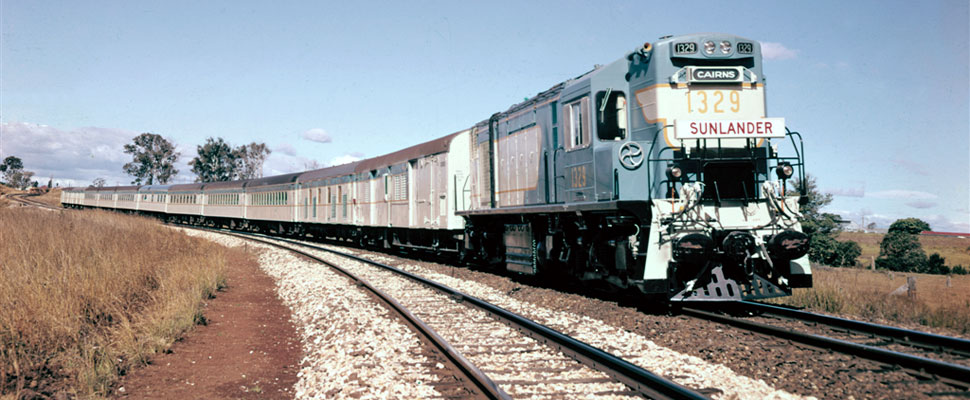
Steam locomotives were being replaced by diesel electric locomotives throughout Queensland, and the 'Sunlander' was a common sight on the rail lines. Bede would spend the rest of his long career with Queensland Rail based in Bowen, driving between Townsville and Mackay - and making himself unforgettable to generations of coworkers and locals.
Margaret and Bede - and the family they created

Bede and Margaret Brigid O'Donnell were married in January 1959 in Bowen. Bede was aged 34. They had met when Bede first moved to Bowen, over ten years earlier, and had gotten to know each other well over the years. Bede had forged close friendships with a couple of Margaret's brothers when he had joined the local cricket club, and was by this time very well known by Margaret's family.
(Here's the story of their wedding day: Memories of a Wedding Anniversary )
By the end of 1961 Bede and Margaret had a daughter and a son, and had moved into their own home on Denison Street.
Then - the part of Dad's story that still makes my throat tighten - Bede's married life was cut short.
He became a widower in 1968, never re-marrying. Shortly after losing his wife Margaret, his older sister Chris left her home in Gympie and moved in to help with the care of the family. With Bede working shift work — long hours, unpredictable calls — it would have been almost impossible raising children alone. Chris stayed close to twenty years, holding the household steady.
The Dad I remember: thermos, torch, and never a sick day
Some memories don’t need embellishment because they already carry everything.
I remember Dad getting up in the middle of the night countless times: dressing for work, picking up his hot food thermos and torch, then walking from the back of our house across empty paddocks to the railway station.
I can’t remember him taking sick days — even when he was clearly in pain from the boils that plagued him for years.
Retirement - and one last classic "Bede" moment
Bede worked until he retired at 65 in 1989, ending a nearly 50-year career.
And then there’s this story — told to me by my brother Mark — which is so Dad it almost reads like a character sketch:
"Perhaps those in higher positions didn't mind too much when he retired, as it was just a couple of years prior to that when he prompted his fellow workers to strike. The Area Manager had called in the drivers, firemen and guards (collectively called the Running Men) who were on the duty one day and proceeded to explain his wonderful idea about changing some of their duties around the station.
One of the workers apparently exclaimed 'Not on!' and wondered aloud what they could all do about it. From the back of the room, a voice stated 'Let's go on strike!' That was Dad! The strike lasted for 5 days, and he managed to get in some treasured lawn bowls time, which had become his favourite leisure time activity by then."
(Story as told to me by my brother Mark).
It wasn’t just cheek. It was one of Dad’s defining traits: a straight-talking, tell-it-like-it-is approach, not backward in coming forward when he thought something needed to be said.
Seven cards, decades of ink and a paper trail that follows Dad from the steam era - Queensland Rail's service record
Before the memories, this moment is where the family story meets the paper trail. Queensland Rail kept a neat (and sometimes brutally frank) record of Dad's career - the jobs he held, where he was stationed, the locomotive classes he qualified for, and even the times he fell foul of the roster and the more serious bumps in the road.
Here's a glance at his career from Queensland Rail's perspective: Service No. 76950

-
3 Jul 1942 | Cleaner | Gympie
Record shows appointment as Cleaner; later note indicates appointment “confirmed”.
1943–1945 — Early movements (southern line postings)
-
15 Jan 1943 | (Cleaner) | Yandina
Leave notation recorded. -
1945 | (Cleaner) | Gympie / Yandina
Multiple entries/ticks recorded; exact detail faint but stations are legible.
1948 — Promotion and the Bowen chapter begins
-
20 May 1948 | Fireman | Bowen
Promotion from Cleaner to Fireman recorded; station clearly Bowen.


-
1950–1954 | Fireman | Bowen
Several entries for failure to report / lateness / absence from rostered duty (they read like classic shift-work pitfalls).-
Outcomes include warnings and fines (£1–£2) (examples recorded 1951–1954).
-

-
18 Dec 1956 | Fireman (qualified) | Bowen
Qualified to operate 1200 / 1300 / 1400 class D.E. locomotives (explicitly recorded).
1958 — Driver posting appears on record
-
13 Oct 1958 | Driver | Richmond / Bowen
Driver recorded; station line shows Richmond with Bowen also written (posting context).
1960s–early 1970s — Progressive loco authorisations
-
1962–1972 | Driver | Bowen
Series of entries recording additional locomotive class authorisations, including later notes such as:-
1502 / 1600 / 1460 class D.E. locos (recorded)
-
Clyde locos in multiple unit (recorded)
-
Diesel hydraulic locos (recorded)
-
Additional class numbers noted (some faint/partial)
-

1967–1968 — Serious operational incident + appeal
-
1 Sep 1967 | Driver | Bloomsbury (yard)
Record describes points not reset before proceeding back, resulting in derailment of carriage MAS.1501.-
Penalty recorded: $10 fine + loss of pay during suspension (2–11 Sep 1967)
-
-
18–21 Mar 1968 | Appeal heard | penalty unchanged
Appeal dismissed; penalty not altered (majority decision).

-
18 Jul 1973 | Driver | Pinbee → Armuna
Proceeded without satisfying correctness of staff received.-
Penalty recorded: $4 fine
-

-
3 Oct 1971 | Driver | Bowen
Qualified to operate 2400 class locos (and other class numbers listed). -
7–13 Nov 1978 | Drivers In-Service Training | Townsville
Training course recorded. -
8 Nov 1979 | Medical | “H.F.S (fit)”
Fitness noted on record.
Based purely on what Queensland Rail chose to record about him, Bede’s career reads like the classic story of a long-serving “running man” who grew up inside the system.
He started young (a 17-year-old cleaner in 1942), moved through the ranks into the footplate as a fireman and later driver, and then spent decades steadily accumulating competency sign-offs across multiple locomotive classes as the railway shifted from steam into the diesel era. Bowen becomes the centre of gravity in the record — not just a posting, but the place where his working life settled and matured.
The early 1950s entries also show a human side the record never spells out but definitely implies: shiftwork, fatigue, and a few rough edges. There’s a cluster of attendance/roster-related offences (warnings and small fines), and later, as a driver, a couple of serious “rules-and-safety” moments appear — including a 1967 incident linked to a derailment and an appeal that was dismissed, plus a smaller fine in 1973. Taken together, those notes suggest he wasn’t a spotless, polished “company man” on paper — but he was someone who stayed in the job, kept qualifying, kept training, and kept being trusted with more complex traction and responsibility over time.
Overall, the service record leaves the impression of a working-life career railwayman: long tenure, practical competence across changing technology, rooted in Bowen, with a few recorded bumps along the way — the kind of candid, unsentimental paper trail that often sits behind far warmer family stories.

The decades in photos: the family man, the rose grower, the trickster
I've always loved looking at Dad's life in "decades," because you can see him changing - and yet also staying the same!
1960s - Dad with his own small family.

1970s - Some of the favourite things Bede loved to do: spending Christmas with the family, studying the horse racing form guide in the newspaper, growing his beloved Roses, fishing every now and then, and sitting out on the front porch.

Dad often exhibited flowers at the local show. Roses were his passion. I still remember sitting in the back of our Morris Minor holding bunches of roses packed with cotton wool between the petals for protection on the drive to the showgrounds.
After years of growing and showing, Dad completed a horticultural judges’ course in the late 1960s and judged at shows across Bowen, Collinsville, and the Burdekin through the 1970s and early 80s.
1980s - his children grown, grandchildren arriving, and his siblings moving into their autumn years.

90 years - and a final resting place beside Margaret.
Bede celebrated his milestone 90th birthday in 2014. By then he had outlived his parents and almost all his siblings, apart from one sister. He made it to one more birthday in 2015, and passed away in early 2016, survived by his two children, two grandchildren, and four great-grandchildren.

Bede was buried at the Bowen Cemetery, laid to rest in the same plot as his beloved wife, Margaret.
💗 Family Anecdote: thanks to my cousin Carmel
(About my Aunty Chris coming to Bowen to help raise our family after Mum died.)
"On a personal (and purely selfish note), although I really admired her decision to leave, I was still at school and really missed Auntie Chrissie when she went to live in Bowen. (Boy, could she cook a roast! Every Tuesday lunch time, I would cycle to her place for a hot roast lunch and Cadbury chocolates for dessert)
Occasionally, she would return to Gympie and the whole clan would take her to the station in the middle of the night to catch the Sunlander back to Bowen."
"THE TRIP TO THE RACES WITH BEDEAlbion Park was the first major city racecourse I ever attended and guess who took me there when I was in about year 10; Uncle Bede.
That too was the year I met one of his oldest friends from Bowen. His name was Arthur who kept calling Bede, 'Bernie'.
When I asked Bede why, up went the index finger to pursed lips followed by a hushed “Ssssssshhhhhhhh!”; a look to the left, then to the right around the crowd in the bar and then back to over his left shoulder and then in a muted whispered, secretive tone he told me that “Bernie” was the code name he used for whenever he travelled interstate on undercover secret investigative work for Queensland Railways.
I was later to learn of course that everyone and their dog called him Bernie in Bowen.
I remember we stayed at the Empire Hotel on the corner of Edward and Elizabeth Streets and on the Friday night the bar was packed with sporting and racing identities from the Brisbane Telegraph, the Courier Mail and the Sunday Truth and they all knew “Bernie”. Two of those are no longer in print but back in the day they were highly popular and part of life.
Right after supper I went up to my room and went to bed.The next morning Bede and Arthur were more than just a little hung over but we still managed to get to the races at Albion Park before the first race.
In those days the parade lane from the mounting yard in front of the member’s stand to the big gates leading out to the track itself was only about 3 metres wide and ran along the fence lined with the crowd and punters eager to get a look at the horses and their jockeys. You could almost reach out and touch them.
The crowd cheered them by, wishing them luck and waving at their favourite riders so I told Bede I wanted to get down there and wish Andy luck too. Bede thought that was nice but that I had to remember Andy was very superstitious and had only fallen off a horse once so I had to wish him not to fall off.
Down I go, squeezing in right up to the fence and as Andy Tindall, the Premier Jockey in Brisbane Racing at the time, was parading, I waved, smiled and called out, “Andy, Don’t fall off! Don’t fall off Andy!
His head swivelled round to glare at me and the expression on his scowling face said it all but not as much as the two fingers on his left hand, in the shape of a V, which he kept on waving up and down at me as he passed.
Well he didn’t win the first race but he did win the Albion Park Cup on that grand old stayer Sumarco.
Needless to say I did not go down to the fence to wish him good luck."
 |
| Dad (on the left) with my cousin John and John's wife Colleen |
"INDIAN LOVE CALLThis is a photo of Uncle Bede, Colleen and Yours Truly at a Birthday party for Mum in Gympie. It is one of my favourites and you can see the beaming light of devilment in Bede’s smiling face.
When we were kids growing up in Gympie one of the great and much anticipated highlights of every Christmas was Uncle Bede’s return home on his annual holidays.He was just so much fun.He was a real trickster though and everyone had to be wary.
I remember one year when Ann and I were about 14, he took Beryl and the two of us down to Brisbane for a day trip on the steam train to see the latest Cinemascope movie musical called “Rosemarie”. It was a coloured movie, starring Howard Keel, Anne Blyth and a Brazilian heart throb named Fernando LaMas. We all knew the songs and story from the original black and white movie with Nelson Eddy and Jeanette MacDonald. One of Oggie’s favourite movies.Back in the day going from Gympie to Brisbane by train was one hell of a great adventure. Well, as we’re queueing up on the footpath for the doors of the Wintergarden Theatre in Albert Street to open, Bede tells me that when I get up to the ticket window if I sing “The Indian Love Call” from "Rosemarie", they’d let me in for free and give me a packet of popcorn as well.10.00 am. The doors open. The line outside on the footpath begins to move forward like a giant snake of many colours, winding its way to the box office to buy tickets for "Rosemarie". We were at the front, so I didn’t have to wait long for my turn.When I got to the box office window I was greeted by a little, old, thin lady with purple hair and a pair of huge, yellow-rimmed glasses perched on the biggest nose I have ever seen. Even bigger than Emanuel Paspallas’s mother.
“Two shillings Please!”
“I can sing!” I proudly announced.
“Wonderful!! Two shillings Please.”
“When I’m calling yoouuuuuu… oo oo ooo…..oo oo…oooooo!!Will you answer tooooooooooo….oo oo oo….oo oo …oooo!!”
Quick as a flash she jumps off the high chair she was perched on, looks out through the box office window and cries out, “Who owns this kid?”
Bede steps in.”He’s with us. He’ll be fine. Just excited about the movie.”
“Take him away NOW and he can get in for free!!!”
“What about the popcorn?” I plead.
“All Gone!!!” she screams.The movie was okay I guess. Ann cried a couple of times. Beryl loved Howard Keel, Bede went to sleep, but I thought Fernando LaMas’s rendition of “The Indian Love Call” left a lot to be desired."
Special Note to any family members: If you have memories to add, photos or information to share, can I graciously ask that you do so. Please use the comments box below or email me. It may prove to be invaluable to the story and provide future generations with something to truly treasure.

I have included your blog in INTERESTING BLOGS in FRIDAY FOSSICKING at
ReplyDeletehttps://thatmomentintime-crissouli.blogspot.com/2018/01/friday-fossicking-jan-19-2018.html
Thank you, Chris
Thanks very much Chris. I have finally caught up with your message.
Delete