Showing posts with label Kiama. Show all posts

Thursday, 25 January 2024

The Story of Adolphus Crittenden Hukins / Memories ... January 26

This post tells the story of my paternal Great Grand Uncle, Adolphus Crittenden Hukins  (1849 - 1897).

Our Common Ancestors are:  Adolphus Hukins and Mary Ann Farley.

I'm publishing this post on the anniversary of his birth.


 Anniversary of a Birthday :   

(For my 'Family Anniversaries' page)


Today is the anniversary of the birth of my paternal Great Grand uncle, Adolphus Crittenden Hukins.  Even though he was born so very long ago and obviously I never got to meet him, he holds a special place in my heart as he was born on the day we know as 'Australia Day'.

Australia Day is the official national day of our country, although this day wasn't adopted as Australia Day until 1935 so my great grand uncle would never have known about it.

  • Adolphus Crittenden Hukins was born on January 26th in 1849.

"What a fabulous name!" I hear you say.  My thoughts exactly!

'Adolphus' was his father's first name and yet despite extensive research, I have not been able to find evidence of any other Adolphus in the previous four generations of that family!  I'm at a loss to know why he was named so.

The Hukins family had been living in the the county of Kent in England since at least 1700 (I haven't been able to get any further back) and the stock standard Christian names in the family had been John, James or Richard.  Where on earth 'Adolphus' came from will likely remain a mystery.

'Crittenden', on the other hand, was the first name of his father's brother (who tragically died soon after the family's arrival in Australia), and the surname of his father's grandmother, Elizabeth Crittenden.  The Crittenden family had been living in Kent since at least the early 1600s so there was a long family history of the name as a surname.  In Adolphus's case however, it had become his middle name.

  • Adolphus Crittenden Hukins was the son of Adolphus Hukins (an English immigrant) and Mary Ann Farley (an Irish immigrant).

  • He was born in Sydney, New South Wales.


  • I have not been able to find a birth record for Adolphus Crittenden, but I have however been reliably informed by distant cousins that he was indeed born on this date.      

  • I was able to track down a transcript of his baptism record.  That gives the date of his baptism as March 4, 1849, just over a week after his birth.

  • The transcript of the baptism record also shows that Adolphus Crittenden was baptised in the parish of St. Lawrence, one of the four parishes that existed at that time in Sydney, located in the southern portion of Sydney.

  • Adolphus was the first of 13 children born to Adolphus and Mary. 

  • The first of his siblings was born in 1850 when Adolphus was one year old, and the last of his siblings was born in 1869 when Adolphus was 20.

  • By the time Adolphus Crittenden had turned 1 year old, the family had moved from Sydney to the small township of Jamberoo, outside Kiama, on the southern coast of New South Wales.  It was there that his father bought land and established a farm.

  • The very early years of Adolphus's childhood would have been spent living and working on his father's farm, and probably helping out on the farms of his grandfather and two of his uncles, which were close by.

  • Adolphus Crittenden's father (I'll refer to him as Adolphus Senior from now on) also became an inn-keeper, following in the footsteps of quite a number of family members from previous generations back in England.  By 1855 he was running a pub named 'Four In Hand' in the town of Kiama, which was about 11 kilometres away from the family farm.  

  • It seems that Adolphus Senior had kept the farm, but the family had moved to Kiama to live.  Adolphus Crittenden would have been 6 years old when the family moved into town.

  • Unfortunately, Adolphus Senior did not experience great success as a publican, and financial troubles raised their ugly head quite early on.  In 1858 insolvency proceedings were bought against Adolphus Senior and he lost the pub.  Adolphus Crittenden would have been 9 years old when all this was happening.

  • By the time Adolphus Crittenden was in his early teens, his father was in trouble with the law, mostly because of public drunkenness.  Then, by 1873, Adolphus Senior lost the family farm following a damages claim bought against him.  Adolphus Crittenden was 24 at this time, but it's likely he had already left home and had begun his own life. 

  • By 1877 Adolphus Crittenden was living in Albion Park, north-west of Kiama, and working as a horse-breaker.

  • He was no longer known by his full Christian name, Adolphus Crittenden.  He was now known as Crit or Chris.

  • Adolphus Crittenden (Crit / Chris) Hukins became quite well-known across the Illawarra Region as a steeplechase rider.  He was apparently quite a familiar contestant at jumping events in all the metropolitan and country shows across the region and beyond.

  • In 1892 Adolphus Crittenden paid quite a hefty price for a horse with a good track record in jumping hurdles.   £200 would have been a very large sum of money in those times, but obviously Adolphus Crittenden was confident he investing wisely.


  • Adolphus Crittenden became quite the successful show jumper / steeplechase rider, winning first place many times riding his horse named 'Mingoola'.  The following newspaper item shows the Grand Jumping Contest results from the Bowral Show in March of 1897 and A.C. Hukins is listed as the winner of that event.

  • Tragically, he died quite unexpectedly just a few months later, on the 20th of October, 1897.

  • Death notices appeared in quite a number of newspapers across the Illawarra region and in the city of Sydney.

  • The following short notice appeared in several newspapers including  The Maitland Weekly Mercury (30 Oct 1897 p12), The Wagga Wagga Express (23 Oct 1897), The Sydney Morning Herald (21 Oct 1897 p6), and The Sydney Mail & New South Wales Advertiser (4 dec 1897 p1164). 


  • This appeared in The Freeman's Journal (30 Oct 1897 p20).


  • This notice appeared in the Bowral Free Press & Berrima District Intelligencer, but this time Adolphus was named as Mr. A. C. Hukins


  • This notice appeared in The Sydney Mail & New South Wales Advertiser (4 Dec 1897 p1164), giving some insight into how he was thought of in the general community.


  •  An obituary was published in both the Bowral Free Press & Berrima District Intelligencer (30 Oct 1897 p2) and  The Kiama Independent & Shoalhaven Advertiser (23 Oct 1897 p2).  His name was recorded as Mr. Crit Hukins in the Bowral Free Press article and as Mr. Chris Hukins in the Kiama Independent.


  • As the obituary states, Adolphus Crittenden suffered quite a lot towards the end.  Such a terrible way to go and all because a splinter got lodged under one of his fingernails!


  • His death certificate states he suffered from "traumatic tetanus" for 3 days.


  • Adolphus Crittenden Hukins was buried at the Church of England Cemetery in Albion, New South Wales.  I have not yet been able to find the exact location of his last resting place.

  • As an aside note:  For those who might be wondering what happened to Mingoola after his owner's death ... well the poor horse died the following year!  The following newspaper item states that he "dropped dead .... while exercising"!  


Sunday, 2 December 2018

The Story of Mary Ann Farley - Part Two

So, this week I'm continuing on with the story of my paternal Great Great Grandmother, Mary Ann Farley  (?1829/1830 - 1910).

Given all the sketchy, yet to be proven, details of her childhood years (discussed in my last post), I'm only really certain about the life story of Mary Ann from the day of her marriage to my Great Great Grandfather.  So I'm beginning her story in her late teens.


In the year 1847, in the town of Wollongong, New South Wales, Mary Ann married Adolphus Hukins, an Englishman born in Kent, who had emigrated with his mother, father and siblings some eight years before this.

Given Mary Ann's age as recorded on her death certificate, it appears that she married Adolphus when she was possibly 17 years old.  He was 24.


A map of the Peterborough Estate in 1847

They married in Wollongong, but both stated that were living in Peterborough which was a little township surrounded by an estate known as  Peterborough Estate.  Peterborough later became known as Shellharbour.

Records show a son, Adolphus Crittenden, was born in 1849, when Mary Ann was 19.  As she had married when she was 17, and after the birth of Adolphus she went on to have another 12 children over the following 20 years, it seems likely she might have lost a child in the year or so after her marriage.

After Adolphus Crittenden (known as Chris),
James was born in 1850.
Susannah (my great grandmother) was born in 1851.
John came along in 1853.
Mary was born in 1854.
Thomas was born in 1856.
Adelaide was born in 1860.  By this time Mary Ann was aged 30.
George was born in 1861.
Alfred came along in 1863.
Twins, Eleanor and Cassandra were born in 1865.
Amy was born in 1867.
Arthur came along in 1869, when Mary Ann was aged 40.


It seems that Mary Ann and her husband Adolphus moved from Peterborough to Jamberoo, outside Kiama, soon after their marriage.


The birthplace of their first four children was listed as Jamberoo.  This is where Mary Ann's parents were living at that time, as were Adolphus's father, mother and older brothers.  Historical electoral rolls for the district of Kiama in New South Wales show that for the years 1855 - 1856, Adolphus, his father James and his two older brothers James Jnr. and John, were all the owners of freehold land on Curramore Estate in Jamberoo.

Sometime around 1854 however, Mary Ann and her husband appear to have moved into the town of Kiama.  By 1855, Mary Ann's husband had acquired a publican's licence, and was following in the footsteps of his father and mother, who had both been innkeepers back in the village of Woodchurch in Kent, England.  He still had the land in Jamberoo, but it does not appear as though the family ever lived there.

Photo of the Steam Packet Inn (on the left), which had originally been the Four In Hand Inn

It's likely Mary Ann would have worked alongside her husband at the 'Four In Hand' Inn in Kiama from 1855 to 1859, whilst raising six children and falling pregnant with a seventh.

The next 30 or so years were to be some of the hardest ever years of Mary Ann's life, and I am in no doubt that the insecurities and experiences she must have endured bought her to the absolute depths of despair.

Sadly, Mary Ann's mother Nancy passed away in 1858 back in the small town of Jamberoo.  It was at this time that Mary Ann's husband Adolphus was having creditor issues and was appearing before the insolvency court.  He lost the main source of the family's income - the 'Four In Hand' inn - but he was allowed to keep the household furniture and wearing apparel.

Imagine the uncertainty and anxiety that must have beset Mary Ann during all of this.  The family had to move out of the inn and Adolphus had to find another form of employment.  I'm not entirely sure what the family did.  Perhaps they moved on to the farmland that Adolphus owned on the Curramore Estate at Jamberoo, outside Kiama.  What appears to have happened though is that they set up home somewhere else in Kiama.

Things didn't improve much when it came to the behaviour and conduct of Adolphus unfortunately.  He was up on charges of stealing in 1862, just a mere four year after losing the inn.  In 1873 he was charged with drunkenness and a damages claim had been lodged against him.

When this damages claim was settled, Adolphus had lost everything.  The land at Jamberoo and all its assets were sold.

It appears that not long after this (or perhaps a little before) Mary Ann, her husband Adolphus and most of their children were living in a place around 180 kms to the south of Kiama.


In mid 1874 Mary Ann's second-born daughter Mary Barnes passed away.  The newspaper item in the Sydney Morning Herald stated that she was aged 19 and living with her mother and father in Broulee.  The registration district listed on her death certificate was Moruya, which is not far from Broulee on the south coast of New South Wales.

Mary Ann was aged 44 at this time.  It would have been heartbreaking losing a child well before her time.  The cause of death was listed as dysentery, which Mary Barnes had apparently been suffering for a period of three weeks.  No doubt it would have been Mary Ann taking care of Mary during her illness.

Her other children would have been aged between 25 and 5.  The oldest boys Adolphus Crittenden (known as Chris), James, John and Thomas were out in the world making a living of their own and appear to have been living elsewhere.  There were all in their early to mid 20s.  Susannah, the eldest girl (my great grandmother) aged 23, was married by this time and living in a home of her own.

The seven youngest children, aged between 14 and 5, were still at home under the care of Mary Ann at the time of Mary Barnes's death.  Mary Ann was no doubt the one who was holding everything together and ensuring the children were housed, clothed and fed, whilst caring for her ailing daughter Mary.  I have no doubt that the loss of Mary Barnes would have hurt Mary Ann deeply.

By 1886 it appears that Mary Ann's husband Adolphus was living in what was then known as Ryde Village, in Sydney.  Sands Directories of Sydney & New South Wales records Adolphus as a store-keeper in Glebe Street, Ryde.  I'm not entirely convinced that Mary Ann was living with him at this stage.

Uncertainty and upheaval still reigned in Mary Ann's life though, as her husband Adolphus was again facing insolvency proceedings just a mere 2 years later in 1888.  At the beginning of 1889, Adolphus was listed as a bankrupt grocer in the Government Gazette of New South Wales.

It definitely appears that by early 1889 Mary Ann and her husband Adolphus were not living under the same roof.  It looks as if Mary Ann was living on her own in Edwin Street, Croydon.  All her children were leading lives of their own and many had families of their own.  Some were living in or around Sydney, and it seems that Mary Ann was still very much a part of their lives.

Not long after the start of 1889 Mary Ann was spending most of her time helping to care for her daughter Adelaide Ann.  Adelaide, aged 29, was married, had two young daughters aged 5 and 3, and was suffering phthisis pulmonalis (pulmonary tuberculosis) for several months.

It seems that the illness and suffering of her third eldest daughter took a toll on Mary Ann, as she attempted to take her own life just days before Adelaide died.  Mary Ann's name appears in the 1889 New South Wales Police Gazette,

NSW Police Gazette 1889

and in a record dated 1889 in the Register of Criminal Cases tried at Sydney Quarter Sessions 1888-1891.

NSW Criminal Court Records - Register of criminal cases tried at Sydney Quarter Sessions 1888-1891

The details written in small newspaper items give a much clearer picture of exactly what happened though.

Evening News, Wed 26 June 1889
According to Doctor Hodgson, who gave evidence at her trial, on the evening of the 20th of June he found Mary Ann on the floor with two deep cuts on her left arm.  It appears Mary Ann had used scissors to inflict the cuts and then collapsed.

The article mentions that Mary Ann had been nursing a patient and had not slept for three nights.  The patient would have been her daughter Adelaide.


The doctor went on to state that it took five or six hours after he had stopped the flow of blood before Mary Ann appeared to show signs of life.


He did not allow her to be removed by the police, and instead arranged for a "watch being kept over the patient."


In another newspaper article it was reported that Dr. Hodgson declared that Mary Ann must have been "suffering from melancholia at the time of committing this act".

Charges were laid a week later, but Mary Ann was allowed out on bail.  She paid the sum of £25, which she apparently paid herself.  Sadly her daughter Adelaide Ann, died on the 30th of June, which was the same month that Mary Ann's eldest daughter, Mary Barnes, had died fifteen years earlier.

Mary Ann appeared before the court on the 23rd of August 1889.  She was 60 years old.


The records show that Mary Ann pleaded guilty.


There were no witnesses appearing before the judge on her behalf, but a man named Charles Septimus Smith paid a sum of £50 as surety and Mary Ann received a sentence of six months good behaviour.


Quarter Sessions - Sydney Morning Herald Sat 24 Aug 1889 p8


I was quite disheartened and upset when I first found out that my great great grandmother reached such depths of despair and pain that she thought suicide was an option.


It was terrific to see that the judge expressed an opinion that "from inquiries which had been made it did not appear a serious case or one demanding punishment and he therefore discharged her on recognizances being entered into by two of her friends that she would be of good behaviour for six months."


How heartening it was to see that she had two good friends who would ensure her good health and recovery for at least a period of six months.


Thankfully, Mary Ann lived for quite a number of years after this, and I hope with all my heart, they were relatively happy years for her, although there were to be a number of sad events that happened before Mary Ann left this world.

Adolphus, her husband (my great great grandfather) died in 1892, when Mary Ann was 62.  They had been married for 45 years.

Five years later, in 1897, Mary Ann's son Adolphus Crittenden (known as Chris) died at the age of 48.  Mary Ann herself was 67 at this time.

Her eldest daughter, Susannah (known as Susan), my great grandmother, died in 1910 at the age of 58.  Mary Ann was aged 80 and only survived Susan by a month.

It appears Mary Ann was living with her youngest son Arthur and his family at the time of her death.  The cause of death was listed as broncho-pneumonia.  It does seem strange that she died during the month of June ... the month that had seen the death of two of her daughters and the month when she had attempted suicide.

Thanks to the dedication of my cousin Carmel, we now know exactly where Mary Ann's final resting place is in the picturesque cemetery at Waverley in Sydney.

The rather plain and unadorned grave site of Mary Ann Hukins, nee Farley
(Photo courtesy of Carmel Ryan)

Her rather plain grave site looks out over the magnificent sight of Bronte Beach at Waverley, and as cousin Carmel has noted, she is buried amongst some of Australia's "greatest cultural shapers including poets Henry Lawson, Henry Kendall and Dorothea Mackellar."   An amazing resting place for such a battler!


Saturday, 3 November 2018

The Story of Susannah Fullagar Hukins

This week I'm telling the story of my paternal great grandmother, Susannah (Susan) Fullagar Hukins (1851 - 1910).

When Susannah (known as Susan) was born in 1851 her father, Adolphus Hukins was aged 27; and her mother, Mary Ann Farley was aged 21.  She was born in a place named Jamberoo near Kiama, on the south coast of New South Wales.


Interestingly, my great grandmother was baptised Susannah Fullagar  (the transcript has the surname recorded as Fallager, which is incorrect) which were the Christian and maiden names of her paternal Grandmother.

This appears to have been a bit of a family tradition - incorporating maiden names into descendants' names.  Susannah's oldest brother's second name - Crittenden - was also the maiden name of his paternal great grandmother.

When Susannah was born, there were already two boys in the family.
Adolphus Crittenden had been born in 1849.
James Edgar had been born in 1850.

After Susannah, there were to be another 10 children born into the family - another 5 boys and 5 girls.

John Smith was born in 1853, when Susan was 1 year old.
Mary Barnes came along in 1854, when Susan was 3.
Thomas Richard was born in 1856.  Susan was 5.
Adelaide was born in 1860.  Susan was aged 9.
George Henry came along in 1861, when Susan was 10 years old.
Eleanor Sabina and twin sister Cassandra Elizabeth were born in 1865.  Susan was 14 years old.
Alfred Edward was born in 1866.
Amy Jane in 1867.
Arthur E in 1869.

By the time that Susannah was 5 years old, her father, grandfather and uncles were all landowners on the Curramore Estate in Jamberoo.  At this time, the region's economy was primarily centred on the dairying industry, and the Hukins family's plots were established as dairy farms.


Susannah's father Adolphus was however also a hotel keeper by this time, and running a pub named 'Four In Hand' in Kiama, not far from Jamberoo.  This pub started originally as part of a family house, so it seems likely that Susannah's family were living in Kiama and not out at the farm in Jamberoo.  It's also likely they were living quite comfortably at this time.


Photo showing the hotel that had been run by Susannah's father,
after it had been sold and renamed

By the time Susannah was 7 years old however, her father Adolphus was having great difficulty running the pub as a successful venture and was having creditor issues.


In 1858, the pub and family home in Kiama were sold at auction as a result of an insolvency proceeding.  (It was renamed 'Steam Packet Inn') Susannah's father was however allowed to keep the household furniture and clothing.


I wonder what impression this all made on the 7-year old Susannah?  I haven't yet been able to find any evidence about what happened in the period immediately after the family had to move out of the family pub/home.  Did they pack up the furniture and clothes they were allowed to keep and move onto the farm at Jamberoo for a while?

At the time, Susannah was the third eldest in the family of six siblings, ranging in age from 9 to 2 years of age.  Another seven siblings were born over the next ten years, and according to the birth records of these siblings, the family was still living in Kiama.  It appears that during these years, Susannah's father Adolphus, was getting into a bit of trouble with the law as a result of drunkenness and larrikin behaviour, so it's likely this was a particularly difficult time for Susannah, her mother and her siblings still living at home.

By 1873, Susannah's father was in more financial trouble and the rather substantial farm at Jamberoo was was now being put up for public auction.  Her father Adolphus had lost everything at this point.  I don't know what Susannah, her mother and siblings were doing by this time, where exactly they were all living, and who was making a living for the family!!

It seems though that Susannah herself had found a way out of the situation.  Perhaps it was true love, or perhaps simply the best choice at the time, but in late 1873 she got married.


Susannah (Susan) Hukins married Thomas Edgar Connors in Kiama in 1873, when she was 22 years old.  Her husband was aged 23.


Interestingly, neither of the bride's nor the groom's parents names were recorded on the marriage certificate.  Susannah had been baptised Church of England, and Thomas baptised Roman Catholic, so there might have been some discord, although Thomas's eldest sister Margaret was one of the witnesses!


By the time I had got to this point in Susan's story during my research, I was hoping that her married life would be far more settled and a whole lot happier than it seems her childhood had been!  I think it certainly started out that way and it does seem that she and Thomas were happy together, raising their large brood.  They went on have 10 children over the next eighteen years.

I will refer to my great grandmother as Susan from here on in, as that was the name she was known as by her family, friends and the wider community during her married life.

Susan and Thomas's first child, Mary Ellen was born in 1874.  Susan was 23 years of age at that time and as the birth place was recorded as 'Gerringong', then it seems that Susan was living on a farm with her husband further south of Kiama.

It appears that Susan was welcomed in the family life of Thomas's parents and his eleven siblings (the Connors clan) over the course of the following year. I wonder how much contact there was between Susan and her own family?

Sadly, Susan lost her eldest sister Mary Barnes Hukins the same year she gave birth to her first child.


Her sister Mary was living with their parents and died at the age of 19.  The cause of death was dysentery, which she had been suffering for at least three weeks.  Perhaps Susan made the trip into Kiama to visit with her sister, as she was obviously terribly ill for some time.

Whatever the circumstances were in regard to her own family, it's very interesting to note what came next for Susan.  In late 1875 or early 1876 Susan, her husband Thomas Connors, and their daughter Mary Ellen joined Thomas's large family on a long trek to Wagga Wagga, in western New South Wales.  The family group, consisting of 16 members, travelled by bullock and dray for quite a number of weeks.

It seems that both Susan and her mother-in-law Ellen, were pregnant during the trip, which must have created a close bond between the two women.


Typhoid fever was responsible for many deaths at this time in New South Wales, and unfortunately it was rampant in Wagga Wagga at the time the extended Connors family arrived there.


Tragically, within months of arriving in Wagga Wagga, Susan's brother-in-law John Connors, aged 8, died of typhoid fever in June 1876.  Both Susan and her mother-in-law Ellen, gave birth the following month in July.

Susan had a son named John Edgar.

Tragedy continued though, with the death of a second brother-in-law Patrick, aged 22, in August and sister-in-law Ellen, aged just 15, in November; both from typhoid fever.

I'm sure that all the family members must have been heartbroken, but no doubt abject fear must have set in for both Susan and her mother-in-law at that time, worrying about who else the dreaded disease would claim. They were both nursing small babies, and Susan had a two-year old daughter.

It wasn't long after the deaths of Susan's brothers-in-law and sister-in-law, that most of the Connors clan left Wagga Wagga.  Susan's father- and mother-in-law, along with a number of her husband's siblings moved to the Tumut area in southeastern New South Wales.  Susan and her husband however, did not join them.  They decided to move back to the Kiama region.  Perhaps the reason for this was Susan's desire to be closer to her own family.  Perhaps Thomas, her husband, wanted to return to a way of life he already knew.

Whatever their reasoning, that was where they were to spend the remainder of their lives.  Whilst originally it seems they settled back on the coast in Kiama itself, within a year or so they had moved a little further south to a place named 'Broughton Creek' (later re-named as Berry in 1889).

Over the following ten years, their family grew.

William Adolphus, was born in 1878.
My grandfather, George Thomas, was born in 1880.  Susan was 28 years of age.
Alice Adelaide came along in 1882.
James Alfred was born in 1884.
Percy Jerome was born in 1886.
Cyril Ernest came along in 1888.  Susan was 36 by then.

The following year, Susan lost another of her sisters.  Adelaide Ann had married, had given birth to two daughters and was living in Ryde, close to Susan's parents.


Adelaide died in 1889, aged only 29.  The cause of death was listed as 'phthisis pulmonalis', which is pulmonary tuberculosis, often referred to as consumption of the lungs.  Adelaide had been suffering terribly for many, many months.

Only days before Susan's sister Adelaide lost her battle with this dreadful disease, Susan's mother Mary Ann, attempted suicide.  Obviously their mother was driven by overwhelming suffering and feelings of hopelessness and despair.  Thankfully, Susan's mother survived and returned to her family.

During all of this Susan was living near Berry in southern New South Wales with her husband Thomas and their family of eight children ranging in ages from 15 years to 1 year old.

Frederick Augustus was then born in 1890.
Erice Sylvester was born in 1892.  Susan was now 41 years old.
Erice was to be the last born of the brood of 10.

Sadly, Susan's father, Adolphus, died that same year, 1892.  The causes of death included hepatitis and peritonitus, which he had apparently been suffering for the six days before his death.  It sounds very much like Adolphus had liver disease at the end of his life.

Berry Estate 1896 - By Unknown - Samuel Cocks, Views in Shoalhaven, 1896,
Public Domain, httpscommons.wikimedia.orgwindex.phpcurid=29308291


In the following year, 1893, Susan's husband's (Thomas Connors) tender for land on the newly established Berry Estate had been accepted and he leased a farm of 19 acres for a period of 4 years.  Susan was now a farmer's wife and raising her large family on a farm that was producing quite a comfortable income.

Four years later Susan lost her oldest brother, Adolphus Crittenden.  He died in 1897.
Obituary for Adolphus Crittenden Hukins,
known as Chris Hukins -
Kiama Independent and Shoalhaven Advertiser Sat 23 Oct 1897 


Susan's brother was single and working on the property of a Major Weston, known as 'Weston's Meadows', where fine bloodstock racehorses were bred.


He apparently became ill one evening while in Kiama, with a "slight stiffness about his face and could barely ride home."


The symptoms indicated tetanus, and he died just a few days later "after suffering great agony".


As an interesting aside, the owner of 'Weston's Meadows', Major Edward Weston, formed the Illawarra section of the New South Wales Lancers, which later became the Australian Light Horse.  Susan's son, Cyril Ernest Connors, served with the 6th Light Horse in WW1.


By 1898 Susan's husband Thomas had quite a substantial property of 94 acres situated on an estate about four miles out of Berry, named 'Far Meadow'.


The property was principally used for dairy farming and employed four people.  Susan, her husband and children were not only busy working the farm, but were quite active in the social life of the community as well.


Thomas, her husband, was a keen cricketer and a member of the local cricket club for many years.  He was elected to the oversight council of the Berry Central Butter Factory in 1905, and this role continued for many, many years.

Susan, Thomas and their sons appear to have been very keen participants in the Berry Show and other agricultural and sporting events and associations over the years.


Shoalhaven News and South Coast Districts Advertiser (NSW),
Saturday 14 February 1891, page 2


I've found articles referring to Susan's prize winning efforts in the Berry Show of 1891 and 1899, where she won second prize both times for her loaf of brown bread.

Shoalhaven News and South Coast Districts Advertiser (NSW),
Saturday 9 December 1899, page 2


An interesting detail about Susan's life in 1898 ... when she was 47 years old, her first grandchild was born.  Mary Ellen, Susan's first born, gave birth as an unmarried mother, and so it was that my great-grandmother Susan and great grandfather Thomas raised their granddaughter as if she was their own daughter.

In 1901 a horrible accident took the life of Susan's cousin, Sabina Montgomery Hukins.


Evening News (Sydney, NSW),
Tuesday 2 July 1901, page 8

Susan's cousin was living with Susan's Aunt Cassandra.  Sabina was the daughter of one of Susan's uncles, James Hukins.  Both her parents had passed, so she was living in her Aunt Cassandra's house in Jamberoo.

Sadly, Sabina (aged 50) was crippled and completely bed-ridden, so when she knocked over a lamp or candle beside her bed, she was unable to escape the flames that quickly engulfed her room.

Apparently Cassandra, aged 72 at the time, tried to run into the building at some point in an effort to rescue her niece, but was beaten back by the heat of the flames.  The effects of her attempt apparently caused blindness, which afflicted her for the remainder of her life.

This tragedy seems to have been the start of quite a number of traumatic events in Susan's life from that point onwards.


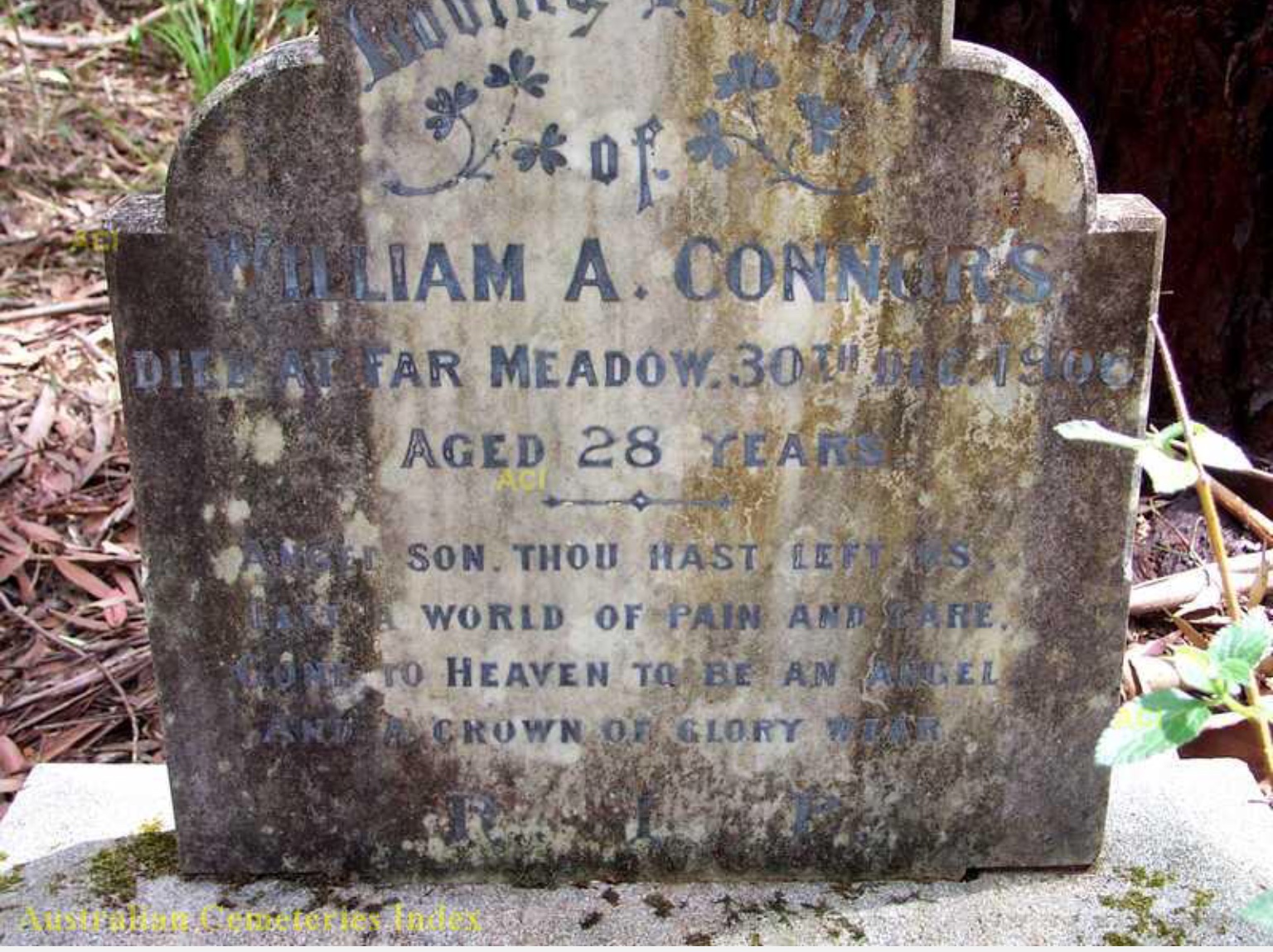
In 1906, when Susan was 55 years old, her son William Adolphus died.


William was single and still living on the farm with his mother Susan and father Thomas.  Sadly, he had been suffering tuberculosis - consumption - for at least three years. This was the same disease that had killed Susan's sister nearly 20 years earlier.  William lost his battle with this dreadful wasting disease at the age of 28.

As a mother, the loss of your first child would seem almost incomprehensible.  Children are not supposed to die before their parents.  It would appear though, that William had likely suffered terribly with the disease and perhaps Susan saw his passing as a blessed relief.


The words inscribed on his headstone seem to imply exactly that.


Isn't it strange the things you notice when creating stories for your ancestors?


The three men in her life with the name 'Adolphus', either as a first name or second (her father, her brother and one of her sons), all died before Susan herself.


By the time Susan's son William Adolphus had died on December 30th 1906, almost one half of her children had already left home.  Her daughter Mary Ellen was aged 32, had married and had given birth to another child.  John Edgar, aged 30, had married and started a family.  My grandfather George, aged 26, married that same year, as had his brother James, aged 22.  They had married the Brown sisters, Grace and Lillian and had moved north to Lismore.  The other half - Alice aged 24, Percy aged 20, Cyril 18, Fred 16 and Erice aged 14 - were still living on the farm near Berry.

Tragedy struck again though in the year after Susan lost her son William.  In 1907, Susan's son James also died.  As stated on the coroner's record, he died of burns following an accident at his work place. The circumstances were truly horrific.

The Advertiser (Oct 17 1907) reported "Man Burnt To Death:  James Connors, of Lismore, went into an oil store for oil, and trod on a match, which ignited the fumes, causing a case of methylated spirits to take fire and explode.  He (James) rushed from the building blazing from head to foot, and was badly burnt.  He died the same evening."

It's hard to imagine the depths of suffering for the Connors family, particularly for Susan herself, to lose another son in such tragic circumstances so soon after the loss of William.  James was only 23 and left a widow and two very young children.

Another of Susan's sons, John Edgar had witnessed his brother's death and had come to the aid of his brother as he burned alive.  The experience left an indelible scar on his psyche for the remainder of his troubled life.

A mere three years later, Susan herself passed away.


She died in 1910 at the age of 58.  The cause of death recorded on her death certificate was cardiac failure and pneumonia.  No doubt the grief and heartache associated with the tragic events in the last ten years of her life contributed to her demise.


The obituary for Susan, under her married name of Mrs. T. Connors, appeared in a local newspaper lists the cause of her death as double pneumonia and pleurisy which leaves the impression that she was quite ill in the last days of her life.

She was survived by her husband and eight of her children.


Susan was buried at the Harley Hill Cemetery in Berry, New South Wales.


Special Note to any family members:  If you have and further information to share, can I graciously ask that you do so.  Please use the comments box below or email me.  It may prove to be invaluable to the story and provide future generations with something to truly treasure.