Showing posts with label direct ancestor. Show all posts

Saturday, 14 January 2023

Memories ... January 14

In Remembrance

(For my 'Family Anniversaries' page)


Today is the anniversary of the passing of my maternal great great grandmother, Susan Muldowney / Downey or Downie.  


I'm still not sure which surname is the one that would have been on her baptism record or indeed would have the been the actual family name of her father.


I've told Susan's story before, with as many of the known facts I was able to uncover.  If interested, you can read that by following this link - The Story of Susan Muldowney / Downey or Downie  


That previous post covers some of the story from her wedding day in 1865, in Scotland, to the day she passed away in 1919, in Queensland, Australia.


There are however still a few pieces of the puzzle missing:

  • I'm still unsure of Susan's exact date of birth.  
Her 1919 death certificate listed her age as 69, which means she wold have been born around 1850.   Of course this information would have been provided by the informant, her son Thomas, and he may not have been in possession of correct information.

Her 1865 marriage certificate stated she was 22, which means she would have been born around 1843.  

The 1871 England Census lists her age as 27 and her birth year as 1844.

The 1881 England Census lists her age as 39 and her birth year as 1842.

The 1887 passenger list from the assisted immigration records listed her age as 37, which puts her birth date back to 1850.

In the end, I plumped for 1842, just because .... well, just because!

  • It's also interesting to note that the age she would have been on her wedding day is different on various records.
On her death certificate it was stated she was 18 years old when she married, but on the marriage registration it was noted she was 22 years old.  According to the date of birth surmised from her death certificate, she would have actually been 15!  Who knows!!

  • I have also not yet been able to find a record of Susan's baptism in Ireland despite the fact that the names of her mother and father were listed on her marriage certificate.  
Her place of birth was recorded as Leitrim on the 1887 passenger list, but was then recorded as Roscommon on her death certificate.  I've researched as far as I can in both counties at this point in time, but without success.

  • Finally, there's the issue of her maiden name.  
On the marriage registration document her name was recorded as Susan Downie.  Her parents were listed as Patrick Downie (labourer) and Elizabeth Downie, formerly Reynolds.

On her death certificate the names of her parents are missing.

On both her sons' Michael's and Matthew's death certificates, and her daughter Margaret's death certificate, her surname was recorded as Muldowney.  Margaret's marriage certificate however, had her mother's maiden name recorded as Muldowney. Her daughter Elizabeth's death certificate had her mother's maiden name recorded as Downey, but Elizabeth's marriage certificate had her mother's maiden name recorded as Muldowney just like Margaret!

The assumption I have gone with is - her maiden name was anglicised a little when she was living in Scotland and England, but then once she was settled into her life in Australia, her family started using what may have been the original spelling of her maiden name in Ireland when she was a child.


Wednesday, 12 August 2020

The Story of Mary Ayears (Airs)

My post this week tells the story of my paternal Great Great Great Great Grandmother, Mary Ayears  or Airs  (1770 - 1858).


Before proceeding with Mary's story, I'll add a cautionary note ... she has been a troublemaker when it comes to my ability to uncover loads of definitive, accurate information about her life.  


First of all ....

Researching an ancestor who was born in England the same year as Beethoven and Wordsworth can be a very hit and miss affair, as civil registration was only introduced in 1837.  

The period before 1837 is often referred to as the pre-Victorian era (as Queen Victoria ascended the throne mid-1837) and anyone attempting to trace their English ancestors during this period basically needs to rely on church registers.  

Unfortunately these church records contain far less genealogical information than the civil records and were handwritten, making them quite hard to decipher most of the time.  


Second of all ...

I've found that the surname Ayears appears to have different variations, spelt in a few different ways including 'Ayers' and 'Airs'.  This has led to a long, long road of assumption and guessing when it comes to records relating to my 4x great grandmother!  I've spent many, many, many months trying to cross-reference with family trees on Ancestry.com and as many records as I could find on several sites such as Family Search and Find My Past.  It's been a messy and confusing journey.


Thirdly ...

I've found that researching female ancestors going back two generations and more is always a little troublesome.  The details of their lives are rarely captured in the records that are available, unless you're fortunate enough to have treasures such as diaries or family stories passed down.  All I've managed to uncover are a few facts from a couple of very short periods of time - between 1797 and 1808, and then between 1851 and 1858.  So here's what I think I know about parts of Mary's story!

When Mary Ayears was born around 1770, her father Samuel Ayears was around 20 years of age, and her mother Mary Vicary was about the same age.  

Old Church of St Mary Major - with the square tower
By Beatrix F. Cresswell (1862-1940) - httpwww.archive,orgdetailsexeterchurches00cres, 

Public Domain, httpscommons.wikimedia.orgwindex.phpcurid=41190059


My research led me to a baptism record showing a Mary Airs was baptised at the Church of Saint Mary Major in Exeter, Devon, England in August of 1770.


I don't have an exact date of birth for this Mary, and I admit I followed information from family trees on Ancestry.com to track down this record.  


Whether or not it's really my 4x great grandmother is probably debatable, but other information leads me to believe it's quite likely.


Later records, which are definitely more reliable,  indicate that Mary was likely born around 1768, so that places the Mary Airs from this baptism record at approximately the right time.  Records of Mary's marriage later on and the baptism records for her children show that all these events happened in Exeter, so again I think it's highly likely that Mary herself was born and baptised in that same town.


Around 1770, Exeter was a economically powerful city with a very strong trade of wool.  The reigning monarch at this time was King George 111, and it was in August of 1770 that Captain James Cook claimed the entire east coast of New Holland for Great Britain.  It was of course later to become Australia, and the home for descendants of one of Mary's daughters Anne (known as Nancy) my 3x great grandmother, and for descendants of her grandson Joseph Hutton.


Apart from a possible birth year, baptism date, baptism place, and parent names, I have no information at all about Mary's childhood.  The next fact I do know, and am sure about, is that Mary Airs/Ayears married John Littlejohns in December of 1797 when she was around 27-29 years old.  On the marriage record, Mary's maiden name was spelt as 'Ayears'.


According to information sourced from other descendants' family research, Mary and John already had three children before they married.

Well, the assumption is that these are John's children as well as they were given the surname of Littlejohns.

Son Henry was born in 1794, but sadly died when he was less than a year old.
Daughter Frances, known as Fanny, was born in 1795.
Daughter Mary Ann was born in April of 1797.

Interestingly, Mary's father, Samuel Ayears, died on the 14th of December 1797; and Mary married on the 19th of December.


I could make all sorts of assumptions about this fact, one of which would be that Mary had been living out-of-wedlock with John for a number of years likely as a result of her father's objection to the match.  Mary was however old enough to marry without her father's consent, so I'm not sure that would be an accurate assumption.  Anyway, very shortly after father's death, Mary seems to have married the father of her children.

After the marriage of Mary and John in December that year, the family grew.

Jane was born mid-1800, but unfortunately passed away in September.
Anne, known as Nancy, Littlejohns (my 3x great grandmother) came along in November of 1801, when Mary was aged around 31-33.
John was born in May of 1803, but he died in February the following year.
John Edwin was born in 1807.  Mary was now around 37-39 years old.

By the year 1808, out of the seven children that Mary gave birth to, there were three daughters and one son who had survived their infancy.  

It's very difficult to glean information about Mary's adult life around the time of and after the birth of her children, but clues from records later on point to the fact that it's likely Mary, her husband John and their family of four, had a hard life and were probably amongst the poorer class in Exeter society.

John worked as a 'fuller', often referred to as a 'tucker', which was not a well-paying job and the conditions of employment were very tough.  A fuller (tucker) worked long hours every day.  It was their job to clean wool cloth during the cloth making process to eliminate dirt and oil, and make it thicker.  Before the cloth got to the fullers (tuckers) it was soaked in urine!  John's job would have been back-breaking and extremely unpleasant.

I imagine Mary worked in some lowly, poorly paid job in the mills of Exeter as well, but I have not yet found any proof of that, and likely never will. Records of women's working life from that era are rare.

Mary and John were married for about 44 years until John died sometime around 1841.  Mary was aged around 71-73 at that time.

By then, Mary's eldest daughter Fanny was a widow as well.  She had married Joseph Perkiss Hutton, and had given birth to three children, but only two had survived into adulthood.  Fanny's son Joseph, Mary's grandson, had been transported to the colonies ten years earlier at the young age of 17.  He had in fact been sentenced to death, but his conviction had been commuted to transportation for a period of 14 years.  In reality, transportation to Australia really was a life sentence.  He lived out the rest of his life in Australia and probably had very little contact with either his mother or his grandmother Mary.

Mary's youngest daughter Anne (known as Nancy) had married William Henry Browning almost twenty years before, in the same church as Mary and John.  By 1841 though, Anne was in Australia, having migrated with her husband and six children.  She lived the rest of her life in the colonies, far away from her mother.

By 1851, ten years after the death of her husband, Mary was living in the Almshouses in Exeter, with another daughter Mary Anne Harris (nee Ayears).

1851 Census - St David's, Exeter, Devon, England


Mary was recorded as being an "Almsperson / Tucker's Widow".  Almsperson basically meant "one who is dependent on the receipt of alms", a "a pauper". The census record indicates she was now aged 83.  She was living in the Atwills Almshouses on New North Road in Exeter, with her daughter Mary Anne who was listed as an "Upholstress".  It seems that daughter Mary Anne's husband had died by this time, as she was now living with her mother.


An excerpt from the book 'A Topographical Dictionary of England' published in 1833 states:

"Atwill's almshouses were founded and endowed by the corporation, with the arrears of Mr. Atwill's charity in 1717, for fifteen aged woollen manufacturers, appointed by the corporation:  the annual income of this charity amounts to about £320."


Almshouses were generally houses or property left to a parish by a community-minded benefactor who was acting philanthropically, and were outside government control.  People who were accepted into these almshouses were approved in some way.  They would no have been vagrants or outcasts, but were likely to have been regarded as respectable and part of a network of obligation which ensure their admission.  

In Mary's case, she was the widow of a 'tucker', another name for a fuller, and the Atwill's Almshouses were by that time earmarked for "poor and aged" woollen trade workers as mentioned in the excerpt from information on the website Genuki: Almshouses, Devon, Exeter, 1850:

ATWILL'S ALMSHOUSES, in New North road, are neat stone dwellings on an elevated site. In 1588, Lawrence Atwill left about 320 acres of land, and several houses, &c., in the parishes of St. Thomas, Whitstone, and Uffculme, to the Corporation of Exeter, upon trust to apply the yearly profits thereof in setting the poor to work. As the charitable intentions of the testator could not be strictly or beneficially carried into effect, a new scheme was sanctioned by the Court of Chancery in 1771, directing that in future the rents and profits of the charity estate should be applied in the erection and support of almshouses for the reception of poor aged woollen weavers, &c., of the city, who should be provided with looms, &c., and small weekly stipends. Accordingly, 12 almshouses were built in 1772. In consequence of the increased income of the charity, these almshouses were enlarged in 1815, at the cost of £425; and again in 1839, at the cost of £160. They are now occupied by 24 almspeople, who are provided with coals in winter; but only 16 of them have weekly stipends of 2s. 6d. each, and none of them are provided with looms. The charity estate is let to fifteen tenants, at rents amounting to about £250 per annum, and large sums are occasionally received for the renewal of leases and the sale of timber.


I believe that Mary and her daughter Mary Anne were two of the 24 almspeople mentioned as living in the Atwill's Almshoues in 1850, and it's likely neither of them were receiving the weekly stipend.  It's more likely that Mary was relying on the income of her daughter to provide food and other essentials.  On a positive note though, at least they had a home, more or less guaranteed, and were provided with coal in winter!

This is photo of the almshouses from around 1900, which is a little while after Mary was living there but certainly gives an idea of what the almshouses looked like during Mary's time as a tenant.

There were 24 houses (more akin to flats) in 3 blocks that were designed in a gabled Tudor style.

The 'houses' were likely to have consisted of one or two rooms with a fireplace.  It would have provided Mary and her daughter with a private space so they would have been able to live quite independently, despite their economic dependence.


Mary died at the Almshouses in April of 1858 at the age of 90, as indicated on her death certificate.  The cause of death was listed as "natural decay", so it sounds as though she was not ailing in any way or suffering at the end of her long tough life.


She was buried five days later in the Parish of St. David and her death notice, albeit brief, does describe her as "greatly respected by all who knew her".


Mary was survived by her three daughters, Frances Hutton nee Littlejohns, Mary Anne Harris nee Littlejohns, Anne (known as Nancy) Browning nee Littlejohns; and her son John Edwin Littlejohns.


Tuesday, 28 January 2020

The Story of Anne (Nancy) Littlejohns

This is the story of my paternal Great Great Great Grandmother, Anne (known as Nancy) Littlejohns (1801 - 1875).


My 3x great grandmother was baptised Anne, but was known as Nancy for most of her life.  This is apparently quite a common tradition for those of Irish heritage.


Huh???

The many peculiarities in Christian names in Ireland can apparently be divided into five different classes:
- names that can apply to both sexes
- names that are usually given to one sex, but are applied to the other
- diminutives that differ substantially from the original given name
- names which are different but for varied reasons are used interchangeably
- Irish equivalents for English names and English equivalents for Irish names


In the case of my 3x great grandmother, it seems that a common variation used for the given name of Anne, is 'Nancy'!  I just can't see the logic in it, and it seems that 'Nancy' was often used for the given name of Hannah as well!!!  It's confusing, and it certainly didn't help my research efforts.  For many years, I felt as though I had hit a brick wall, until a distant family member enlightened me about the use of 'Nancy' for those actually christened Anne.

For the purposes of this post, I shall refer to my 3x great grandmother as Anne (Nancy), using both names so it's clear for all who might be reading this story.

Anne (Nancy) was born in November of 1801.  Her father John Littlejohns was aged 29 at the time, and her mother Mary Ayears was aged 31.

St Sidwell's Parish Register - Baptisms and Burials 1772-1804


Anne (Nancy) was baptised at the same church where her father and mother had married in Exeter, Devon, England.

page from St. Sidwell's Parish Register - last entry


She was baptised at St. Sidwell's Church in Exeter on the 29th of November, 1801.


So far my research has only produced records showing six other children born to Anne's parents, John and Mary.

A boy named Henry was born in 1794, but died a month before his first birthday.
Frances (known as Fanny, which makes a whole lot more sense!) was born in 1795.
Mary Anne came along in 1797.
Jane was born in 1800 but died the same year.
John was born in early 1803, when Anne was only 1 year old.  Sadly, he died the following year, in 1804.
John Edwin was born in 1807, when Anne was 5 years old.

With the deaths of three of the Littlejohns children before Anne (Nancy) had turned 6,  Fanny, Mary Anne and John Edwin were to be Anne's (Nancy's) only siblings as she grew from a young child to an adult.  It appears that the family were quite poor and lived in impoverished circumstances for most of Anne's (Nancy's) childhood.  Father John worked as a fuller in the woollen cloth-making industry, which was not a well-paying job.

By the time Anne (Nancy) was born, in 1801, Exeter had a population of around 20,000 and was considered an important town in England.  This however changed very quickly as the industrial revolution more or less passed Exeter by, and other towns grew enormously in terms of size and economic importance.

Exeter decreased in size over the following sixty years and dwindled to becoming just a market town.  This coincided with the decline in its wool manufacture and tanning industries.  As a result, it ceased to be an important manufacturing centre and rates of unemployment grew, along with the numbers of impoverished people.

I imagine Anne (Nancy) and her siblings would have been sent out to work at a very early age.  Most likely my 3x great grandmother would have worked in one of the woollen manufacturing factories or worked as a servant / household staff.


When she was 20 years old, Anne (Nancy) married William Henry Browning in Exeter, Devon on the 28th of July 1822. On this record her name was recorded as Nancy.

You can see that Anne (Nancy) had not learned how to write her own name, as she signed her marriage record with a mark - an X.  My 3x great grandmother had not benefited from an education during her childhood, which would indicate her family was indeed very poor and most likely had no fixed address for any great period of time.  It was probably a tough childhood for Anne (Nancy).


The obligatory banns had been posted three times previous to her date of marriage, on three consecutive Sundays.  Obviously there were no objections made, so their marriage was solemnized in the presence of a James Legitt and John Marwood in 1822.


Anne (Nancy) and William Browning went on to have 11 children over the next 24 years.  The first seven of their children were all born in England, and the records of their births indicate that Anne (Nancy) and William moved quite often between Exeter in Devon, Anne's (Nancy's) home town, and Launceston in Cornwall, William's home town.  It's possible that this was the result of a constant search for work and the means to support their growing family, hence the constant moving between Anne's birthplace and William's.

Daughter Susannah was born in 1823.  She was born in Exeter.
Hannah was born in 1825, but the family had moved by then as she was born in Launceston, Cornwall.
John Thomas was born two years later in 1827, but the family was back in Exeter by then.
Caroline Penelope (my great great grandmother) was born in 1830, when Anne (Nancy) was 28 years old.

The family had fallen on really tough times by then though, as Caroline was born in the Poor House, and the family were once again back in Launceston, Cornwall.  The next three children were all born in Launceston, so it seems the family stopped moving for a while as they were likely dependent on parish relief.

William Henry was born in 1832.
Dinah was born in 1835.
Mary Anne was born in 1837.

Sadly, daughter Dinah was to pass away the following year, in 1838, when she was only aged 3.  Anne (Nancy) at the time was 37, and it appears that the family was once again living in the work house.  The living conditions they had to endure at this time might have contributed to the decline in the health of daughter Dinah, and ultimately caused her death.  I can imagine the heartache that Anne (Nancy) endured during these years as she and her husband tried to find work wherever they could, and when they couldn't, were forced to rely on parish relief and life in the poor house.

The workhouse that was in operation at this time in Launceston housed up to 40 inmates.  It was a building that had originally been a prison and the day-to-day life of the workhouse inmates would have been harsh, to say the least.

A mere 30 years previously the Quaker and prison reformer James Neild visited the workhouse in Launceston and reported that there was:
"a scene of filth, rags and wretchedness ... The large room below stairs has a mud floor; and whole families, men, women and children, pig together.  The upper room had several bedsteads in it, with the most ragged and dirty bedding I ever saw; the windows were small and close, the want of ventilation and decent cleanliness produced a stench almost insupportable.  I was in the room but a few minutes before I was seized with sickness, which obliged me to withdraw."
Nothing would have changed much by the time Anne (Nancy) and her family were living in that same workhouse.  It wasn't until 1838 that a new workhouse was built on acreage just outside Launceston.  The Browning family would not have known this newer, much larger and cleaner workhouse.


By early 1840, Anne (Nancy) and her husband William, had made the decision to take the opportunity to emigrate under what was known as the 'Bounty Scheme', leaving their country of birth to face the challenges of a new life in the far-off colony of Australia.

Anne (Nancy) and her husband were both in their late 30s when they made the decision to leave home and family and travel to the other side of the world.


I've been fortunate enough to have benefited from a lot of family tree research compiled and published by Esme Smith in her book: The Browning Story: Tracings From The Past, published in 2001.


Esme is a descendant of Anne's (Nancy's) daughter Mary Anne, whilst I am a descendant of Anne's (Nancy's) daughter Caroline Penelope.


According to Esme's book, Chapter 1 p.1 "It may have been the prevailing adversity of being poor that drove them to leave England.  Perhaps the conditions in the Poor Houses, where they had spent a number of years, were so difficult for the family that the parents were prepared to forego the known for the unknown.  The harshness of their circumstances may have caused them to believe that there was nothing to be lost in taking this journey."
Bounty Immigrant List showing William and Anne Browning and four of their children. 
 Their eldest daughters were listed separately under 'single females'.

The Browning family were members of a party of 158 assisted immigrants on board the ship 'Premier' which set sail from Plymouth, England on the 2nd of April, arriving at Port Jackson on the 1st of July 1840.  Assisted immigrants were individuals who were paid for or subsidized by another person or through an agency working on behalf of an employer in the colony.

At the time of their journey to Australia, Anne's (Nancy's) six children would have been aged between 16 and 3 years of age.  What strength of resolve and fierce willpower would a mother need to ensure the health and happiness of her children while undertaking such a voyage?

The ship did not touch land at any point on the journey, so the family would have endured a tedious three-month long trip on a crowded ship, with little food to eat and very cramped living conditions, although this would not have been a totally new experience for any member of the family really, given the time they spent living in the workhouse.  Sickness and disease were rife as well.  There was an outbreak of measles one week into the journey and the epidemic lasted for five weeks!

I can imagine the worries Anne (Nancy) must have had about whether or not her children would succumb to the disease.  Four babies did die on the journey, so Anne (Nancy) would no doubt have been particularly concerned about the health of her youngest, Mary Ann, who was aged 3 at the time.  Given that Anne (Nancy) had already lost a daughter when she was three years old, it must have weighted on Anne's (Nancy's) mind a great deal.

View of Sydney Cove - 1838, by Conrad Martens

Thankfully all of the Browning family survived the trip and landed safely in Port Jackson on the 1st of July, 1840.


Although both Anne (Nancy) and her husband William were really close to the cut-off age for eligibility for assisted migration (40 years of age), they had a family which included four daughters, two of whom were close to a marriageable age.  This was considered an asset, as the colony had very large numbers of young men looking for brides!  No surprise then that Anne (Nancy) and her husband were accepted for the assisted immigrant scheme, despite their ages.
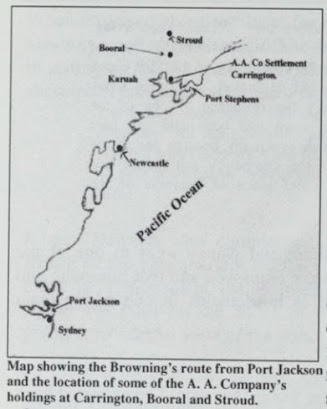
Map from Esme Smith's book: 
The Browning Story: Tracings From The Past p.17


Even after three months of sailing, the travelling continued for the family after they had arrived in the colony.  The Browning family were all employed by the Australian Agricultural Company on the company's holding at Carrington, Port Jackson.  


This was a fifteen hour journey on another smaller ship further north.  It was here that William began working as a shepherd.


Map showing some of the sheep stations
the Brownings worked on as shepherds - including Carrington


Anne (Nancy), and the younger children, would have worked alongside William while it's likely the two older daughters were employed as servants in one of the large property houses at either Carrington or Stroud.

While at Carrington, another son was born to Anne (Nancy) and William.

Francis came along in August of 1841, just over a year after Anne (Nancy) and her family had arrived in Australia.  My 3x great grandmother was aged 39.

During the next month, September 1841, Anne (Nancy) saw her eldest daughter Susannah married to Joshua Craven, a convict assigned to the AA Company.

Just four months later, in January of 1842, the second eldest daughter Hannah was also married. She wed Thomas Norton, also a convict who had been assigned to the AA Company.

It seems that Anne (Nancy), her husband and the rest of the family left the AA Company and Carrington sometime after the weddings of the two eldest daughters.  By the end of 1842 her son John Thomas would have been 15 years old; daughter  Caroline Penelope (my 2x great grandmother) would have been 12; son William Henry would have been 9 years old; daughter Mary Anne would have been aged 5; and baby James Francis would have been 1 year old.

Over the next few years, Anne (Nancy), husband William, and the children that were still living with them, moved around a lot.

George Bishop, Surveyor-General's Office, New South Wales 1872 [Public domain]


According to the information in Esme Smith's book, "it's likely that the Brownings moved, initially to Ward Stephen's holdings in the Hunter River District (marked in red), and then to the New England area (marked in green) and finally to the Richmond River District. (marked in yellow)" (p. 22)


By June of 1842 Anne (Nancy) and husband William were employed as part of a family team of shepherds who drove Ward Stephen's flock down from the highlands of New England, to the rich plains of the Richmond Valley on the coast (later to become known as the Lismore area).

Ward Stephen's station 'Runnymede' highlighted on map


It was here that Ward Stephens moved to Runnymede where he built his homestead, and the Brownings went there as employees.  Sadly, whilst Anne (Nancy) was working alongside her husband at Runnymede, her daughter Susannah passed away back up on the highlands of New England, in Stroud.  Susannah was only aged 20 at the time and had been married for just two years.

It appears that Anne (Nancy), William and their younger children remained working for Ward Stephens for at least another five to six years.  During this time in the Richmond River district Anne (Nancy) and William had another three children.

Joseph was born in 1845.
Elizabeth was born the following year, in 1846, but died just a few weeks later.
Matthew came along in early 1848.  Anne (Nancy) was aged 45.

By this time however, Ward Stephens, their employer, had sold his property Runnymede and the Brownings had moved on once more.  They had taken another shepherding job, together with members of their family, at Maryland Station back up on the New England Tablelands.  Maryland, then owned by Matthew Henry Marsh, was in the Darling Downs area, which was still part of New South Wales at that time.

According to Esme Smith's 'The Browning Story: Tracings From The Past:
"The family's employment at Maryland commenced on 4 May 1848." (p. 30)  ...
"When William and Nancy arrived at Maryland Station, they had with them their children, John, William, Mary Ann, Francis, Joseph and Matthew.  There they worked as shepherds and watchmen at a wage of  £70 per annum.  This is a rather large annual wage given the times. ...so it probably meant that it included the work of the other members of the family."  (p. 31)
By 1848, their daughter Caroline Penelope (my 2x great grandmother) had married.  She was aged 15 when she wed Henry Brown in 1846, and was now a mother herself.  It appears Anne (Nancy), her husband William and six of their children, had followed their daughter Caroline and her husband Henry to Maryland Station, as Henry had started work there in March of 1848.

1848 was also the year that the second eldest daughter, Hannah, re-married.  She had been widowed around 1846, when she was aged just 21, and soon after becoming a mother for the first time.  It's likely that Hannah, with her daughter Mary Ann, had also joined the family soon after the death of her first husband and had moved onto Runnymede Station when the family had been working there.  Hannah then followed the family to Maryland Station where she met her second husband.

Anne (Nancy) and her husband William left Maryland Station sometime between 1851 and 1853.  When their daughter Mary Ann married in late 1853, when aged 16, the family were living in the Armidale area.  It's possible Anne (Nancy) and William were working on one of the other properties owned by March, either Salisbury Court or Booralong, which were both in the Armidale district.


By early 1855, Anne (Nancy) and William were living in the Tamworth area, on Goonoo Goonoo Station, a property owned by the A. A. Company.  This is where their son William Henry married.  Their daughter Mary Ann and her husband were also living and working on Goonoo Goonoo, and were witnesses at the wedding.  As Esme Smith stated on p. 38 of her book "It is likely that various members of the family were again working for the A. A. Company at that time."

Sometime between 1858 and 1859, the family appears to have moved back to the Richmond River District / Lismore area.  Then in mid-1864 Anne's (Nancy's) husband William made an application for the purchase of some land, a block of 40 acres, on the western back of Terrania Creek.  This is where Anne (Nancy) and William built their own home and where they finally settled.  Their property was known as 'Rosehill'.

Their son Francis bought a block of 40 acres right next door to his mother's and father's block, and both William and son Francis, along with the other younger sons Joseph and Matthew, began working as timber-getters.

Anne's (Nancy's) husband William died at Rose Hill a mere 3 years later, in 1867.  He was buried at the Rosehill burying grounds.  Anne (Nancy) remained living at Rosehill until her death in 1875, when aged 74.

The years between 1840, when the family arrived in Australia, and 1864, when the family finally had their own home, would have been years of back-breaking hard work with quite austere and challenging living conditions for Anne (Nancy), as the wife of a shepherd.

Information gleamed from an article titled:  Shepherding in Colonial Australia, written by John Pickard in the 2008 edition of 'Rural History' indicates that there was no idyllic life for a shepherd,  "the reality in colonial Australia was brutally different.  ...  They worked in isolation, with poor accommodation and rations, exposed to a range of diseases, and were relatively poorly paid."  (pp. 55-56)

Replica of a bark gunyah

Living conditions would have been quite primitive (by our standards!)  It's likely that the first type of accommodation for Anne (Nancy) and her family would have been a tent or a bark gunyah - a temporary structure made with bark and tree branches - until a proper shepherd's hut was erected.  They may have even lived out in the open for a time.

Shepherding was a nomadic lifestyle and Anne (Nancy) went with William wherever work could be found; living, working and raising their family in temporary homes quite a long way away from towns and settlements.  They would have lived quite an isolated existence, apart from the day-to-day presence of their own family and perhaps the occasional meeting with other shepherds and their families.

"The logistics of shepherding in the Australian colonies varied somewhat, but most often ... shepherds were based at an outstation which consisted of a hut with a set of yards made of moveable hurdles for each shepherd (where the sheep were penned at night).  Some outstations had fixed yards made of brush or logs.  These outstations were five to twenty-four kilometres from the head station." (Shepherding in Colonial Australia p. 56-57)


"A well-established outstation had a pole-frame hut, perhaps eleven feet wide by twelve or fifteen feet long, covered with bark stripped off suitable Eucalyptus trees, or shingles.  The bark roof would be held down with a framework of logs pegged together.  The fireplace would be lined with stones and clay, and smoke dissipated up a bark chimney."

The artist impression shown here was an idealised version of a well-established outstation.  It's highly likely the artist never ever saw one for himself!


A more commonplace hut would have been "slabs with bark roofs about twenty-four by ten feet, with two rooms ... and there would be a slab fireplace for cooking, a three-legged pot and a bucket would be all the household business.  The floor was just the ground."  (Shepherding in Colonial Australia p. 65)  This is likely to have been the home that Anne (Nancy) would have been familiar with.


It was usual that when married couples were employed, the husband shepherded and the wife was the hut-keeper.  Children were expected to look after sheep from an early age as well. It's likely that Anne (Nancy) and the younger children would have slept in the hut at night; whereas her husband William and the older boys most likely slept in a watch-box or even in the open near the yarded flocks of sheep, keeping guard against predators such as the native dogs, the dingoes.


There would have been the constant dangers of snake bites and accidents, and no chance of  prompt medical assistance.  There is likely to have been the constant fear of Aborigines as well, as relationships between the white settlers/squatters and the indigenous people were strained, to say the least.


The diet would have been extremely monotonous, based essentially on meat, damper and tea.  "Shepherd's wages included rations which would most likely have been:  ten a half pounds of meat, ten and a half pounds of flour, seven ounces of sugar, three and a half ounces of soap, two ounces of salt per man per week.  (Shepherding in Colonial Australia p. 66)


Throughout all of this it would have fallen upon Anne's (Nancy's) shoulders to keep the family together and to keep her family fed, housed and healthy.  Given that the entire family remained close-knit and close-by for her entire life (and onwards with the following generations), it seems Anne (Nancy) was the rock on which this family built their lives.

When Anne (Nancy) left her homeland and her own family far, far behind, I have no doubt she would have had some trepidation about the future.  I can't imagine what it would have been like to leave everything behind, including your own mother, father and siblings, to travel so very far away.  Did she keep in contact with her family back in England?  I doubt that very much, given the life she experienced as the wife of a shepherd and the fact that she never learned to write.

It's unlikely she would have known about the deaths of her father and her mother.  It's unlikely she would have known much about the lives of her sisters Fanny and Mary Ann, her brother John Edwin.


Anne (Nancy) passed away in early 1875.  The details on Anne's (Nancy's) death certificate were recorded by son Matthew, but are not all correct - Anne's (Nancy's) father's name was listed as Thomas, whilst her mother's name was listed as Martha Killark.   Neither of these pieces of information are supported by the details provided by Anne (Nancy) herself upon emigration to Australia.

New South Wales Assisted Immigrant Passenger Lists - 1828-1896
- Anne Browning (nee Littlejohns) 1840


The assisted immigration passenger list for those arriving on board the ship Premier in 1840 shows Anne's (Nancy's) parents listed as John and Mary.  Perhaps an explanation of the mismatch between the details on these records can be found in the fact that it's unlikely there was much communication between Anne (Nancy) and her English family, so therefore it's unlikely her son Matthew would have been in possession of the true facts.

At the time of her death, Anne's (Nancy's) family was quite large.  Eight of her children were still alive, and there were around 44 grandchildren living at that time ... with many more to come!

Her daughter Hannnah had married twice and still had 8 surviving children.
Her son John Thomas had married and had 8 children by then.
Her daughter Caroline Penelope (my 2x great grandmother) had married twice by this time, and still had 10 surviving children.
Her son William Henry (known as Bill) had married and had 5 surviving children.
Her daughter Mary Ann had married and had 10 children.
Her son James Francis had married, but had no children at that time.
Her son Joseph Edward had married and had 3 children by then.
Her son Matthew had married just the year before.

The Browning (Littlejohns) dynasty had been well and truly established in the land downunder!


Some of Anne's (Nancy's) children or grandchildren:
Top row:  granddaughter Caroline Maris Kean nee Browning with her children
Middle row L to R:  granddaughter Harriett Thomas nee Wright, granddaughter Sarah Ann Smith nee Bustard, and grandson John Thomas Brown.
Bottom row L to R:  grandson James Irving Stevenson Brown, granddaughter Eliza Stevenson Duncan Brown and grandson William Edward Wright.

Top row L to R:  grandson Thomas Charles Bustard and wife, grandson Arthur John Browning and wife
Middle row L to R:  grandson Richard Joseph Brown ( my great grandfather), his brother Richard Brown, and grandson William Henry Browning Jnr. with his mother Sarah.
Bottom row L to R: daughter Mary Ann Bustard nee Browning with her husband, granddaughter Martha Ann Reeves nee Bustard, grandson William Francis Browning.

Top row L to R:  grandson Joseph W Browning and family, and son Matthew Browning.
Bottom row L to R:  granddaughter Margaret Alice White nee Browning, and grandson Alexander Johnson Brown.


Special Note to any family members:  If you have memories to add, photos or information to share, can I graciously ask that you do so.  Please use the comments box below or email me.  It may prove to be invaluable to the story and provide future generations with something to truly treasure.


Thursday, 22 August 2019

The Story of James Hickey

This is the story of my paternal Great Great Great Grandfather, James Hickey (1798 - 1879).


The details of my 3x great grandfather's birth and early life are rather scant, but it's been a fascinating research journey trying to find clues.  From the few records I have ended up with, which really only includes the immigrant passenger list, the baptism records for two of his children, and his death certificate, there appears to be a difference in his supposed place of origin.  It appeared that James hailed from both County Limerick and County Clare.  So, which was correct?


From what I've been able to glean so far, it seems that both are most likely correct.  Why?  Well, that needs an explanation.


James was probably born and definitely lived in the Coonagh area (not to be confused with the Coonagh Barony!).

Coonagh was comprised of two townlands, Coonagh East and Coongah West.


The area was part of the Civil Parish of Killeely.


The Civil Parish of Killeely was part of the Roman Catholic Parish of Parteen-Meelick-Coonagh in the Diocese of Limerick.


Both the Civil Parish of Killeely and the Diocese of Limerick straddled two counties, County Limerick and County Clare. Indeed, the majority of the Limerick Diocese was in fact within the borders of County Clare, as was most of the Parish of Parteen-Meelick-Coonagh. 

The area of Coonagh (which included Coonagh East and Coonagh West) sat on the banks of the Shannon River, and was at different points in time considered to be part of both counties, although when James was growing up it was most definitely considered part of County Limerick.
Sunset on the Shannon, taken from Coonagh
By ThadysLamp - Own work, CC BY-SA 4.0,
https://commons.wikimedia.org/w/index.php?curid=44392588


I have not yet uncovered a definitive date of birth, but the year 1798 is an educated guess, based on the age recorded on James's immigration passenger list.  His death certificate contradicts this date though, and indicates that he was born a lot earlier, in 1793.  I do think that 1793 was in fact the date of birth for one of James's brothers.

James was the son of Patrick Hickey and Mary Price.  He had at least two older brothers.  I think that it was Patrick who was born in 1793, and then Denis came along in 1795.  James was the youngest of the boys.  It's likely other siblings were born to his parents, but it seems they did not survive into adulthood.

My 3x great grandfather James married Margaret McNamara sometime around 1820, when he would have been aged 22.  On James's death certificate it is recorded that he married in County Clare, and that would be correct if they married in the Catholic Church in the Parish of Parteen, which was part of the Diocese of Limerick!

After their marriage, James and Margaret went on to have at least 8 children whilst living in Ireland.
Their eldest son Dennis was born in 1822.
Patrick came along in 1824.
Twins, John and Thomas were born in 1827.
Bridget was born in 1829.
Ellen (my Great Great Grandmother) came along in 1832.  At that time James was 34 years old.
James (Jnr.) was born in 1835.
William was born in 1837, but it seems he died as a very young infant.

Sadly, back in 1833, James's father Patrick had died.

Tithe Applotment Book 1833 Townland of Coonagh


At that time, in a valuation undertaken on May 30th 1833, recorded in the Tithe Applotment Books, the inhabitants of Coonagh were listed under three main family groupings - Coonagh Hickey, Coonagh Sexton and Coonagh Calcutt.  The townland of Coonagh itself was owned by the Earl of Thomand and leased to these families, who would have in turn probably subleased portions to others.

Tithe Applotment Book 1833 - Coonagh Hickey


The 1833 record showed that the Hickey brothers Patrick, Denis and James, along with a Widow Hickey (likely to be their mother Mary) were all working farmland in Coonagh, totaling 18 acres.

Patrick, being the eldest brother would have been left the lease of the large 15 acre farm after the death of his father that year.  That was in accordance with the inheritance traditions at the time.  The younger brothers, including my 3x great grandfather James, would have worked the land together as well as their own small 1 acre plots.  Apparently it was fairly common for each fully fit man to work 5 acres with a spade at this time.  Hard, back-breaking work!

Both James and Denis, the younger brothers, would have been deprived of property rights, and that would have been the reality for their own sons as well. My 3x great grandfather James already had 5 sons by this time (1833) and his brother Denis had 4.  Whilst James and Denis remained working the farmland as tenants for several more years after 1833, they were to make a life-changing decision in the hope of changing their futures.

Upon the death of their mother Mary, which happened sometime between 1833 and 1839, the two younger brothers decided to emigrate, in the belief they could build a better life for their families elsewhere and perhaps end up as landowners themselves.

In November of 1839, James Hickey and his family of 8, as well as his brother Denis and his family of 6, boarded the ship Adam Lodge, along with what is highly likely to be a number of other Hickey relatives.  In all, there were 28 people with the surname of Hickey from either County Limerick or County Clare who departed Cove Cork in Ireland on the 11th of November 1839.

The Adam Lodge was a 576-ton ship carrying 273 government immigrants.  According to the journal kept by the Surgeon Superintendent Alex Stewart:
"The immigrants included 54 Protestants and 219 Catholics.  A crew member and two children died on the voyage, one child was born.  A school was established and 37 regularly attended.  The schoolmaster was very attentive and many of the scholars improved considerably. The chief amusements were dancing and leap frog and were always encourage in the evenings until 9 o'clock.  Divine Service was performed five times during the voyage, the unfavourable state of the weather, the rolling of the ship and their indisposition prevented its being done oftener."
 The Sydney Gazette and New South Wales Advertiser Sat 15 Feb 1840 p2


The Adam Lodge arrived in Sydney on February 14th, 1840, after a voyage that lasted for 95 days.  The ship had taken a course from the Cape of Good Hope, across the Southern Ocean, and then up the Eastern seaboard of Australia.  The ship had 'spoken' with the Mary Ridgway whilst passing through Bass Strait, on the 10th of February 1840.


Upon arrival in Sydney all the immigrants would have resided in the government barracks on Bent Street, where an immigration muster was completed detailing information about James and his family.

It was noted that James had been 41 years old upon embarkation, but was 42 years old by the time he had arrived in the Colonies.

His previous occupation had been 'farmer'.

He was Roman Catholic and could both read and write.

James's wife Margaret was recorded as being 38 years of age and her occupation was listed as 'farm servant'.  She could neither read nor write.

Children Patrick, Thomas, John, James, Bridget and Ellen were all listed with Margaret.  Son Dennis was listed separately as a Single Male.

Dispersal List for assisted immigrants on Adam Lodge 1840 p.3 - James Hickey and family


James and his family had been bought out as part of the Assisted Immigration Scheme, which means their passage had been paid for by either the government of the colonies or a wealthy private individual.  In James's case, his passage was paid for by the government as the Dispersal List (shown above) lists his prospective employer as "unknown".

Dispersal List for assisted immigrants on Adam Lodge 1840 p.2 - Denis Hickey and family


His brother Denis and his son Dennis, on the other hand, had been sponsored by a Mr. Hunt of Sydney for 1 year at wages of 90 pounds plus rations.  It's likely that James stayed in Sydney for a while, close to his brother and son, anxiously awaiting employment prospects.

I'm not entirely sure just how long after landing in Sydney, James and his family moved north to the Hunter River District, and in particular the Maitland; but within two years of disembarkation, as another son was born in the Maitland area in 1842.

Son Michael was born in October of 1842, when James was 44 years old.

James was to reside in the Hunter River District, around Maitland, for the remainder of his life, as did his brother Denis and most of the extended Hickey family.  It seems that they were a close-knit clan.

Article in the Empire Newspaper Wed 5 Aug 1857 p2

There is mention of a "Hickey's Farm" in an article published in the Empire newspaper dated 5th of August 1857.


The article told of the effects of significant flooding in the Narrowgut / Morpeth / Phoenix Park area of the Hunter River District in New South Wales that year.


In the last paragraph there is mention that:

"Below Hinton the river broke over at several places, and poured a deluge of water into the adjacent hollows.  This was the case at Berry Park, Duckenfield, Hickey's Farm, Nelson's Plains, and Miller's Forest - all the low lands in these localities were covered with water."

Was this my 3x great grandfather's farm?


Map of Hunter River District around Maitland -
shows location of Wallalong, Phoenix Park and Narrowgut.


Oral family stories mention that James originally tenanted a farm at Wallalong sometime in the 1850s, moved across the river to Phoenix Park, and at some time tenanted farmland in Cooley Camp (later known as Bolwarra).

Given that James's brother Denis had died in 1852, then perhaps the "Hickey's Farm" mentioned in that 1857 newspaper was indeed the farm of James Hickey.  The death of his brother Denis would have been a terrible blow to James, considering they had made the journey out to Australia together and spent their lives in the colony living in the same places.

I have little knowledge of the life of James during his years spent farming in the Hunter River District.  Did he end up owning his own land, or did he spend his life as a tenant farmer?

Maitland Mercury and Hunter River General Advertiser Sat 21 Jun 1879 p16


James Hickey died on the 14th of June, 1879 and the death notice published on Saturday the 21st of June states:

"Mr. James Hickey, senior, died on Saturday night, the 14th inst., at his late residence, Narrowgut."

The article also mentions that he was an "old and respected resident of the district" who had been a "native of Ireland, but has spent thirty-nine years in this colony, always located in the Hunter River  district."  It was wonderful to see that he was described as "of a remarkably active temperament, and possessed a warm-hearted, genial disposition, which served to endear him to a large circle of friends."  The death notice also mentions that James died "with his children all around him", which seems to indicate the closeness of the family unit.


James's death certificate stated that he died of "senile debility" and that he was survived by 7 of his children - Patrick was 46, the twins John and Thomas were 44, Bridget was 40, Ellen (my great great grandmother) was 38 and Michael was 35.  That means his eldest son Dennis was deceased by that time.

The death certificate also lists 1 other male as deceased, and 1 female.  I know that James and Margaret had lost a son named William before they left Ireland, but I have not yet found any record of a third daughter born to them, either in Ireland or Australia.  These details were given by son Michael, so I'm assuming he would have known the true facts and I now have some more researching to do!


Special Note to any family members:  If you have memories to add, photos or information to share, can I graciously ask that you do so.  Please use the comments box below or email me.  It may prove to be invaluable to the story and provide future generations with something to truly treasure.