Showing posts with label miner. Show all posts

Sunday, 12 April 2026

The Story Of Thomas Farrell

This is the story of my maternal great grand-uncle, Thomas Farrell  (1868 - 1927).  

Our common ancestors are: Michael Farrell and Susan Muldowney — sometimes recorded as Downey or Downie — my 2x great-grandparents.


I have written about Thomas before, but it was really only an outline: born in England to Irish immigrant parents, emigrated to Australia with his family, spent most of his adult life at one address in Charters Towers, and then passed away comparatively young.


I felt the need to return to his story and approach it a little differently. He was not a man who left behind a large paper trail, nor does he seem to have lived the kind of life that draws much notice in the records. There are no dramatic headlines around him, no rich archive of letters, and sadly, no photograph of Thomas himself in my collection.


And yet, I have increasingly felt that his life is worth pausing over precisely because it was so quiet.


Family history is not only about the ancestors who made a stir or left behind plentiful records. It is also about those who lived more modestly — people whose lives were shaped by work, endurance, sorrow, loyalty, and family care. Thomas seems to have been one of those people. The records for him are thin, but they still reveal something strong and lasting: a man who worked steadily, remained close to home, endured much, and at the end of his life was held within the care of family.


That is really the intention of this piece: to try to honour the shape of a quiet life. Not an empty one, and not an unimportant one, but a life lived without fuss, and still deserving to be remembered with tenderness.


Sadly, I do not have a photograph of Thomas himself, but the few family photographs I do have help place him more closely within the family group he belonged to — his parents and the Farrell brothers and sisters whose lives were so intertwined with his own.

The  Farrell  Family

(with the few photos of the Farrell siblings that are in my collection)

A Quiet Life

When I sat down to write this post about Thomas Farrell, I was immediately aware of the gaps.  I could trace him through the official breadcrumbs left in records — a birth record, census records, electoral rolls, a passenger list, and a death record - but these are thin facts. They do not tell me what kind of company he was, what made him laugh, what his voice sounded like, or what private burdens he may have carried. 


Family history can so often be like that. Sometimes it gives us the frame of a life, but leaves the person inside it only partly seen.


Yet, every now and then, one small detail says more than a whole page of records ever could. In Thomas’s case, that detail kept drawing me back.


When Thomas — unmarried and living alone by that stage of his life — became seriously ill, he did not die alone, and he did not die in a hospital surrounded by strangers. He died at Molongle Creek near Gumlu, in the home of his married sister, Margaret McCane, née Farrell, my great-grandmother.


That single fact does not tell me everything about Thomas, but it tells me something that matters very much. He was with family. He was cared for. He was loved.


That feels like the truest starting point for telling his story. Thomas may be one of those relatives who left only a light paper trail, but his life does not feel empty because of that. Instead, it feels quiet in the truest sense: modest, steady, and deeply human. 


The family Thomas belonged to

1868 Birth Record - Thomas Farrell

Thomas was born on 15 January 1868 at East Field House, Holmside, County Durham, England, the second child of Michael Farrell (1834–1917) and Susan Muldowney, whose surname appeared in records as Downey or Downie at times (1842–1919).


Thomas's siblings were:

·         Margaret (1865–1955) - my great grandmother

·         Michael (1869–1873) - who sadly died in infancy

·         Helen Ann “Annie” (1871–1937)

·         Elizabeth (1873–1934)

·         Michael (1875–1918)

·         Patrick Joseph (1877–1917), WWI soldier

·         James “Jim” (1880–1946), WWI soldier

·         Matthew Felix (1887–1922), WWI soldier


Even set out simply as a list, there is something moving about it. It speaks of a large family life — full at first, and then gradually marked by sorrow, distance, war, and loss.


Thomas belonged to that family story in the deepest sense. His life cannot really be separated from the people around him — the parents, brothers, and sisters whose names appear alongside his in the records, and whose own lives shaped the course of his. 


A boy already in the mines: Tanfield, 1881

The Farrell family lived in the Durham coalfield region of north-east England.  They moved around the region regularly, looking for lodging as the family grew, and likely experienced impoverished living conditions, periods of hunger, and poor health.


1881 England Census - Civil Parish of Tanfield, County Durham, Registration District of Lanchester


One of the records that brings Thomas closest for me is the 1881 England Census, because it shows him before emigration to Queensland, before adulthood, before all the later losses in his life. In the civil parish of Tanfield, County Durham in England, Thomas appears aged 13, living at home with his parents and younger siblings. Unlike many boys of that age, whose occupation might still be given as “scholar,” Thomas already has a job recorded beside his name:

Thomas Farrell — “Screener Collier”

That single line says so much. At thirteen, Thomas was not just growing up in a mining district — he was already part of that working world. He was a child, really, but also a worker who had likely been toiling for a number of years.


The primary duty of a screener collier was to inspect coal as it passed over screens, picking out stones, slate and other impurities by hand. Screeners worked above ground, usually on the brow of a pit or in a screening shed.  The work was physically demanding, carried out in high-dust environments, with the working day often lasting twelve hours.  It is sobering to think that this was his childhood.


Thomas's father, Michael Farrell, is also recorded with a mining-related occupation in the 1881 census:

Michael Farrell — “Coke Drawer (Burner)”

So here we have father and son, both working within the industrial life of County Durham long before the family ever came to Queensland, Australia. It also helps explain why, years later in Charters Towers, Thomas appears again and again in local census records as a miner. Mining was not some new path he stepped into in Australia. It had already shaped him from boyhood.


I always find details like this especially affecting, because they bring a person down from the branch of the family tree and place them back into real life. Thomas was not only a name in a lineage. He was a thirteen-year-old boy who already knew the reality of hard work.


Two sisters go first: January 1886

Before the rest of the Farrell family left England, two of the sisters — Margaret and Helen Ann, known as Annie — emigrated ahead of them in January 1886.


This is one of those family details I particularly love. Margaret, my great grandmother, is the one who was credited by family members with working diligently and saving her money to sponsor the family’s emigration. That gives such a strong little glimpse of her character. She was not simply hoping life might improve — she was actively helping to change its course. 


For Thomas, as for the rest of the family, her determination mattered enormously. It is another reminder that quiet lives are often shaped by the quiet strength of others around them.


The Chyebassa voyage: Thomas follows with the rest


Queensland, Australia, Passenger List - Cheybassa 1887

In September 1887, the remaining Farrell family emigrated aboard the Chyebassa: Thomas, aged 19, his parents Michael and Susan, and siblings Elizabeth, Michael, Patrick, James, and baby Matthew. They arrived in Townsville on 28 September 1887 and then travelled on to Charters Towers to reunite with Margaret and Annie, who were already there.


The records do not tell us what that reunion looked like, of course, but it is hard not to pause there and imagine it. After the long voyage, after all the uncertainty and upheaval, there must have been great relief in seeing familiar faces in a new land.


For Thomas, still a young man, this was the beginning of the life he would go on to live in North Queensland — a life that, on paper at least, would remain remarkably steady for many years afterwards.


Charters Towers: the steady years on Bridge Street

By the early 1890s, Thomas and his family were firmly settled in Charters Towers.  His parents had moved into a house on Bridge Street that would remain the family home for nearly thirty-five years.   


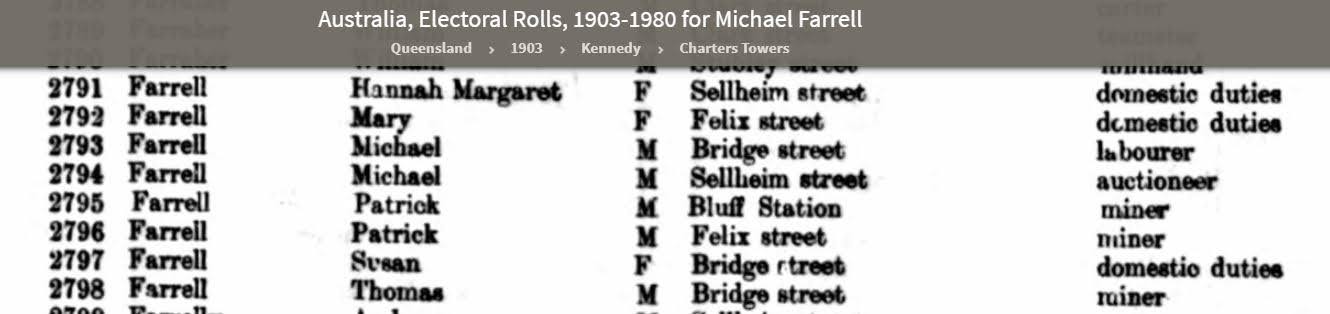
From 1903 through to 1925, Thomas appears in electoral roll records living at that address for that entire time.  He was the family member who remained in the family home the longest.


·        The 1903, 1905, 1906, 1908, 1913 electoral roll records show him living on Bridge Street with his parents and his occupation was listed as miner.  During the years spanning 1903 to 1908, Thomas's younger brother Patrick was also living in Charters Towers and worked alongside his brother as a miner.

·        The 1919 electoral roll record still shows Thomas, aged 51, living on Bridge Street, but only with his youngest brother Matthew at this time.  Occupation: miner

·        The 1925 electoral roll record shows Thomas, aged 57, living on Bridge Street, but by this time he is living on his own.  Occupation: miner

On paper, it looks like a steady working life: one town, one street, one occupation, repeated across the years. 


There is something about that repeated pattern that feels quietly revealing. Thomas does not come across in the records as restless or showy. Instead, he seems to have been one of those people who remained — living on, working on, and holding to the familiar centre of home as the household around him gradually changed.


That too feels like part of the meaning of his life. It was, in many ways, a quiet life — not empty, but steady.


Loss, war, and what Thomas carried

Thomas’s later years in Charters Towers were marked by a great deal of family grief.


His brother Patrick Joseph Farrell was killed in Belgium on 20 September 1917 at Polygon Wood, West Flanders. Years later, Patrick’s Victory Medal was sent to Thomas in May 1923.


I always stop over details like that. A medal arriving years after a brother’s death — an official token of service and sacrifice — and it is Thomas who signs the receipt and receives the engraved medal.


Whether that happened because he was the next-of-kin contact, or because he was the one still at the family address, it feels meaningful. Thomas became the one who received that tangible reminder of Patrick’s absence.  He seems to have been the family member who remained at the centre of things when others were gone.


By 1917, Thomas’s sisters - Margaret, Elizabeth and Helen (Annie) had long since married and left Charters Towers.  Thomas's brother James had also married years before, moving out of the family home but still remaining in Charters Towers.  The family home on Bridge Street had become a much quieter place.  Then, after Patrick's death, other losses followed in quick succession:

·       18 November 1917 — his father Michael died in Charters Towers, a mere two months after the loss of Patrick in WW1.  

·         7 July 1918 — his brother Michael died in Charters Towers

·         14 January 1919 — his mother Susan died in Charters Towers

·         23 July 1922 — his brother Matthew Felix died at Charters Towers District Hospital, four years after returning from WWI

Undoubtedly, after his father's death, Thomas, aged 49, would have stepped more fully into the role of head of the household and carer of his ageing mother.


The death of mother Susan left just Thomas and his younger brother Matthew still living together on Bridge Street. Then, by mid 1922, Matthew too was gone. After that, Thomas, aged 54, was left on his own.


There is something especially poignant in that. The earlier Farrell years must once have been full and busy, with parents, brothers, sisters, and all the ordinary life of a crowded household. Then, little by little, over a period of just six years, that household thinned significantly through marriage, war, illness, and death. Thomas’s story seems to carry much of that quiet aftermath.


A shift in working life: miner to auctioneer

After the death of his younger brother Michael in 1918, it appears Thomas took over Michael’s auctioneer business, possibly in an effort to support Michael's widow and fatherless children.


Queensland, Australia, Government Gazettes, 1859-1918

The Queensland Government Gazette has Thomas's name recorded on a list of Auctioneers' Licenses issued at the end of September 1918.  


Newspapers published a few years later gives one of those wonderful little glimpses into the practical everyday world of his later life.


On 12 March 1920,
The Northern Miner published a full auction notice under the name “T. Farrell, Auctioneer.”


The notice advertises his “usual weekly auction sale” at “the old address,” given as Carg’s Buildings next to Carr Bros., Saddlers, with the sale to begin “tomorrow at 11 o’clock.” 


What I love here is how practical and ordinary it all is. Poultry in the yard — prime ducks, hens, and good turkeys — and then, in the mart, produce, fruit, vegetables, and useful items such as fly veils for horses, an ice chest, and confectioner’s scales. The tone is brisk and businesslike: “No reserve. Terms cash.”


Then, on 4 April 1925, Thomas appears again in
The Northern Miner, this time in the paper’s “To-Day” auction listings:

“T. Farrell, mart sale, 11 a.m.”

It is only a very brief notice, but it says a lot. By then, a T. Farrell sale was familiar enough to be part of the town’s ordinary weekly rhythm.


Taken together, these newspaper mentions help explain why Thomas’s death certificate lists him as an auctioneer, even though earlier records over many years call him a miner. Lives do not always fit neatly into a single label. Sometimes the paperwork preserves one part of a life while another part is already unfolding.


The closing chapter: illness, and a sister’s home


Thomas died on 7 February 1927 at Molongle Creek near Gumlu, Queensland.


Death Certificate 1927


He had celebrated his 58th birthday less than a month before this.  His cause of death was pulmonary tuberculosis.


Now here comes the detail that moves me most in his story.

Death Notice - published in a prominent northern Queensland newspaper


Death Notice - published in a Charters Towers newspaper 
(his home town in Australia)


Thomas died at the house of his older sister, Margaret McCane, née Farrell.


In the years before effective antibiotic treatment, pulmonary tuberculosis could mean a long and difficult decline. It was a feared illness, and often a lonely one. So, the fact that Thomas was taken in and cared for at home by family feels deeply important. He was not left to face that closing chapter alone.


At this point, it is hard not to notice the quiet echo of Margaret’s place in this story. She is remembered as the sister who worked and saved to help bring the family out from England and at the end of Thomas’s life, she is there again — the sister whose home became his refuge. 


Burial: the two unmarried brothers, side by side


One more detail adds a quiet tenderness to the ending.


Thomas never married, and neither did his younger brother Matthew Felix. Younger brother Matthew had served in the First World War, returned home, and then died four years later in 1922.


When Thomas died in 1927, he was buried beside Matthew in the Charters Towers Cemetery — the two unmarried brothers laid to rest, side by side.


Burial plot for the Farrell brothers at the Charters Towers Cemetery
(its present day condition looks rather sad)

It is such a simple fact, but it feels like a deeply human one too. After all the movement in this family story — from Durham to Queensland, from the mines to the auction mart, from a full household to the losses of later years — the brothers were together again. 


What I am left with

Thomas Farrell’s story is still mostly outline, but it is not empty.


He was a Durham boy already working in the mines at thirteen. A young man who crossed the world to Queensland as part of a family migration made possible by his sister Margaret’s determination. A man who spent years in Charters Towers, first recorded working steadily as a miner, and later appearing in the newspaper as “T. Farrell, Auctioneer.” A brother trusted to receive his younger brother Patrick’s Victory Medal. A man who, at the end of his life, was cared for in his sister’s home. Then finally, a brother buried beside his brother.


There is still much I would love to know about Thomas that the records cannot tell me. But I do not think of him as a faint figure at the edge of the tree. He feels to me like someone who lived quietly, worked steadily, endured much, and remained close to the heart of his family.


Perhaps that is the true shape of Thomas Farrell’s life: not a loud one, not a highly documented one, but a quiet life lived within the shelter of family, and remembered with love.


Note:  For those who are interested, my previous post is all about the Farrell home on Bridge Street in Charters Towers.  Here is the link - The Story Of The Farrell Family & Bridge Street

Tuesday, 6 February 2024

Memories ... February 7

Anniversary of a Birthday /  In Remembrance

(For my 'Family Anniversaries' page)


Today is the anniversary of my paternal Grand Aunt Lillian Ruth Brown's birthday .....  


.....  and the passing of my maternal Great Grand Uncle Thomas Farrell.


Here's some of Lillian's story:

Our common ancestors are: Richard Joseph Brown and Ellen Cusack.

  • Lillian was born in 1887 in Lismore, New South Wales.

  • She was the second of four daughters born to Richard Joseph Brown and Ellen Cusack.

  • At the time of her birth, her father Richard was 25 years old and her mother Ellen was 24.

  • Lillian's older sister Grace (my paternal grandmother) had been born two years before Lillian.  Then when Lillian was 3 years old her sister Elsie came along.  When Lillian was 5, her sister Marcella (Marcy) was born.

  • The sisters grew up in Lismore, New South Wales.  They were the descendants of well-known pioneering stock on both their paternal and maternal sides (the Browns and Brownings on her father's side, the Cusacks and the Extons on their mother's side).  As such the girls inherited a well-respected family name.

  • After leaving school, Lillian worked as a dressmaker for a number of years.  

  • In 1906, when she was 20 years old, Lillian married James Alfred Connors.

  • James was in fact the younger brother of George Connors (my grandfather), who had married Lillian's sister Grace (my grandmother) that very same year.

  • Lillian and her husband James welcomed their only child into the world in April of 1907, a daughter named Lorna Mary Grace.

  • Sadly, Lillian became a widow just six months later, when her husband died as a result of burns inflicted during a tragic accident at his workplace.  (I have told James Alfred Connors' story before.  For anyone interested in knowing more, follow this link:  Fire and its Tragic Consequences!)

  • Lillian re-married just over a year later to an Irish immigrant named Jeremiah (Gerry/Jerry) O'Donnell, who hailed from County Cork.  Lillian was 21 years old at the time and Jeremiah was 23.  

  • Sadly, Lillian and Jeremiah lost their first born, a son named Roger, on the day he was born in 1909.

  • Their daughter Lillian Margaret was born 1911.

  • Unfortunately though, Lillian would never see her two daughters grow up.

  • Standard practice for women giving birth in hospitals in the early 1900s included the women remaining 'in confinement' at the hospital for a couple of weeks after giving birth.  Tragically, Lillian contracted pneumonia while in confinement, became weaker and weaker until her heart gave out and she passed away.


  • Lillian was only 24 years old when she passed away on the evening of August 31st, 1911.  She died at the maternity hospital which was known as Nurse Atkins' Private Hospital, in Lismore.

  • She was buried in the Roman Catholic section of the Lismore Cemetery.  I have yet to locate her exact resting place.

  • Lillian was survived by her second husband, a daughter aged 4 and a newborn aged just 14 days.  She was also survived by her father Richard, her mother Ellen, and her three sisters, Grace (my grandmother), Elsie and Marcella (known as Marcy). 

  • Interestingly, Lillian's second husband did not provide details of Lillian's first husband on the death certificate, nor indeed the name of Lillian's first child.  I think there's a story there that I have yet to uncover!


Here's some of Thomas's story:

Our common ancestors are:  Michael Farrell and Susan Muldowney/Downey.


  • Thomas's birth record shows that he was born on the 15th of January 1868 in Holmside, County Durham, England.   

  • At the time of his birth, his father Michael Farrell was 34 years old and his mother, Susan Downey / Muldowney was 26.

  • Thomas was the second of nine children born to Michael and Susan, and he was the oldest boy. 

  • Thomas was born at a place named 'East Field House' which was part of a row of small, rather humble, colliery houses, built by the owners of the coal mines and coke works in the Durham Coalfield area of north-eastern England to provide housing for the their workers and families.  It was substandard housing and families often lived in tiny one-room cottages, quite inadequate for housing large families.  The harsh living conditions became a breeding ground for disease and ill-health.   

  • Sadly, Thomas's younger brother Michael died as an infant when Thomas was 5 years old.


  • The 1881 England Census shows that Thomas was working as a 'screener' at a colliery when he was only 13 years old.  While Thomas was working above ground (a whole lot better than being down the mine), the work was laborious and the days were long.  
Definition of 'screener':  watches that coal passes over screens and dust or small coal is properly sifted through; may also pick dirt from conveying belt as coal passes to screens.

  • It was not uncommon at the time for children to start work when they were 7 or 8, sometimes younger!!  I suspect that Thomas had started work a few years before the census date.

Australia Passenger List - Queensland
Ship - Chyebassa

  • Thomas emigrated to Australia at the age of 19, along with his father, mother and six of his siblings.  Two of his sisters (my great grandmother Margaret and her sister Helen Ann) had already emigrated and were living in Charters Towers.

  • After arriving in Townsville in September of 1887, Thomas and the other members of his family travelled to Charters Towers to meet up with his sisters.

Australian Electoral Roll 1903

  • The 1903 Census shows Thomas living on Bridge Street in Charters Towers, with his father, mother and Thomas's occupation was listed as 'miner'.  He was 35 years old at this time.

  • Thomas remained living on Bridge Street until he became ill later in life.

  • Thomas worked as a miner in Charters Towers until he became quite ill in his late 50s.

  • Thomas never married, but was very close to his family throughout his lifetime.

  • Thomas's three youngest brothers, Patrick, James and Matthew, all went off to serve in WW1.  Tragically, his brother Patrick was killed in action in 1917.  Brothers James and Matthew did return home.

  • Sadly, Thomas also experienced the loss of both parents and another brother before the end of 1919.

  • His father Michael died in 1917, the same year as his brother Patrick was killed in action.  Thomas's brother Michael died in 1918.  Thomas's mother Susan died in 1919.

  • When the war finally ceased, things had changed quite dramatically for Thomas.  His three sisters and his brother James had all married and moved away from home.  His brother Matthew was the only sibling left in Charters Towers, and was living with Thomas at the family home on Bridge Street.

  • Then, quite unexpectedly in mid-1922, Thomas's brother Matthew also passed away.  Thomas was now living on his own in Charters Towers.


  • The 1925 Electoral Roll lists Thomas as still living on Bridge Street and his occupation was still 'miner'.  Thomas was 57 years old.

  • Thomas became very ill with pulmonary tuberculosis in 1926.  He left Charters Towers to live with his older sister Margaret (my great grandmother) at her home on the family farm at Molongle Creek near Gumlu.


  • On the 7th of February 1927 Thomas passed away at the age of 59.  He would have only just celebrated his 59th birthday a month before.  (Note:  his age is recorded incorrectly on his death notice and on his headstone.)


  • Death notices for Thomas appeared in the Northern Miner (a Charters Towers newspaper) and the Townsville Daily Bulletin.


  • He was returned home to be buried at the Monumental & Lawn Cemetery in Charters Towers, alongside his brother Matthew.  Unfortunately, both burial sites are now quite severely damaged and need repair.


  • Thomas was survived by his three sisters and his brother James.

An interesting note:

  • The brother still living when Thomas passed away - James - also suffered with pulmonary tuberculosis for a couple of years before he died, and this was listed as one of the causes of his death as well!


Friday, 23 March 2018

The Story of Owen McCane (Muckian)

My post this week is about my maternal Great Grandfather, Owen McCane (Muckian) (1859-1930).  


Photo shared by Lawrie McCane


In the year of Owen's birth, French acrobat, Charles Blondin, became the first person to cross Niagara Falls on a tightrope; George Simpson patented his electric range; Charles Darwin published his revolutionary text "On the Origin of Species" radically changing the view of evolution forever.


It was also the year that Queensland, here in Australia, was established as a separate state from New South Wales. That happened on the sixth of June, which later became known as Queensland Day.  


Coincidentally, Owen was born on the sixth of June, and after migrating to Australia, he was to spend the rest of his life in Queensland.


Owen was born in 1859, in the townland of Ballintemple, in the civil parish of Killevy, and the Catholic parish of Lower Killeavy, in County Armagh, Ireland.

The surname that Owen was known by here in Australia, McCane, was an anglicized version of Muckian.  To his family in Ireland, he was Owen Muckian.


    (Transcription below ... with errors and variations in names!)


You can see on the baptism record however that the surname Muckian has been spelt with an 'a' instead of 'u', and the mother's name was incorrectly recorded as Liza McCann instead of Sarah McCann.


There are many variations of the spelling of Muckian on the various records I've found during my research - Mackian, McKean, Mackean, Muckean.  It's been an interesting journey researching the McCane / Muckian side of my family tree!


Finding my Great Grandfather's baptism record actually took a very long time.  It wasn't just because of the variations in surname spelling, but I was also using the information provided on his cemetery headstone as a guide to his birth year.  That turned out to be wrong by a few years.  Of course that would have been information given by a family member who may not have had any real idea about when his father was born.


Owen was the third child of Patrick Muckian and Sarah McCann.  In many records, Owen's father's name was recorded simply as Patt, and not Patrick.  Patrick would have been aged 39 when Owen was born, and Sarah would have been 38.


At the time there were only two Muckian families living in Ballintemple.


There was Patrick / Patt (Owen's father) and someone named Owen, perhaps a brother of Patrick. 


It seems likely that the Muckians had come from elsewhere, perhaps just one generation before, to settle in this area.


When my great grandfather Owen was born, there were already two children in the Muckian family. Edward was the first born son, born in 1854.  He was aged 4 when Owen was born.
Mary had been born in 1856, and she was 2 years old when Owen was born.
After Owen came John in 1863 and Ann in 1864. 


What was life like for this family of seven living in a small townland, on land rented from Reverend Robert Henry?  No doubt the family worked tirelessly to eke out a living, farming their small piece of land.  The farm however was not going to support all of the siblings in their adulthood years.  That seems to have been a very common thread amongst so many of the stories of my ancestors.  As the children became adults, most of them moved away to build a new life for themselves.
 

Owen's father Patrick died in mid-1887, when Owen was aged 28, and it appears that both Owen and his younger brother John had already left their home country by then.

Queensland, Australian, Immigration Index 1848-1972


Owen had boarded the ship 'Taroba', aged 28, and migrated to Queensland, Australia in 1888. The ship left London on the 30th of June 1888.  As you can see on the record above, Owen's name was recorded as the anglicized version - Owen McCane.


My great grandfather was listed as a 'remittance' passenger.  Usually the passage of a remittance passenger was paid for by a relative, a friend, or a church representative living in Queensland.  Any Queenslander at that time could purchase a "passage warrant" from the government, forward it to a person living in Ireland, the United Kingdom and Europe, who could then present it to a government agent there and board a ship at no cost to him/herself.  


I have not yet found evidence of another Muckian relative living in Australia at that time, so I wonder if it was indeed a church representative who arranged to pay the cost of his passage to the government?  Unfortunately, the Immigration Index does not include information about who paid the passage of the remittance passengers.


Owen's occupation on the Immigration Index was listed as 'miner'.  That begs questions: When did he leave the farm to become a miner?  Where did he go to become a miner?
 

There's no evidence that there was mining happening in County Armagh during the 1880s, when Owen would have been in his twenties.  It's far more likely he had travelled elsewhere to work in mines.  I thought perhaps he had moved to England, where there was lots of work available in the mines for poor Irish looking for an income.


That led me to a census record for an Owen Muckian who was living in the north-east of England in the county of Durham, known for coal mining at the time. Could this be my great grandfather?  Whilst his occupation was recorded as - labourer - he probably worked as a labourer at a colliery first, and then got a job working in a coal mine.  Looking down the page on that census record, you can notice that 'coal miner' was the most common occupation.


It's highly likely that this was indeed my great grandfather Owen, and I have no doubt that he would have read about or heard about the opportunities for gold mining work in Australia during his time in England.  That would have seemed like the golden opportunity for a better life.


I'm always interested in tracking down the description of the voyage my ancestors took when coming to Australia, and I was able to find the article relating to Owen's voyage to Townsville in August 1888.


Brisbane Courier (Qld. : 1864 - 1933), Monday 20 August 1888, page 3.
(an extract) "THE H.M.S. TAROBA.
The Taroba, which is the latest addition to the fleet of the British India Steam Navigation Company, is under the able command of Captain Arthur Morris, who has commanded vessels trading here ever since the inauguration of the British India Company's mail service.

The Taroba has made a very fine run of only forty-eight days from Gravesend, including all stoppages. She left Gravesend with a full crew, consisting of 141 officers and men all told, and 605 passengers, first, second, and immigrants, at 5 p.m. on the 30th June, four days behind time, and arrived off the Isle of Wight at daybreak the following morning. 

Here the compasses were adjusted by an expert who had accompanied the vessel from London, and after about two hours' delay the pilot was landed and the Taroba's course shaped for Ushant.Gibraltar was passed at night-time four days later, and Malta after another three days. 

Port Said was reached on the 10th of July, the journey so far being 350 miles,... the actual steaming time to Port Said was 9 days 21 hours and l0min.,the vessel thus averaging 11 miles per hour ... the Canal was entered the next day. 

The passage was made in good time, Suez being reached on the following day and the vessel slowed down to allow of letters being sent ashore. The Taroba then started again at full speed for Aden. 


During the passage down the Red Sea the thermometer stood at an average of 95deg fahr. in the shade, but on one day it reached l00 deg. One casualty occurred from heat apoplexy. At 11 p.m. on the 16th July the anchor was let go off Steamer's Point, Aden, the distance from Suez-1309 miles-having been accomplished in four days four hours. At Batavia strict quarantine was enforced, and after being delayed for thirty-six hours coaling, the Taroba left for Thursday Island at 11 p.m. on the 31st July, arriving there at 2 p.m. on the 8th August, five days ahead of contract time. Here a most exacting inspection took place of all the passengers and crew by Dr. Salter, the local health officer, who granted pratique.

At 7 a.m. on the 9th August the steamer left for Cooktown, arriving there at daylight on the 11th. Here the English mails were transhipped to the steamer Warrego, and having discharged 180 tons of cargo and landed twenty immigrants, the Taroba left at 8 p.m. the same day for Townsville, arriving there at 3.40 p.m. on 12th August. Eight hundred and twenty tons of cargo and 109 passengers and immigrants were landed."


It seems his trip was a quick one for the time, only 48 days, despite leaving the London port four days behind schedule! Part of the trip would have been excruciatingly hot for most passengers, with daytime temperatures around 100 deg F.  It's likely though that Owen would have experienced temperatures as high as 100 deg F before, if he had worked underground in mines.  Good preparation for living in Australia!


I've only included the details of Taroba's journey up until the point Owen disembarked.  He was amongst the 109 passengers who left the ship in Townsville on the 13th of August 1888.  I wonder if he knew anyone on the ship?  Having read through the passenger / immigrant list, there didn't appear to be any other family members, and there was only one other immigrant from County Armagh.  Perhaps there were men on the ship that had worked in Durham County, and they had made the trip together.  Many of the passengers were listed as 'miners' and they disembarked at Townsville, just like Owen.


Upon landing, Owen would have boarded a train and headed out west to Charters Towers to start work in the mines.  Charters Towers had been founded in the 1870s after gold had been discovered.  1872 to 1899 were boom years for the township, with the mining of rich gold deposits underground.

Charters Towers Mining Settlement circa 1890       
By The photographers Allom and Bailey, Public Domain, https://commons.wikimedia.org/w/index.php?curid=10005348

Photos of miners / mine in Charters Towers c.1890s - John Oxley Library Qld.


Life as a miner though would have been tough-going.


I haven't been able to find out whether Owen tried to find gold for himself, or if he went to work in a mine owned by someone else.


Either way, I expect it was a daily grind, and Owen certainly didn't become a rich man from his efforts.


It also seems that he headed north and found employment on the Cairns to Herberton railway line construction (this was information recorded in Owen's death notice many years later).  The construction of this railway line occurred between 1886 and 1892, so it's likely Owen headed there sometime around 1890.

Workers on the Cairns to Herberton railway line c.1890s (John Oxley Library Qld.)

This work would have required demanding, gruelling, back-breaking labour, and it would also have been dangerous; as the railway line climbed up into the Kuranda Range.  It appears that Owen only remained there for perhaps a year or so.


A short item in The Cairns Post lists Owen McCane as a person who had left the electoral district of Cairns by the July of 1892.   He had most definitely left the Cairns district and was back in Charters Towers by the end of February that year as evidenced on his marriage certificate dated 1892. 


Owen married Margaret Farrell on the 21st of February, 1892 in Charters Towers.

Interestingly, Margaret had been born in the north-east of England, and was living in Durham County at the time when it's likely Owen had arrived from Ireland.  Perhaps they had met in England, and not in Australia, as I had originally thought at the beginning of my research.  Margaret had emigrated in 1886, two years before Owen though; so I'm not entirely sure if they knew each other in England.


On the day of their marriage, Owen was 32 (although his age on the marriage certificate was recorded as 29) and Margaret was 28.  Margaret had quite a number of family members who had migrated not long after she had moved to Australia, so Owen would have instantly become a member of a large family once again.  As previously stated, Margaret had been born in northern England, but to Irish-born parents, so no doubt they would have welcomed Owen with open arms.


Owen and Margaret went on to have seven children over the following 15 years.

Susan Mary was born in 1892, when Owen was 33 years of age.
Sarah Mary Josephine (my grandmother) was born in 1894.
Edward William was born in 1896.
Thomas Owen came along in 1899.
John Michael was born in 1901, when Owen was aged 41.
James Patrick was born in 1904, when Owen was 44.


It seems that Owen, aged 38, tried to purchase land in early1898, between the births of his third and fourth children.  A newspaper item appeared in The North Queensland Register in February of 1898 detailing information about applications that went to the Warden's Court to purchase "Goldfields Homesteads" in and around Charters Towers.


Owen appears to have made an application to purchase 40 acres of land at a locale named 'Sheep Station Creek', to the north of Charters Towers, and after carefully reading the newspaper item, it appears his application was successful, as the word "rejected" does not follow his name as it did on others.
  

I have endlessly searched for information about this purchase, but have not found out much at all!  I have assumed that Owen did become the owner of this 40 acres of land and ran cattle on the property.  He may have looked at this purchase as a long-term investment, but it appears it was not an immediate money-maker, as the 1903 census shows Owen was employed at the local water pumping station.


As evidenced in the Australian Electoral Roll for 1903, Owen was employed as a fireman at the Burdekin River Pumping Station.  He was obviously no longer working as a miner and taken on a steady job in an effort to find a more stable income once he and Margaret started their family.  


The address on the electoral roll record was the 'Pumping Station'. The family didn't actually live inside the pumping station obviously!  The Burdekin River Pumping Station was located on the peninsula at the junction of the Burdekin River and Sheepstation Creek, and there was a collection of buildings at the site. In close proximity to the pumping station, there was an engineer's residence, some worker's cottages and a school, all located on the north bank of the creek.  Owen and his family would have been living in one of the worker's cottages, which would have been rather a tight fit for a family of eight at that time.


On the 5th of February 1905, tragedy struck the family.  Edward William, Owen's first born son, passed away at the age of 8.  The details of the tragedy were reported in several newspapers of the time.

Northern Miner (Charters Towers),
Monday 6 February 1905, page 4


Transcript of article in the local newspaper: 

"A sad drowning accident occurred at the Burdekin yesterday, the victim being a lad named Edward McCane aged eight years. The boy, with a younger brother went fishing, and fell off a log into the water. His little brother ran to give the alarm, but first went to the pumping station engine-house, which was untenanted. He then ran home and told his father, who is one of the foremen at the station. The father rushed down to the spot, and others came to his assistance, but it was 45 minutes before the body was recovered under the bank in 8ft. of water. All efforts to restore life were futile."


The picture I have of Owen during this ordeal is one of a frantic father diving into the river, searching desperately for his son under the water.  I wonder if it was Owen who found Edward?  I wonder if it was Owen who tried in vain to revive Edward?  I would imagine that my great grandfather Owen and great grandmother Margaret would have suffered immensely for a long time.  Both would have carried on though, as they had five children to take care of, and thankfully a large group of family members on my great grandmother's side would have no doubt supported them through the weeks and months that followed.


Two years later, in 1907, Owen, now aged 48, and Margaret had another son.  They named him Edward Joseph.  There would have been great joy in the home once more, and there might have been some healing of the emotional wounds left by the loss of their first born son.


Unfortunately, more tragedy was about to unfold.  Just a year after the joy of his son's birth, Owen was involved in a rather nasty accident at the pumping station.


Evening Telegraph,
Thursday 7 May 1908, page 4

Transcript of the article:

"ACCIDENT AT THE PUMPING STATION.
This morning the managers of the mines and other consumers who use the water for boilers and commercial purposes were informed that owing to an accident the water would be cut off except for domestic purposes.
A circular was issued as follows: — ' Water Board Office, Mary-street, May 7.— As a serious accident has occurred at the pumping station, and there is under 3ft. of water in the reservoir, you are hereby notified to cease using Burdekin water at once until further notice.— By order, J. W.' Carter, clerk.'

It appears that the intake had just been cleaned out and preparations were being made to start pumping again. But there are always some little bits of floating material left behind. Some of this got into the valves of the pumps and they had to be cleared. 

But evidently the flotsam had carried even further than was anticipated, for it appears to have got into the air chamber between the pumps and the rising main. This air chamber is a sort of reservoir or buffer of compressed air, which takes off the great vibration (which comes from the plunging of the pumps) from the rising main and enables the water to be pumped along steadily. 

This air chamber must have got choked to a certain extent, and the continuous compression of the air caused the reservoir to explode; 

From what we can gather the explosion went off with a terrific report (and has made almost a total wreck of one of the pumps.
 
One of the men employed at the works— Owen McCane— who was working near at the time, was struck by a piece of the pump and had his head split open. It is a wonder he was not killed, for a piece of the machinery, weighing about half a ton, we understand, fell down near him." 


It seems that Owen was working at the pumping station when a huge explosion occurred, and he was struck in the head by a piece of the pump.  He must have received a rather nasty wound as the article reports he "had his head split open"!  Things apparently could have been worse if he had been standing in a different spot.  


I know little of what transpired in Owen's life between the accident in 1908 and the records I found pertaining to 1913.  Electoral records show that Owen and Margaret are still living at the Pumping Station, and Owen's occupation is still recorded as 'fireman', but I suspect that Owen, now in his early 50s, was ready for a change in both lifestyle and employment.  


Another record I found from 1913 provides a clue of what was to come.


The Queensland Brands Directory records show that in 1913 Owen had a brand registered to his name.  This means he was keeping livestock.  I'm not entirely sure what livestock he could have had, or where he was keeping them.  Horses perhaps?  Cattle?  The address given was still the Pumping Station, but then two years later, things had changed.


In the City Directories of 1915 Owen is recorded as living at Gumlu, and his occupation is 'farmer'.  There is no record of his wife Margaret residing with him at this point, but his daughter Susan is recorded as also living in Gumlu working as a teacher.  So it seems Owen had now left Charters Towers and moved on to property near Gumlu.


A little gem I found while researching on the Trove Newspapers collection shows that Owen had obviously felt right at home once he had moved to this area.


Bowen Independent, Saturday 1 May 1915, page 2.


In the 'Social' column of  the Bowen Independent, there was a short paragraph stating the 'Captain' Owen McCane had entertained guests for afternoon tea at his property.


I think Owen's property was actually called 'El Rita', but it had been recorded as 'E.C. Rita'.
So it seems Owen had quickly become an important member of the Gumlu Rifle Club Committee not long after moving!


Two years later, in 1917, the electoral roll record shows that Owen, his wife Margaret, their daughter Susan, (and the younger children not old enough to vote / show up on an electoral record) are now living along Molongle Creek, close to Gumlu.

Map showing the position of Molongle Creek

The 1919 electoral records for the McCane clan is quite interesting.


These records show that his daughter Sarah is now living on the farm with her father Owen and mother Margaret.  There's an entry next to Sarah's name: "care of O. McCane", which would have been her father, Owen.  

I've never really seen that listed before, and am left wondering ... does that mean she's in the care of her father (which seems an odd thing to note), or does it mean that she is caring for her father because he is unwell. Could it have been on-going complications from the pumping station accident or the results of an accident on the farm?  I'm hoping that one day I'll find the answer to my questions around this entry.

From that time on, Owen and his family continued living in the area.  It does seem as though Owen prospered a little in these years, and perhaps misfortune was now left in the past.


Photo shared by Lawrie McCane


Here is Owen and his wife Margaret at their property, known as 'El Rita', near Gumlu.


Clues (such as the mat on the ground and the water tank in the background) indicate this photo was probably taken in 1919 upon the occasion of Owen and Margaret's eldest daughter's wedding.


Looking at the photo of Susan McCane (eldest daughter of Owen and Margaret) on her wedding day, you can see the similarities between one of the rugs on the ground, the chair and the water tank in the background.


The photo below was taken on the occasion of Owen and Margaret's second daughter Sarah's wedding day in 1921.


Shared by Lawrie McCane

Back row L-R:  Owen and Margaret's sons, James Patrick (Jim), Thomas Owen (Tom), John Michael (Jack) and Edward Joseph (Eddie).

Front row L-R:  Sarah Mary Josephine (my grandmother), Owen McCane, Margaret McCane nee Farrell, and Susan Mary McCane

Owen would have been 62 years old.


The photo shown below would likely have been taken a few months before Sarah's wedding, and shows Owen in the cane fields on his farm.


Left to right:  Owen's third-born son John Michael (known as Jack), Owen's last-born son Edward Joseph (known as Eddie), Owen's son-in-law Frank Bidgood, Owen McCane (Muckian) and his first grandchild, Leonard Ashley Bidgood (known as Len or Lenny).

Photo taken in the canefields of Owen's farm at Molongle Creek, near Gumlu in Queensland.


Another little gem found whilst researching the Trove newspapers collection, dated 1923:


Bowen Independent (Qld. : 1911 - 1954), Saturday 18 August 1923, page 2

ANOTHER FORD AND A SON OF FORD.


Messrs B. J. Magees report having sold a Ford de Luxe car to Mr. Jas. Conway Manager State Coal Mine, and a Fordson tractor to Mr Owen McCane, Gumlu. 
This is the first Fordson tractor to come into the Bowen district, and the second tractor. The Fordson is very popular in other places and when it is seen at work here, we feel sure other farmers will speculate in one and get their ploughing done in quick time, before the moisture disappears from the soil, but of course we must get moisture first and, from all appearances it is not far off.


It seems Owen earned some distinction as being the first owner of a Fordson tractor in the district!!!

Update: Recent contact from another Muckian relative has shed some light on what was happening in Owen's life during the early 1920s.

In 1923, Owen paid for his two nieces, Bridget and Rose Barry, to come out to Australia.  They were the daughters of his sister Anne (known as Nancy) Barry nee Muckian.

Thanks to my 3rd cousin Maureen, daughter of Bridget, I now have re-collections passed on to her by her mother Bridget about the time she spent living with my great grandfather Owen once she reached Australia.

“Owen paid for Mum's and her sister Rose's passage to Australia. That would suggest he was in contact with his own sister Ann (Nancy) Barry. Seemingly they were close. He was small in stature like her, and unlike his brother Edward. Mum had no photos of Owen. She was 26 when she arrived in Australia. Mum met my Dad Herbert (Bert) Goodwill on the ship to Australia and he travelled with Mum and Rose by sea from Sydney to Bowen as they became engaged to be married in Sydney. Owen's sons Jack and Jim met them in Bowen and took them to Owen's farm.

My mother knew little about Owen but thought he grew sugar cane, pineapples and bananas on his farm. Mum and aunty Rose helped around the house.  I recall a story told by Mum about when she was cleaning in the kitchen and threw out a smelly can of substance which turned out to be yeast that her Aunt Maggie was cultivating to use to make bread! (Irish country girls would not have been familiar with using yeast as a raising agent for bread making as they used buttermilk and bicarbonate soda instead.)"
Photo shared by my 3rd cousin Sarah Nevans nee Beattie, descendant of Anne

The photo above shows Owen's sister Anne with her husband and some of her children.  The two daughters who emigrated to Australia are standing in the back row - Rose Barry on the left, and Bridget Barry on the right.


By 1925 the electoral records show Owen's son John Michael living in the area and working on a farm, and his eldest son Thomas Owen was living further south, but not all that far away.


By 1928 Owen's sons, James, John, Thomas (and his wife Agnes) were all living in the Gumlu area.  Owen's eldest daughter Susan was now married and was living on a farm a little further to the north at Wakala.  His younger daughter Sarah was also now married and living on a farm not far away at all, at Kyburra near Armstrong Creek.  Owen's youngest son, Edward, was most likely living with his mother and father, but that wouldn't have been recorded on the electoral roll as he was not yet of voting age.

1928 was also the year that Owen became a sponsor once again and paid the passage for more relatives to emigrate to Australia.  Owen's older sister Mary Elizabeth McCabe nee Muckian had a son named William Joseph McCabe and a daughter named Mary Elizabeth McCabe.  Owen paid passage for his nephew William, his wife Elizabeth and six children, along with his niece Mary Elizabeth, to come out to Australia.  They all settled in the Ayr / Home Hill area, close to Owen's farm near Gumlu.


Photo shared by my 3rd cousin Trevor White, a descendant of William Joseph McCabe


This photo shows Owen's nephew William Joseph McCabe with his wife Elizabeth Rocks and some of their children.  The photo was likely taken in 1915, many years before William emigrated to Australia.


Death Notice - Townsville Daily Bulletin,
Saturday 22 March 1930, page 4.


Not long after Owen arranged for another niece and his nephew to come to Australia, he passed away.


The cause of death appears to have been a heart attack.

Death Notice - Owen McCane -
Townsville Bulletin Mar 27 1930.


The death notice in the Townville Bulletin mentions his time working on the Cairns to Herberton railway line, and also mentions that Owen was a member of the Wangaratta Shire Council in his latter years. 


Owen McCane (Muckian) died on the 15th of March, 1930.  He was actually aged 70.  Owen was buried at the Home Hill Cemetery.


An extra little snippet:

A couple of years back I had contact with other descendants of the Muckian family (which is how I found out about the 'Muckian' family name) and they sent me photos of the plot of land where the ancestral family farm used to be, as well as a view of the surrounding countryside.

Photos shared by my 3rd cousin Brian Rafferty


Top photo shows the plot of land where the ancestral family farm was, and the site of the family home.


This photo shows the view over the neighbouring county, County Down, from the hill behind the location of the ancestral family farm in County Armagh, in the north of Ireland.


It's apparently quite a remote spot.  One day I hope to visit and see it for myself.


Special Note to any family members:  If you have memories to add, photos or information to share, can I graciously ask that you do so.  Please use the comments box below or email me.  It may prove to be invaluable to the story and provide future generations with something to truly treasure.