Showing posts with label Cusack. Show all posts

Saturday, 23 August 2025

The Story of Mary Ann Catherine Davies / Memories ... August 24

This post tells the story of my paternal great-granduncle's wife, Mary Ann Catherine Davies (1866 - 1941).

We do not have common ancestors, obviously, as our relationship is through her marriage. We do, however, have something else in common: our birthplace, and this is the reason I'm adding her story to my family tree blog. 


Mary Ann is the first person I've found on my father's side of the family tree actually born in the same area as myself (and my brother). On my mother's side, the O'Donnell / McCane side, there are many relatives born near or in Bowen - aunts, uncles, cousins. My father's side of the family tree, however, has roots deep in southern Queensland and New South Wales, so discovering that someone on my father's side also comes from north Queensland has been a total surprise.

I'm publishing her story on the anniversary of her birth.


Anniversary of a Birthday

(For my 'Family Anniversaries' page) 


Some family member's stories begin in the most rough and tough, unexpected places.  Mary Ann's life began on the banks of the Don River, near Bowen, Queensland, during the very early days of settlement in that region.  Her story is one of pioneering courage, resilience, and the enduring strength of family - a story that bridges the very first European settlements in northern Queensland to the rich family networks of New South Wales.


Roots in Early Bowen

One of the earliest photos of Bowen - taken in 1867.
The photo shows the main street and the port.


  • According to her birth certificate, Mary Ann Catherine Davies was born on 27 August 1866, at “Don River near Bowen,” a reflection of her father’s occupation and lifestyle at the time. 

  • Her father, John Davies (sometimes spelt Davis), was a bushman—a rugged rural labourer tied to the pastoral industry, living a self-reliant and often itinerant life. Her mother, Jane Jenkins McNeill, was one of the brave young women who journeyed to Australia seeking opportunity. Jane arrived in December 1861 aboard the ship 'Persia', the first immigrant vessel to arrive at Port Curtis (later Gladstone), at just 16 years old. She was among a small group of over 100 immigrants from Ireland and England, travelling as a single woman to find work as a domestic servant.

  • Mary Ann was the second-born child of John and Jane, although their first-born sadly died soon after birth. Over the years, Mary Ann would have at least ten siblings, giving her a bustling, hand-to-mouth early childhood. The family most likely lived in tents or shacks by the Don River, as Bowen’s settlement was still in its infancy. By the time Mary Ann was born, Bowen’s population had grown to about 1,000, with cleared tracks serving as streets and the area beginning to establish itself as a hub for northern pastoral activity.

  • Around the age of 10 or 11, Mary Ann’s family relocated to northern New South Wales, where her younger siblings were born, giving the family a slightly more stable environment as she approached adolescence.


Marriage and Family Life


  • In December of 1882, aged 16 years, Mary Ann married my paternal great-granduncle, James Cusack,  who was 25 at the time. Permission to marry had to be given by Mary Ann's father, as she was under the age of 21. The marriage took place at her parents’ home in Lismore, New South Wales, suggesting that by then her family were enjoying a more comfortable lifestyle. 


Marriage Notice
The Northern Star Wed 3 Jan 1883 p2


  • Mary Ann had married into a large, well-known Lismore pioneering family, highly respected in the area. There would have been some prestige associated to the union with the Cusack family. After the wedding, Mary Ann and James initially established their own household in Lismore, later moving to the Murwillumbah area, and then Byron Bay.


  • Together, Mary Ann and James had thirteen children:

  1. Florence Edith Cusack (1884–1889) – died at age 5

  2. William Hugh Fay Cusack (1885–1933) – married Mabel Hicks in 1906

  3. Jane Lillian Cusack (1887–1941) - never married

  4. James Herbert Cusack (1889–1954) – served in WW1 1916-1919, married Edith Annie Grinstead in London in 1919

  5. Alice May Grace Cusack (1891–1961) – married William J. Daly

  6. Harold John Charles Cusack (1895–1942, twin) – served in WW1 - married Maud Mabel McDermott in 1917

  7. Eliza Violet Cusack (1895–1961, twin) - married Alexander S. Forster in 1918

  8. Ernest Thomas Stanley Cusack (1897–1919) – served in WW1, died of influenza while on leave from the front in London, England

  9. Charlotte Bertha Cusack (1899–1971) – married Francis Sydney Busine in 1917

  10. Marie Olive Cusack (1902–1965) – married Lewis Wooldridge in 1925

  11. Eva Doris Ethel Cusack (1904–1966) – married James W. Milgate in 1926

  12. Wilfred Harold George Cusack (1906–1978) – married Evangeline Grace Davidson in 1942

  13. Mabel Eunice Susan Cusack (1910–1985) – married Harold R. Armfield in 1930


  • Mary Ann’s early years as a mother were marked by both joy and sorrow. Her first-born, Florence, passed away at just five years old while Mary Ann was pregnant with her fourth child—a poignant reminder of the challenges families faced in that era.


Mary Ann Catherine Cusack nee Davies
- pictured later in her life.
Date of photo unknown.
(photo shared by Holmes_Lindy on Ancestry.com)


Trials of Widowhood and War


Mary Ann endured considerable hardship. Her husband, James, passed away in 1915 when she was just 48 years old, leaving her a widow with five young children ranging from 5 to 15 years old. Fortunately, her older children were approaching adulthood and likely assisted in caring for the younger siblings.


During this time, Mary Ann also faced the terrifying realities of World War I, seeing three of her sons depart for service between 1915 and 1916. Only two returned; the youngest, Ernest, tragically died of influenza while on leave in London. 


Despite these trials, Mary Ann’s resilience and devotion to family ensured that her household remained a place of care and continuity.


Later Life and Legacy


  • Mary Ann lived to see most of her children grow into adulthood, marry, and have families of their own.  By the time of her death, she was surrounded by sons, daughters, sons-in-law, daughters-in-law, and at least 20 grandchildren. 


  • She passed away on 27 December 1941, aged 75, at the St. Vincent's Hospice in Lismore.  She was buried at the Presbyterian Cemetery in Byron Bay, New South Wales.


  • Her life, from a rough riverside settlement in Bowen to the established towns of northern New South Wales, was one marked by courage, adaptability, and enduring family connections.  Her story is a bridge between the early frontier settlements of northern Queensland and the well-established pioneering families of Lismore.  Her life reminds us of the strength, resilience, and enduring legacy of early settlers.


Mary Ann Catherine Cusack nee Davies
- pictured as an elderly woman in her 70s
Date unknown.
(Photo shared by bluehills05 on Ancestry.com)


Friday, 26 July 2024

Memories ... July 27

Anniversary of a Birthday:   

(For my 'Family Anniversaries' page)


Today is the anniversary of the birth of my paternal Great Grandmother, Ellen Cusack.


I have previously written a post about Ellen, with the details I've managed to uncover through research.   To be honest, the details are quite sparse, which is typical for women of that period.  They lived rather anonymous lives, and unless there are family stories passed down through the generations about them, the only information to be uncovered comes from records such as birth, marriage and death certificates.  This is the case for my great grandmother.  Sadly, I have not yet been able to track down a photo of her either.


For those who are interested in reading the rather sparse story of Ellen, please click on this link: The Story of Ellen Cusack  


That post is based around these facts:

  • Ellen Cusack was born on the 27th of July in 1862.

  • She was sixth of eleven children born to Patrick Cusack (an Irish-born convict) and Eliza Exton (an English born immigrant).

  • Ellen was born at Rose Hill, north east of Lismore, in New South Wales.

  • Ellen's childhood was spent living in cedar cutter's camps in this area.

  • When Ellen was 13 years old, her father Patrick died at the age of 47, and her youngest sister Mary died at the age of 2.

  •  When Ellen was 21 years old, she married Richard Joseph Brown.
 
  • They married in December of 1883 at the residence of the Reverend Hugh Livingstone is Lismore, according to the rites of the Presbyterian Church.

  • Ellen and Richard went on to have four daughters.

  • Ellen passed away one month before her 80th birthday.

Friday, 18 August 2023

Spotlight On ... Twins!

Do twins run in families?   I've made a recent discovery about twins in my family tree and it certainly does seem that twins do indeed run in my family.


I am the daughter of a twin.  My Dad had a twin brother and both were born in the early 1920s to George Thomas Connors and Grace Olive Brown.


This photo shows those twin brothers, my Uncle Reggie and my Dad, when they were quite young.   


While some have said they were similar in looks when they were young, I did not see that when, as a child/teenager/young adult, I knew them as men in their 40s and 50s.  They had their own quite distinctive looks, personalities and traits.


I also have twin grandchildren, who are not at all similar in looks and most definitely have their very own personality and traits.    


Over the last year, I've become quite interested in finding out just how many sets of twins there are in my family tree.


Of course, the extent of my family tree research so far means I will not get to a definitive answer to this question.  I haven't gone down all the various branches and twigs of my family tree, so there could still be more twin discoveries to stumble upon.

So far though, I have found 22 pairs of twins.

In this post however, I'm going to leave out my grandchildren and only list the other 21 sets of twins, starting with those of my own generation and then going back 4 more generations.

The majority are definitely on my paternal side, but I have found a few sets on my mother's side as well.  Interestingly, I've found twins in every generation on my Dad's side going back four generations so far.  On my Mum's side, I've found twins in all but one of the generations as I went back four generations from my own.  

One really noticeable fact as I went back through the generations was the decreasing survival rate the further back I went.  As I looked back into twins born in the early to mid 1800s, there were sadly a number of twins that appear to have been stillborn or at least only survived a couple of hours or weeks.  Of course, in those days the mothers would have been giving birth at home, with no assistance from any medical professional, and complications no doubt arose with heartbreaking consequences.  

So, here is the record of twin births in my family tree at this point in my research: 

Paternal:

My own generation -  

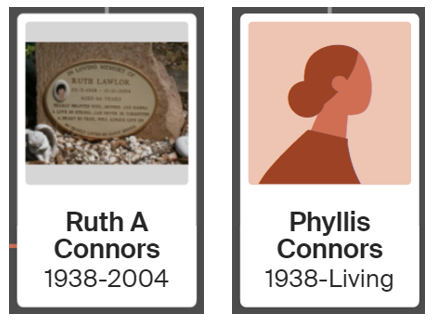
My 1st cousins, Ruth Adeline and Phyllis Connors, daughters of my father's brother Colin Connors and his wife Ruth May.

They are granddaughters of my grandparents, George Connors and Grace Brown (common ancestors).


1 Generation Back - 

My father, Bede William, and his brother, my Uncle Reginald Frederick (known as Reggie) Connors.

They were sons of George Connors and Grace Brown, my grandparents (common ancestors).


My 2nd cousins once removed, Joan Margaret and John William Connors - children of Edward Thomas Connors and his wife Lily Emily Insull.

They are great grandchildren of 2x great grandparents, William Connor (Connors) and Eleanor (Ellen) Hickey (common ancestors), through their son Michael.


2 Generations Back - 
My 1st cousins 2x removed, Harold John Charles and Eliza Violet Cusack, children of James Cusack and Mary Ann Catherine Davies.

They were grandchildren of my 2x great grandparents, Patrick Cusack and Eliza Exton (common ancestors), through their son James.


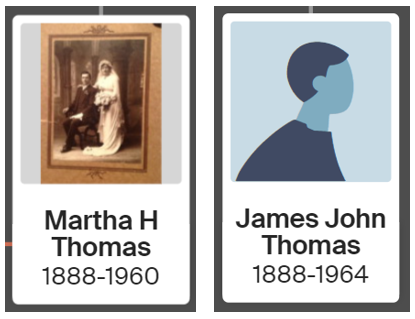
My 2nd cousins 2x removed, Martha Hannah and James John Thomas, children of Andrew Thomas and his wife Harriett Matilda Wright.

Great grandchildren of my 3x great grandparents, William Henry Browning and Anne Littlejohns (common ancestors), through their daughter Hannah Browning.


My 2nd cousins 2x removed, Hector Patrick and Harold Michael Cusack, children of James Cusack and his wife Hannah Sutton.

Great grandchildren of my 3x great grandparents, Michael Cusask and Mary Green (common ancestors), through their son John Cusack.


3 Generations Back - 

My 1st cousins 3x removed, Alice and Ellen Murphy, children of Patrick Murphy (aka Maguire) and Bridgit Hickey.

They were grandchildren of my 3x great grandparents, James Hickey and Margaret McNamara (common ancestors), through their daughter Bridgit Hickey.

I have not done much research about either Alice or Ellen as yet, hence the lack of a date for their death.


My 1st cousins 3x removed,  James, Jane Caroline, Francis, Joseph, Matthew, Thomas, Arthur George and Sarah Wright, children of James Wright and Hannah Browning.

Yes, you're seeing correctly ... 4 sets of twins born to the same parents!

They were grandchildren of my 3x great grandparents, William Henry Browning and Anne Littlejohns (common ancestors), through their daughter Hannah Browning.

It's quite confronting when you realise that two sets of these twins did not survive their birth.  How heartbreaking that would have been for their parents.


My 1st cousins 3x removed, George Henry and Peter Browning, children of John Thomas Browning and Margaret Redmond.

They were grandchildren of my 3x great grandparents, William Henry Browning and Anne Littlejohns (common ancestors), through their son John Thomas.


My 1st cousins 3x removed, Mary Ann and William Matthew Browning, children of James Francis Browning and Eliza Kennewell.

They were grandchildren of my 3x great grandparents, William Henry Browning and Anne Littlejohns (common ancestors), through their son James Francis.


My Great Grandaunts, Eleanor Sabina and Cassandra Elizabeth Hukins, children of Adolphus Hukins and Mary Ann Farley.

They were daughters of my 2x great grandparents, Adolphus Hukins and Mary Ann Farley (common ancestors).


My 1st cousins 3x removed John and Thomas Hickey, children of Patrick Hickey and Julia Hawley.

They were grandchildren of 3x great grandparents, James Hickey and Margaret McNamara (common ancestors), through their son Patrick.

Sadly, one of the twins died at birth and the other died before he reached his second birthday.


4 Generations Back

My 2x great granduncles, Thomas and John Hickey, children of James Hickey and Margaret McNamara.

They were the sons of 3x great grandparents, James Hickey and Margaret McNamara (common ancestors).

You might notice the match in names between these twin sons of my 3x great grandparents and their twin grandsons (listed above)!


Maternal

1 Generation Back -

My 2nd cousins once removed, David (Davey) and Robert Edward (Bobby) O'Donnell, children of John O'Donnell and Catherine O'Connor.

They were the great grandchildren of my 2x great grandparents, John O'Donnell and Catherine Joy (common ancestors), through their son Michael.


2 Generations Back - 


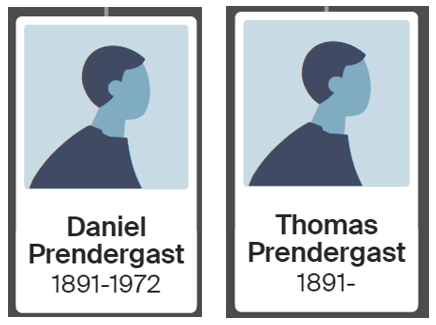
My 2nd cousins 2x removed, Daniel and Thomas Prendergast, children of Thomas Prendergast and Mary Shea.

They were the great grandchildren of my 3x great grandparents, Patrick O'Donnell and Margaret Rafter (common ancestors), through their daughter Brigid.


My 1st cousins 2x removed, Helen Ann and Margaret Lillian (Madge) Davies, children of David Davies and Helen Ann Farrell.  Helen Ann Davies was also known as Sister Mary Francis as she became a Sister of Mercy in her adult years.

They were grandchildren of my 2x great grandparents, Michael Farrell and Susan Downey (common ancestors), through their daughter Helen Ann.


My 1st cousins 2x removed, Myreen Catherine and Laurine Florence Farrell, children of Michael Farrell and Hannah Hynes.

They were the grandchildren of my 2x great grandparents Michael Farrell and Susan Downey (common ancestors), through their son Michael.


4 Generations Back

My 2nd Great Grand Aunt and Uncle, John and Mary O'Donnell, children of Patrick O'Donnell and Mary Rafter.

They were children of 3x great grandparents, Patrick O'Donnell and Margaret Rafter (common ancestors).


The twins I've known in my family - my father and my uncle, and my grandchildren - were/are not identical, and are therefore known as fraternal (dizygotic) twins.  

It's a known fact that fraternal twins are the most common type of twin and they run in families. I think I'm probably correct in assuming that the majority of the twins in my family tree are fraternal.  

Some interesting facts about fraternal twins to finish off this post:

- fraternal twins come from two different eggs

- they each have their own placenta

- they can be either the same gender or a combination genders

- the highest rate of fraternal twins occurs in Africa

- fraternal twins are the result of hyperovulation

- they share half of their genes just like their brothers and sisters.


Saturday, 8 April 2023

Spotlight On ... Solitude!

The definition of 'solitude', according to the Merriam-Webster dictionary, is:  the quality or state of being alone or apart from society.  'Solitude' is the prompt for this week's 52 Ancestors in 52 Weeks Challenge, and my immediate thoughts were about the solitude I've felt when being outdoors in nature ... at the beach, in the rainforest ... but none of that really related to the challenge.


Upon further reflection, I realised that I've experienced the feeling of solitude when standing at the last resting places of close family members ... my parents and grandparents in particular.  When standing there, I have definitely felt alone, but alone with my memories, and I'm always overwhelmed with a sense of thankfulness for all that they were and, of course, the fact that I would not be here if not for them!


This thinking has led me to put together a post about the last resting places of some of my direct ancestors.  I know exactly where my parents, all my grandparents and great grandparents have been laid to rest, and I've found it very interesting to note the simplicity of their headstones ... well at least the headstones that have been erected.  I've also found it rather heartbreaking to find out that some burial plots are not marked at all!


Going through the line of direct ancestors to my great grandparents, here's what I have found ....... 

My parents:  Bede William Connors and Margaret Brigid O'Donnell.


My mother passed away many years ago.  Then when Dad passed, we made the decision not to have a separate burial plot, but rather inter his ashes next to my mother and add a memorial plaque underneath Mum's headstone.


While my Mum was born near Gumlu in northern Queensland, and my Dad was born in Maleny in southern Queensland, they are both buried in Bowen, north Queensland.


My maternal grandparents

My maternal grandparents:  James O'Donnell and Sarah McCane. 

James, the son of Irish immigrants, was born in Toowoomba, southern Queensland.  Sarah, the daughter of immigrants from Ireland and England, was born in Charters Towers, north-western Queensland.  Both James and Sarah were buried in the Bowen Cemetery, the same resting place as my parents.


My paternal grandparents

My paternal grandparents:  George Thomas Connors and Grace Olive Brown

George, second generation Australian, was born in Meroo, New South Wales.  Grace, also second generation Australian, was born in Lismore, New South Wales.  They were both buried in Gympie, southern Queensland.


My maternal great grandparents

My maternal great grandparents:  Edmond O'Donnell and Bridget Burke.

Edmond was born in Ireland and after immigration to Australia, lived in Toowoomba, southern Queensland.  He was buried in the Toowoomba Cemetery, and up until this week I had no idea where his plot was.  


The #52 Ancestors prompt for this week sparked new interest in finding the plots of my maternal great grandparents Edmond and Bridget, and I went directly to the website of the cemetery.  I noticed there had been some updating since I last searched the site a few years back, and this resulted in my discovery of a photo of Edmond's plaque on a family graveyard memorial!!!


Strangely, his name on the cemetery online record was 'Edward' not Edmond, even though his correct first name was inscribed on the plaque.  This accounts for the great difficulty I previously had in locating a photo of his burial plot!   


Bridget was also born in Ireland and lived in Toowoomba after her immigration to Australia.  She was buried in the Toowoomba Cemetery as well, but under the name Bridget O'Brien (as she re-married after the death of my great grandfather Edmond).  Whilst I have been able to find her final resting place, as yet I have not been able to secure a photo of that plot.


My other maternal great grandparents:  Owen McCane (Muckian) and Margaret Farrell.

Owen was born in Ireland and after immigration to Australia, he first lived in Charters Towers, until his mid-50s.  He then moved, with his wife and family, to farmland near Gumlu in coastal north Queensland.  He was buried in the Home Hill Cemetery.


Margaret was born in England and immigrated to Australia (before Owen), where she first lived in Charters Towers.  Margaret met Owen in Charters Towers and they were married there.  She moved with her husband and family to farmland near Gumlu, and is buried beside her husband in the Home Hill Cemetery.


My paternal great grandparents

My paternal great grandparents:  Thomas Edgar Connors and Susannah Fullagar Hukins.

Thomas was born in Australia, near Kiama in New South Wales, the eldest son of Irish immigrants.  Susannah was also born near Kiama, in northern New South Wales.  She was the daughter of an Irish immigrant mother and an English immigrant father.  Thomas and Susannah were both buried in the Harley Hill Cemetery at Berry, in New South Wales, but sadly I have no photos of their plots, or even photos of them.


My other paternal great grandparents:  Richard Brown and Ellen Cusack.

Richard was born in Lismore, northern New South Wales.  He was the son of two English immigrants and he spent his life living and working in the Lismore area.   Richard was buried in the East Lismore Cemetery.  I do have a photo showing the plot where he was buried, but sadly there is no headstone or memorial to mark that spot.


Ellen was born at Rose Hill on the Richmond River, in northern New South Wales.  She was the daughter of an Irish immigrant father and an English immigrant mother.  


The only information I have about the burial of Ellen is that she was "privately interred" somewhere in the Rookwood Cemetery and Crematoria.


Now, when going further back to my 2x great grandparents, I hit some patchy information.  When it comes to the locations of resting places for my sixteen 2x great grandparents, I know the cemeteries where they are all buried, but I only know a few of the specific locations of their plots within those cemeteries.  


My maternal and paternal Great Great Grandparents

William was buried at the Tumut Pioneer Cemetery, in Tumut, New South Wales. Ellen was buried at the Roman Catholic Cemetery in Tumut. 


Adolphus is buried at St. Anne's Cemetery in Ryde, New South Wales (no photo) and Mary Ann is buried at the Roman Catholic Cemetery at Waverley.  (see photo 1 below)

Henry is buried at the North Lismore Cemetery in New South Wales.  

Caroline is buried at the Rookwood General Cemetery.

Patrick is buried at Rookwood Catholic Cemetery (no headstone - see photo 2). 

Eliza is buried in a plot with a headstone, at the East Lismore General Cemetery.


John and Catherine are both buried in the Owning Old Graveyard, in County Kilkenny, Ireland.  (see photo 3 below)


Unsure of where both James and Catherine are buried, but I know they are somewhere in County Kilkenny, Ireland.


Unsure of where both Patrick and Sarah are buried, but likely to be near Ballintemple, County Armagh, Ireland.


Both Michael and Susan are buried at the Charters Towers Cemetery, in Queensland.  (see photo 4 below).


Photo 1 - the gravesite of my 2x great grandmother Mary Ann Hukins nee Farley.

Waverley Cemetery, Sydney, New South Wales, Australia
Plot:  W-18-RC-OR-3452


Photo 2 - the unmarked gravesite of my 2x great grandfather Patrick Cusack.

Rookwood Catholic Cemetery, Rookwood, Sydney, New South Wales, Australia
Plot:  M1 sect 7 Plot 124

The oldest and largest working cemetery in Australia.


Photo 3 - my 2x great grandparents John O'Donnell (Daniel) and Catherine Joy

Owning Old Cemetery, Owning, County Kilkenny, Ireland


Photo 4 - my 2x great grandparents Michael Farrell and Susan Muldowney / Downey.

Charters Towers Cemetery, Queensland, Australia


I'm joining Amy Johnson Crow's 52 Ancestors in 52 Weeks 2023 Challenge  .


This time I'm catching up with the prompt for Week 15  - ''Solitude".

You can join by blogging or posting on social media with the tag #52Ancestors.

Check out Amy's FB pages:  Generations Cafe  or  Amy Johnson Crow

Friday, 22 April 2022

The Story of Ernest Thomas Stanley Cusack

Documents are the essential resource for anyone researching their family tree.  I spend a lot of time reading through records of all types, then follow this up with hours and hours spent analysing the information, coming to conclusions and entering accurate, worthwhile data on my family tree. Most of the time this process does not elicit an emotional response.  

There are some documents however that really do tug at the heartstrings.  They make you pause and consider the impact certain events have on people you may have never met but feel a very strong connection to, because they're family.  War Service Records belong in this category of documents.  

Every year, as we approach our national day of remembrance known as ANZAC Day (April 25th), I pull out one of these records, spend time reading through it all very thoroughly, then pause to reflect on the contribution made by that family member, and the impact their service must have had on their immediate family at the time.  This year I thought I'd share some of the details from one particular war service record, from World War 1.

What's in an Australian World War 1 service record?

- an attestation paper completed on enlistment.  It includes next-of-kin, employment, marital status, age, place of birth and a physical description

- a service and casualty form which shows movements and transfers between units, promotions and details of injuries and treatment

- military correspondence between the Department of defence and the soldier's next-of-kin notifying of wounds or death, awards and medals, and answering questions on the whereabouts of a service member.

There are no details about that service member's involvement in particular actions and battles, nor any account of their day-to-day life in the service.  Those aspects of their war-time service need to be discovered elsewhere.

This week's post uses one particular war service record to tell the story mostly of my paternal 1st cousin 2x removed, Ernest Thomas Stanley Cusack (1897 - 1919), but I do include a few little details about two of his brothers, who also answered the call to support the British Empire during the dark days of World War 1.

Our Common Ancestors are:  Patrick Cusack and Eliza Exton.


Ernest Thomas Stanley (known as Tom by his close family) was born in July of 1897, the son of James Cusack and Mary Ann Catherine Davies.  He was the 8th of 14 children born to James and Mary Ann.  There were 6 boys and 8 girls in the family.  Ernest was born in the Murwillumbah area of New South Wales, but by the time he was 18, the family were living in Byron Bay.

As Ernest was approaching the end of his teenage years, his world was drastically changed by the outbreak of a world war.  When the U.K. declared war on Germany on the 4th of August 1914, nations in the British Empire, including Australia, followed willingly.  Recruiting offices around Australia opened only 6 days after the war began. 

Around 55,000 young men joined the newly formed AIF (Australian Imperial Force) in the first 4 months of the war.  Nearly 100,000 enlisted between April and October the following year, 1915.


One of Ernest's older brothers, Harold John Charles Cusack was amongst those 100,000. 


He was the first of the Cusack brothers to answer the call.  He joined the armed forces - 15th Battalion, 12th Reinforcement -  in August of 1915, at the age of 20, and embarked for overseas in November, aboard HMAT A23 Suffolk.  


Tel elKabir, Egypt
The Australian Army training camp c. 1916
Photo courtesy of the Australian War Memorial


Harold made it to training camp with the 15th Battalion in Tel elKebir, in Egypt, and was then posted to Zeitoun. 


Unfortunately, or luckily (depends on your point of view), he was admitted to hospital in March of 1916 with acute appendicitis.  


Harold did not proceed with the Mediterranean Expeditionary Force, and did not end up seeing action during the war. 

He returned to Australia in May of 1916 and was discharged, medically unfit, upon arrival back home.


I'm assuming Harold met up with his younger brother Ernest upon his return to Australia, and no doubt had many long conversations about what it was like sailing overseas and landing in Egypt.  Maybe these stories helped convince Ernest that he also needed to serve.

Not long after, on the 15th of June 1916, Ernest himself enlisted with the 5th Machine Gun Battalion.  

First of all, he submitted his application to enlist: 

Application to Enlist

This provides some basic information - Ernest was literate, as he was able to provide a complete signature.  His occupation was that of labourer.  His father, James Cusack, had passed away and his mother, Mary Ann, was the one who gave consent for Ernest to enlist and added her signature to the document.  Ernest was aged 18 years and 11 months.  

On the same day, in the town of Lismore in New South Wales, his attestation papers were completed and signed by Ernest.

Front page of the Attestation Paper

So it was, that on June 15 1916, Ernest signed his life away.

For some unknown reason, of the three Cusack brothers who enlisted in WW1, there are enlistment photos for both of Ernest's older brothers, but none of Ernest.  His attestation papers do however provide a little detail about his physical appearance.


This is why I spend time pouring over documents.  Given this information, I found I was able to visualise Ernest without a photo.  He was quite a tall sturdy young man, 5 ft 8", with brown hair and grey eyes, weighing 9 1/2 stone. 


Another of Ernest's older brothers enlisted just two months later.


James Herbert Cusack enlisted in August of 1916 and his unit embarked from Brisbane on the 27th of October 1916.


James remained overseas, fighting on the Western Front, throughout 1917, 1918 and half of 1919.  He returned to Australia in August of 1919.


He had married in London, in May of 1919, so returned home with a bride.


Sadly, his younger brother Ernest never returned home.  Let's return to Ernest's story:

Just three days before Christmas of 1916, Ernest embarked from Australia on the ship "Persic" and sailed off to join the war effort.  His point of disembarkation was Devonport in England in March of 1917. 

Belton Park Camp, near Grantham during WW1

He was "marched in" to the Machine Gun Corp training camp at Belton Park Camp near Grantham, but it appears he fell ill within a week and was in hospital for 11 days.  


After that he returned to training.  Each man in the Machine Gun Corp (MGC) spend a minimum of five weeks in training before being posted to one of the frontlines.  They were taught the mathematics of the machine gun, firing, map reading and the use of semaphore flags.


It wasn't until June of 1917 that Ernest saw action in France.  All of these details are clearly recorded on the first page of Ernest's Statement of Service Form:

Statement of Service Form


Page 1 of this service form also shows that he was transferred to the 15th Machine Gun Company in late June of 1917.  Shortly after, Ernest was wounded in action, with a "shell wound to the chin", in September of 1917.  Sounds like he was hit by debris from an exploding shell.  

The military correspondence section of Ernest's war service record shows that his mother received this telegram in October of 1917:


Such a brief, stark statement!  Imagine receiving such a telegram!  It would be frightening and I can only imagine the anxiety it must have caused.  Of course, unknown to Ernest's mother, he was already in recovery.  Ernest re-joined his unit just a couple of weeks later.

Ernest's Casualty Form Active Service  (two pages) provides some detail about his whereabouts during his service  

He was at Camiers Camp in France, which was the base depot of the Maching Gun Corps (known today as Etaples Camp).  

He was also at Le Treport, which was an important hospital centre on the coast of northern France, about 50 miles south of Camiers.

As mentioned previously though, there is no mention of particular battles that he was involved in.


You can see on page 2 of this Casualty From that in March of 1918, he was granted leave in the U.K. for two weeks, and then was granted more leave in February of 1919.  

Leave was granted to the majority of men and women who served in the First World War. When the war first begin, there was an expectation that it would be a short war.  Of course, that proved to be far from the reality, so as the conflict dragged on, morale flagged and it became alarmingly clear that the hardship and horror of the front line fighting was taking a toll on soldier's physical and mental health.

Leave provided some respite from the dangers of war, and was deemed necessary in order to reduce the sense of separation which many of the Australian troops would have experienced, being so far from home.  The intervals of leave were not long, but provided much needed moments of rest and recreation.  

Unfortunately, whilst on this second round of leave, the benefits of this time off from war were very short-lived for Ernest.  He contracted influenza and was admitted to Endell Street Military Hospital in London on the 21st of February 1919.  

Endell Street Military Hospital
London


On February 24th there was an entry that read "dang. ill", which obviously meant "dangerously ill"; but that abbreviated word "dang." was crossed out at some point and "ser." was written underneath.  That meant "seriously".  So within 3 days, Ernest's health had deteriorated badly.


He hung on for nine days, but early on the tenth day, on the 3rd of March 1919, the Military Hospital at Endell Street sent a telegram to the Australian Army Headquarters in London, informing the office of the death of Private Cusack.  He was 21 years old.


This is a section from the Report of Death Form completed at Endell Street Military Hospital:


The form lists 'influenza' as the disease Ernest was afflicted with, but there is the word 'pneumonia' scribbled in pencil underneath as well.  It sounds like Ernest was indeed gravely ill.  The form states that he passed away at 6.50 am on March the 3rd.

Ernest's mother, Mary Ann, received this telegram on March 6th indicating that her son, who had been away from home for over two years, was "seriously ill". 


This news would have been devastating for everyone in the family, given they had not seen Ernest for such a long time.  Of course, Ernest had already died by the time this telegram had been sent, so worse was to come for his mother and siblings.

A newspaper article printed in the Tweed Daily newspaper indicates that the news of Ernest's death did not reach home until March the 8th (although there is an error regarding his name).  The article goes on to say that it was the Byron Bay Shire Clerk who received this news first.  He apparently then passed this on to a Reverend M. Gerry, who went to visit Mary Ann to give her the news.

Newspaper item in the Tweed Daily, Tues Mar 11 1919, p2                                               

Amongst the war service records of my relatives who fought and died in the first World War, disease was not listed as a common cause of death.  Of course, war creates perfect conditions for diseases to flourish and before the beginning of the 20th century, disease had indeed claimed many more military lives that combat itself.

Australians volunteering for the first world war were subjected to quite strict medical tests before enlistment and many were rejected.  Australians were also given a range of inoculations when they joined up, including jabs to fight smallpox and typhoid.


Unfortunately, despite all these precautions, many thousands of Australian troops succumbed to disease during the war.  The most common cause was respiratory tract infections, including influenza and pneumonia.  Combined, they claimed around 3,300 Australian lives during the war, and Ernest was one of them.

In Ernest's war service record there is a Burial Report, dated 12th March 1919, that provides some information about his funeral. 


Ernest was buried in the Australian Military Burial Ground at Brookwood, in Surrey, England - Plot IV, Row J, Grave No. 7 - and he was "accorded a full military funeral".


The report lists a Private Atherton, from the 4th Machine Gun Battalion, as either a relative or a friend, along with a Miss and a Mrs. Atherton, who all attended the funeral.  I found that particularly interesting as it seems to indicate that Ernest had family or perhaps a close friend over in England and probably spent his leave with them.  I suppose they visited him in hospital as well.  I do hope so.  It would be so comforting to think Ernest was not on his own when he was so gravely ill.

The information from the burial report then became the content of a letter that was sent to Ernest's mother on May 29th, 1919.


I do wonder if Mary Ann ever received a photo of Ernest's headstone.


In August of 1919 yet another telegram was sent to Ernest's mother, Mary Ann, informing her that she would be receiving a parcel of her son's personal effects. 


This is the list of what would have arrived in that parcel.


The following In Memoriam item appeared in the newspaper, The Byron Bay Record, on the 22nd of March 1919.


A Roll of Honour item appeared in the newspaper, The Northern Star, on the 21st of March 1919.


A Roll of Honour item appeared again in the newspaper, The Northern Star, on March the 3rd 1922.


Each evening between sunset and sunrise, names from the Australian War Memorial's Roll of Honour are projected onto the facade of the Hall of Memory (the dome) at our Australian War Memorial in Canberra.  


This Roll of Honour lists the 102,000 men and women from Australia's defence forces who have died in the service of our nation and Ernest's name will appear on these dates:


One of these days I would love to be there to see the name of a relative highlighted and acknowledged in this way!


Special Note to any family members:  If you have memories to add, photos or information to share, can I graciously ask that you do so.  Please use the comments box below or email me.  It may prove to be invaluable to the story and provide future generations with something to truly treasure.