Showing posts with label Bourke. Show all posts

Saturday, 24 December 2022

The Story of William and Johanna Burke (Bourke)

My post this week will be telling the story of my maternal great granduncle William Burke (Bourke)  (1841 - 1891), and his wife Johanna McNamara (c1830 - 1906).  Theirs is a story of perseverance in the face of seemingly never-ending sorrow and adversity, and my research attempts to uncover the details of their lives has also been an exercise in perseverance.  

My Common Ancestors with William are:  James Burke and Catherine Crotty.

Memorial at the Drayton & Toowoomba Cemetery, Toowoomba, Queensland

I've been attempting to uncover their stories for about seven years now, ever since a distant relative, my maternal 3rd cousin, sent me a photo of this monument erected to their memory.  


My distant cousin and I knew we were related to the William Burke etched on the monument, but didn't know many of the details of his life, and we certainly knew nothing of his wife Johanna.  The only thing we knew for certain was that they had been born in Ireland and had lived all their married life in Toowoomba, Queensland, Australia.

So began my research efforts, and over time, a picture of these lives has started to emerge.


I started with the etching on the monument, which stated:

In Loving Memory of

our Dear Father

and Mother

WILLIAM BURKE

died 21st March 1891

aged 51 years

JOHANNA BURKE

died 10th July 1906

aged 76 years

R.I.P.


With that inscription I had some information to work with, dependent of course on the accuracy of the dates and years that had been provided by a family member  (later on I was to find out that it was their only surviving son who had paid to have the monument erected).

So, possibly William had been born in either 1840 or 1841; and Johanna had probably been born in 1830 or 1831.   Hmmm, a ten-year difference between their ages?  Certainly not unheard of, especially if it was the man who was older.  In this case however, it was Johanna who appeared to be older.  Food for thought!

I then went to our Queensland Registry of Births, Deaths and Marriages and searched for a marriage record for William and Johanna, hoping that they had been married in Australia after immigration from Ireland.  The family history research collection has records of marriages between 1829 and 1947, and I instantly found and purchased a record that matched both names.


I now knew for certain that their stories had begun in Ireland, as their place of birth was listed as County Tipperary.  


The marriage record also listed the names of both sets of parents, and this confirmed my connection with William, as his parents were indeed my great great grandparents - James Burke and Catherine Crotty. 

William was an older brother of my great grandmother Bridget Burke, who had also emigrated from Ireland and with her husband Edmond O'Donnell had started my particular Aussie branch of the O'Donnell / Burke family.

Transcript of the original Catholic Parish Register of Births.


I went on to find the baptism record for William, on the Roots Ireland website, using the parents' names listed on his marriage certificate, and the date of birth I had surmised from the marriage certificate.  I was able to then say with certainty that William was in fact born in 1841 in the area known as Three Bridges in County Waterford.  He was the second-born son of his father, James Burke and his mother Catherine Crotty (my great grandparents).  

The entry in the original Catholic Parish Register from the Waterford & Lismore Parish.


The name on his baptism record was Gulielmus Burke and he was baptised in Carrick-on-Suir, County Tipperary on the 22nd of March, 1841.


My next step was to scour a number of genealogy websites to find a record of baptism for Johanna, using her parents' names as listed on her marriage certificate - John McNamara and Catherine Sheehey.  

There was a problem straight away however, as I was uncertain about a possible date of birth.  The age listed on her marriage certificate led to a completely different possible date of birth than the calculation made after seeing the inscription of the cemetery monument.


If she was indeed 22 when she married in 1866, then her date of birth would have been 1843 / 1844, but the inscription on the cemetery monument stated that Johanna was aged 76 in 1906, which meant a date of birth in either 1830 or 1831.  Quite confusing, and quite a difference!

I went and purchased death certificates for both William and Johanna (again from our Queensland Registry of Births, Deaths and Marriages, which holds death records for the period 1829 and 1992), to confirm the names of both sets of parents, and possible confirmation of dates of birth. 

Both Johanna's marriage and death certificates confirmed that her parents' names were John McNamara and Catherine Sheehey / Shehey, but the death certificate had her age recorded as 74 at her time of death.  That meant a possible birth date of 1832!  I was starting to think that Johanna was a whole lot older that the age recorded on her marriage certificate, and was becoming more confident in relying on the information gleaned from the monument inscription and her death certificate.  

So far though, I have not been successful in uncovering any birth or baptism record for Johanna with those parents' names, or indeed any variants of the parents' and her name, and no success searching within that broad set of possible dates of birth - 1830 to 1844!  


Where to next?  I went in search of records that would indicate when both William and Johanna had arrived in Australia.  Given that they had married in Australia in 1866, then it was absolutely clear that they had emigrated before that.  Our Queensland State Govt. Archives holds immigration records kept by the Immigration Department for the years 1848 to 1912, and this was the place to start.

I begin searching for William's emigration record first, because there were likely to be less variants for his name - the surname could have been recorded as either Burke or Bourke - and I had a definitive date of birth.  I thought this search would be of short duration, and I could not have been more wrong!

Finding a record of William's emigration to Australia proved to be quite laborious and time-consuming.  It has literally taken years!  There have been many, many dead ends, as there were an inordinately large number of men named William Burke or Bourke, who were born around the same time and had emigrated during the period I was interested in - those years between my great grand uncle's birth and the year he married in Australia, 1841 to 1866. 

Each of the records that seemed more promising - ie. they had what I considered to be a more accurate age or place of origin - was not really helpful at all in the end, as they did not contain anything other than a name, nationality, port of departure and port or arrival.  None of that actually provided definitive proof it was my great grand uncle.

Finding a record of Johanna's emigration was even more difficult. There are quite a number of name variants that could have been recorded for her - Johanna, Johannah, Joanna, as well as McNamara, Macnamara, etc.  I once again used many genealogy sites to search for a Johanna McNamara, and all the variants of that name, who may have emigrated during the same time period I had been researching for my great grand uncle - 1841 to 1866.   

There was literally only one Johanna McNamara listed on the emigration records during all that time.  She was born in 1832, had emigrated to Australia in 1849 on her own, at the age of 17.  The problem with this possibility was that this Johanna would have led a single life in Australia for at least 17 years before getting married to my great grand uncle with her maiden name of McNamara.  That seemed extremely unlikely for those times.  The Johanna that had emigrated in 1849 had also came from County Limerick, not County Tipperary, so in the end, I dismissed this particular person as a match for my great grand aunt.

I essentially then gave up using their names to search these immigration records and took a break for a couple of years.  Recently however, a rather serendipitous event occurred.


I often randomly choose lists from the Queensland Registers of Immigrant Ships' Arrivals when I'm researching, without entering any particular names, and read through them just on the off chance I might recognise a name or two. 


Interestingly, I found a William Bourke and a J. McNamara travelling on the same ship and arriving in Australia in 1865.  The page was only part of the original record and there wasn't a great deal of detail on it, but my hopes rose!


You can see that the original book was intended to record the re-location of Pacific Islander labourers, but this title has been crossed out and the word "Melmerby" added.  These couple of pages then became the record of passengers who were aboard the ship Melmerby which left the port of Liverpool, in May of 1865, and arrived in Brisbane in September of 1865.

There were 14 first cabin (saloon) passengers, 8 second cabin passengers and 501 passengers in steerage.  The William Bourke and J. McNamara I found were both in steerage.  That was a good place to start a possible match.  Both William's and Johanna's parents were poor tenant farmers in Ireland, so they would definitely not be travelling in first or second cabin class on any ship.


The name, age and year of emigration appeared to match with William extremely well.  Although the surname was spelt 'Bourke', this was how it was sometimes spelt in Ireland.  The age certainly matches as William would have been 23 years old when the ship set sail in May.

Regarding Johanna, the 'J' in J. McNamara doesn't prove that it was actually Johanna, but I do think that if we accept that she was more likely born in either 1830/1831 or 1832 (as indicated on the cemetery monument / death certificate), then Johanna would have been close to 30 years of age, making it a possibility that this was indeed Johanna travelling with William the year before they got married in Australia.

If I accept that this was indeed my great grand uncle and his wife-to-be, that means they left Ireland and travelled aboard the ship Melmerby, bound for Australia the year before they were to be married, arriving in Brisbane, on September the 9th, 1865.  Of course, I can not say this is definitive evidence, but it has the right vibe!!!  Genealogy research can be a lot of guesswork at times.

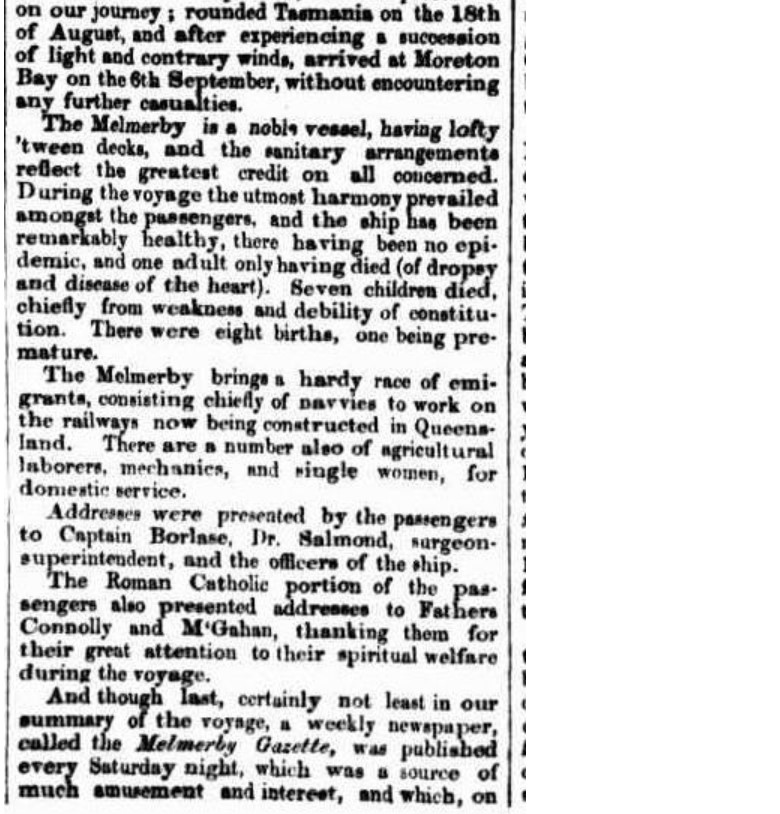
If I am correct, then William and Johanna had a rather eventful journey aboard the Melmerby.  Newspaper reports published in September of 1865 give a detailed account of the trip:


Apparently, the first half of the four-month voyage was relatively uneventful, consisting of light winds and beautiful weather.  The ship crossed the equator in June, passed the Cape of Good Hope in July and all appeared to be well.

Then on the morning of July 27 

"suddenly and without any warning the mainmasthead broke, bringing with it the mainyard, main-topmast, topgallant and royal masts, also the mizen top-mast, topgallant mast, and all the gear attached; also the foretopgallant mast, foretopsail yard, and all the gear belonging thereto, leaving the ship for the time being quite a wreck.

The captain, officers and crew displayed the utmost coolness at the time of the disaster, and proceeded with

great despatch to cut away the wreck of masts, sails, yards, etc. hanging over the side of the ship, which happily was effected before dark, without any accidents, and so saving the mainmast, which was tottering with the weight of wreck attached to it at every roll of the ship, and the vessel made as snug as the circumstances would allow of.

It seems difficult to account for the accident, as the wind was steady and not a gale, but the prevailing opinion is, that a whirlwind must have passed over the ship."


Imagine how the passengers would have reacted to all this happening, and the relief they would have felt once the crew had worked their magic!

That was not the end of their troubles however.
Just a few days later, on the morning of August 1st:

"about 8 a.m., during a violent gale, a heavy sea struck the vessel, and having fallen on the main hatch house completely smashed it in.  It was temporarily covered up and secured."

This was followed by another worrying event the very next day:

"Again, on the morning of Wednesday the 2nd, about 2 o'clock, a violent hurricane struck the vessel, lifting one of the quarter boats clean out of the davits, carrying it overboard.  The other one, with the heavy rolling of the ship, broke the poop rail, and split the covering board of the poop about eight feet, and to prevent further damage, the captain ordered it to be cut away."


According to the report, 

"the conduct of the passengers was very exemplary, they remaining calm, and not giving way to excitement, and providentially there was no accident to life or limb."


Interestingly, the report goes on to state that:

"The Melmerby brings a hardy race of emigrants, consisting chiefly of navvies to work on the railways now being constructed in Queensland."


This statement added weight to my supposition that my William and Johanna were indeed on this ship.  Even though William's occupation was listed as "saddler" on his marriage certificate, his death certificate listed his occupation as "railway employee".   I took this as an indication that I might be on the right track with my thoughts that there was a match between the two listed as passengers on the Melmerby and my great grand uncle and aunt.  


Now we get to the point where I can make an absolutely factual statement - William Burke married Johanna McNamara in Toowoomba, Queensland on the 26th of September, 1866.  Their life together had begun, but it was not going to be an easy one.


Making use once more of the Queensland Registry of Births, Deaths and Marriages, which holds birth records for the period 1829 to 1922, I found evidence of nine children born to William and Johanna, between 1866 and 1878.


In January of 1867 Johanna gave birth to a boy named James.  

Traditionally, the Irish named their first born son after the father's father, and this seemed to be the case with William and Johanna.

Their first born was named James, the name of William's father.

Sadly, the little baby was stillborn.


Johanna was pregnant again within four months and a second son, named John, was born on the 29th of February, 1868.  

Once again, the second born son was named according to the traditional Irish naming pattern - named after the mother's father.  Johanna's father was named John.

Both Johanna and William would have been overjoyed to see their little one survive the birth and start to thrive.  Tragically however, their second born son died on the 20th of January the following year, 1869, aged only 1 year.  


The cause of death listed on his death certificate was "dentition".  This means the little boy died as a result of teething!   Teething!  I know the infant mortality rates were quite high in the late 1860s, but I was completely unaware that an infant could die as a result of a seemingly ordinary part of their growth.  How does something so innocuous result in death?

I remember my two sons' experiences with teething.  There were periodic episodes of crying and irritability, drooling, high temperatures and sleepless nights, for both boys and parents!!  Bonjela and teething rings were essential, (the occasional sip of good quality whisky, for the parents!) as well as long car rides in the middle of the night.  At no time however, did teething present as life-threatening in those days.  


A third son was born on the 12th of January, 1869.  His name was David. 

Whilst traditionally, the third born son was usually named after the father, in this case William and Johanna appeared to have named this son after William's older brother. 

Sadly, baby David passed away on January 30th, aged 18 days. The cause of death on his death certificate was "Marasmus".  This was a form of severe malnutrition.  


Let's just stop for a moment and think about what's happened to Johanna and William within a period of just two years: 

- their first son James was stillborn

- Johanna fell pregnant four months later

- Johanna gave birth to their second son

- She became pregnant the following month

- Johanna gave birth to their third son 

- Johanna and William then lost their second born son, eight days after the birth of their third

- Then tragically, their third son David died just ten days later, aged 18 days

So by the end of January 1869, they had lost three sons.   What misery they endured at the start of their marriage, and sadly their grief would continue. 


Johanna gave birth to their fourth son Robert on the 4th of November 1870.  

Heartbreakingly, he died on December 23rd, before he reached the age of 2 months.  

The cause of his death was listed as "debility from birth".  This generally means he was born as a physically weak baby.

Can you imagine the depths of despair both Johanna and William must have reached with the passing of each child!  Miraculously Johanna was pregnant again within a month.


A daughter was born in October of 1871.  She was named Catherine.  

According to traditional Irish naming patterns, the first born daughter was usually named after the mother's mother.  This was the case with William and Johanna's first born girl, as Catherine was Johanna's mother's name.  Coincidentally, it was also the name of William's mother.

Perhaps this was an omen as daughter Catherine was the first of Johanna's and William's children to survive, thrive and outlive both her parents.


Five months after Catherine's birth, Johanna was pregnant once more.  

Another daughter, named Ellen, was born on December 15th in 1872.  Tragedy struck again, as Ellen died in the 29th of January 1873, aged only 14 days.  

The cause of death was listed as "Aptha / Diarrhoea". 


A son named William Patrick was born on the 21st of March 1874. He seems to have been given his father's name


William was the second child to survive infancy and went on to survive both his parents.


Johanna was pregnant once again a year later, and gave birth to a daughter named Mary Ann on the 1st of December 1875.  

Tragically, Mary Ann died at the age of 5 weeks.  The cause of death was listed as "Debility from birth".


I found one more record of a child born to William and Johanna in September of 1877, but once again the poor little one was stillborn. 


So, after giving birth to nine children within a period of ten years, Johanna would only see two of them make it through their childhood years.  This tells me that William and Johanna were likely living in poverty and deprivation, and nutrition was severely lacking.  I'm making assumptions, but it sounds as if poor Johanna was herself not strong and healthy, and was poorly nourished.


The impression I get is that William and Johanna lived a harsh life for a lengthy period at the start of their marriage, but perhaps things turned around for them by the time their two surviving children reached their teenage years.

Information gleaned from William's death certificate and Johanna's death notice indicates that William spent his working life as a Queensland Railways employee and worked in the railway goods shed at the Toowoomba Railyard.  He, Johanna and their children lived in a house near the railway yard gates.  It would have been a modest home as working for the railways would have only provided a modest living.

William and Johanna were married for 24 years, but then William passed away in 1891 at the age of 50 (according to the information on his death certificate).


The cause of death listed on William's death certificate was heart disease and dropsy.  The length of time in the Australian colonies was listed as 25 years.  Given that William had died in early 1891, this makes 1865 as William's arrival date in Australia, giving more credence to my supposition that he was aboard the ship Melmerby!

With William's death, Johanna was widowed at the age of 59, with two children.  Catherine was 19 years old and William Patrick was 17.  I have not been able to find out much about their lives at this point.  

I found Johanna in both the 1903 and 1905 census records for Toowoomba, in her 70s, living at North Street.  There's also a Catherine and William Patrick living at North Street, her daughter and son.  Neither had married and they were living with their mother in the family home. 


In 1903, Johanna would have been aged 72.


In 1905, Johanna was aged 74 and living with her children, who no doubt looked after her with care in her elderly years.


In 1906, Johanna passed away.  Her death certificate states she was 74 years old and the cause of death was mitral valvulas disease of the heart and chronic nephritis.  Secondary causes listed included bronchitis and exhaustion.  It does sound as though poor Johanna was very ill towards the end of her life.


Using the National Library of Australia's online resource Trove Newspapers, I was able to find a death notice for Johanna.  


Her married name was recorded as Bourke, not Burke as recorded on her death certificate; but as I've previously mentioned the spelling was interchangeable on different records. 


The newspaper item does mention that she had been born in County Tipperary and had arrived in Toowoomba in 1865.


This once again lends credence to the possibility that she did come to Australia aboard the ship Melmerby.


Both of William's and Johanna's surviving children lived well into old age.  William Patrick died in 1953, aged 78.  Catherine died in 1959 at the age of 87.  I have not been able to find any record of William Patrick marrying and his death notice (which I found by using the National Library of Australia Trove Newspaper collection) did not mention any spouse or children.  


Information in William Patrick's death notice did indicate that he was living in Southport, Queensland, but died in Brisbane, and it mentions he died at Brisbane Hospital.  I wonder if he had been suffering an illness at this time?  I noticed that he was buried at the Toowong Cemetery in Brisbane, and not with his parents. 

I also noticed that further down the column in this newspaper, there was a 'Return Thanks' item, which appears to have been written by Catherine.  Her address is listed as High Street, Southport, so I'm assuming she was living in the her brother's house by the 1950s.

Using the Trove Newspapers online resource again, I then also found a notice for creditors who may have had a claim to make against the estate of William Patrick:
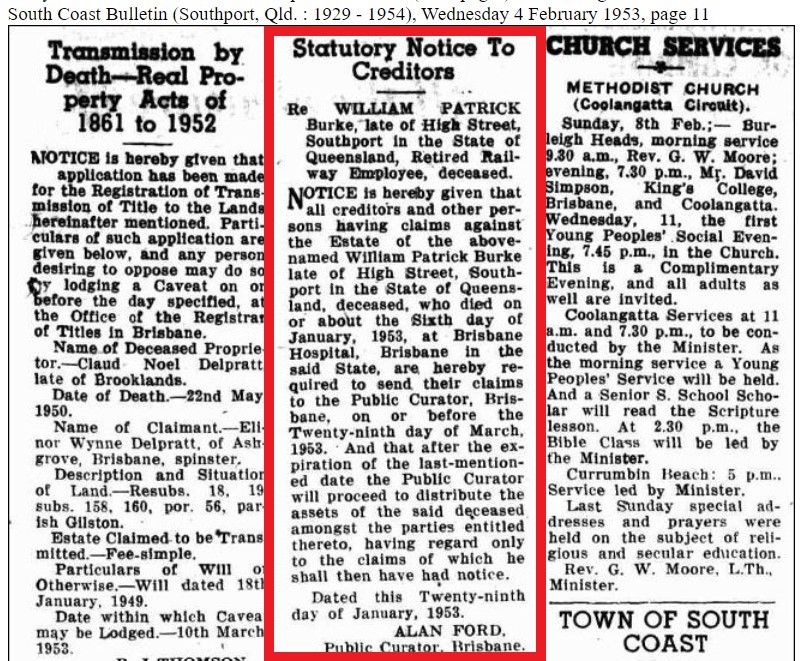

Catherine, as stated in her mother's death notice, had been unmarried at that time and it appears this was the case for the remainder of her life.  I found a notice of a Transmission of Title dated November 1953 (using the Trove Newspapers collection once again), which stated that Catherine Burke had claimed the title of the Southport property owned by her brother.  


This newspaper item stated that Catherine was a spinster in 1953 at the age of 81, so that provided additional confirmation that she had not married.

What seems so very tragic to me is that whilst the two surviving children of William and Johanna both lived long lives, it appears this particular family branch ended with them.  There were no grandchildren to continue the family name, and that seems such a desolate ending for a couple who appeared to be trying hard to have a large family.  


Catherine, the only daughter of William and Johanna, was buried at the Southport Cemetery, so as it happens, the two surviving children of William and Johanna were buried in separate places to their parents, and to each other.


The final tragic note to this story is that poor Catherine, the last of this family to pass away, was buried in an unmarked grave, as it appears there was no family member to arrange a headstone for her burial plot.  


Thursday, 1 March 2018

The Story of Bridget Burke

The story of my maternal Great Grandmother, Bridget Burke (1851-1937), is one of extraordinary forbearance and great strength of character in the face of hardship and tribulation.

Thought to be a photo of young Bridget by family members.
(Photo shared by my uncle Terry O'Donnell)


In the year of Bridget's birth, 1851, Queen Victoria opened the Great Exhibition at Crystal Palace in London; the first publication of the New York Times went on sale for 2 cents a copy; Herman Melville's novel Moby Dick was first published in the U.S.; and gold fields were first discovered in Australia.


In the Church baptism register, Bridget's name was recorded in Latin as 'Brigidam'. Her mother's name is recorded as 'Catherina' and her father's name recorded as 'Jacobi'.


Bridget's birthplace was recorded as Three Bridges in the Parish of Carrick-On-Suir in County Waterford.  I think it's correct to say that Three Bridges was (is?) situated on the outskirts of Carrick, between Carrick and Piltown, but in County Kilkenny. 

When Bridget was born, her father James Burke was 40, and her mother, Catherine Crotty, was 37. There had already been five siblings, all boys, born before Bridget.  She came into the world destined to be the only daughter of James and Catherine.  Her younger brother came along a few years later.

David was born in 1835.
William was born in 1841.
Tobias in 1843.
Maurice in 1846.
John in 1848.
Then James was born in 1854, when Bridget was 3 years old.

All of the children born before James, the youngest, were born at a place named 'Three Bridges'  (outside Carrick-on-Suir), but then James was born in Killonerry.  That means the family must have moved sometime between 1852 and 1854, just after the period known as The Great Famine, to the farm in Killonerry where descendants still live today.

As the only girl in a family of six boys, I imagine she would have grown up quite the tom-boy, knocking about with her brothers.  No doubt, she would have spent a lot of her time helping her mother with the household chores, as well as pulling her weight with the everyday chores around the farm. 


In all likelihood there would have been mixed farming practised on the farm, including keeping livestock such as cows, and growing crops like root vegetables and grains.


Life on the farm would not have been easy.


Later on, I mention that Bridget was employed at a dairy in Australia, so I imagine she grew up learning how to milk cows and make butter.


Sadly, Bridget's mother passed away in early 1873, when Bridget was aged 22.  Bridget would have then had to shoulder the burden of running the home and taking care of her father who would have been in his 60s.

It seems likely that Bridget's eldest brother David had emigrated from Ireland before this, as family history shows that he did not stay on the farm.  It passed on to a younger brother.  Bridget's second eldest brother, William, had emigrated from Ireland to Australia around 1866, long before the death of their mother.  Bridget would have been 15 when William left the farm and emigrated.  The third eldest brother, Tobias, is also likely to have emigrated at some point, as I have not been able to find out much of his life story after his birth!  His name has not turned up in any census records for the parish.

At the time of her mother's death, Bridget would have been living on the family farm with her father James, and brothers Maurice, John and James Jnr.

Five years later, towards the end of 1878, her father James died.  By that time, Bridget's brother Maurice had fathered a son with a woman named Mary MacNamara, had then married Anne Prendergast in 1876, and had fathered two more children with Anne.

Were they all living on the farm together?  I'm assuming so, because Maurice stayed on the farm for the rest of his life, and went on to have seven more children with Anne. The farm is still owned by his descendants to this day.

Youngest brother James had by now immigrated to the U.S., probably sometime around 1878; and Bridget's other brother John seems to have left the farm not long after that and had settled in Piltown, not far away.

Life might have been a little bleak for Bridget at this time.  She was still living on the farm, which had now become the family home of her brother, his wife and children. There was at least some prospect for a change in her circumstances though.

It appears she had a sweetheart, Edmond, who lived on a neighbouring farm.  Edmond was in a similar position. Many of his brothers and sisters had and were about to emigrate, as their family farm could not provide a living for them all either.  Neither Bridget nor Edmond saw a bright future ahead of them if they stayed in Ireland.

So it was that at the end of 1882 Bridget and Edmond were in Plymouth England, boarding a ship bound for Australia. They had made a life-changing decision to leave their homeland and travel to an unfamiliar land.


Bridget, now aged 31, travelled aboard the ship 'Almora' on a three-month trip to a promising, new future.  Her surname was recorded as 'Bourke'.  Her age was not exactly correct on the register, but it wasn't far wrong.

An interesting aside ... Bridget appears to have had a remittance paid for her journey. She had a brother, William, who had immigrated to Australia many years before this, and perhaps he had paid for her trip out as many relatives in Australia were encouraged to do.

The trip out to Australia aboard 'Almora' appears to have been a fairly good one, according to the entries in a shipboard diary kept by an unknown passenger.


"In the Bay of Biscay encountered rather rough weather for two days, but otherwise the run to Malta was fair. Malta was left at 1.30 p.m. on the 2nd December, and had favourable weather to Port Said. Port Said was left on the 6th, at 10.00 a.m.; had an easy passage through the Canal. 

In the Red Sea weather very warm till Aden was reached. At Aden detained four days for the mails; left Aden on the 16th, at 8 a.m.; encountered adverse trade winds in the Indian Ocean; otherwise had a fine run to Batavia. Left Batavia 2nd January, at 7.30 a.m., and proceeded to Thursday Island."  (author unknown)


The 'Almora' then stopped at Cooktown, Townsville, Bowen, Mackay and Rockhampton on the way to its final destination, Brisbane.

Bridget would have spent the entire journey up on the deck.  


Edmond and Bridget disembarked in Brisbane on the 20th of February, 1883.  They made their way another 130 kilometres inland to Toowoomba.  That's where Bridget's brother William, his wife Johanna, and their two surviving children were living.


It seems that Bridget and Edmond lived apart for a few months upon their arrival in Toowoomba.  On the marriage certificate Edmond's place of living was recorded as 'Irish Town', which was a little township a little way away from Toowoomba itself.  

(Photo shared by my uncle Terry O'Donnell)


Bridget however, appears to have moved in with her brother in Toowoomba itself, and had found employment at a dairy.  


Bridget married Edmond O'Donnell in Toowoomba on the 22nd of July, 1883.  She was now 32 years old  (the age recorded on the marriage certificate was out by a number of years!)  She went to live with her husband in Irish Town, as indicated on the birth certificate of their first child, daughter Catherine.   

Bridget was aged 33 when she gave birth to Catherine (known as Kate) in 1884, and her husband Edmond was only 21.


Irish Town was an area of small farms, just outside Toowoomba to the north, where it's likely Edmond had work as a labourer on one of the farms. 


Bridget was aged 35 when she gave birth to John in 1886.  Life was looking a little bleak.  Bridget and family had moved into Toowoomba because Edmond had now found a steady job, but they were all living within the Showgrounds.  I don't imagine living at the Showgrounds would have been a dream come true.  I think it's likely they had moved into some sort of temporary shelter and were living hand to mouth because Edmond's job was certainly not a well-paid position.


My Grandfather James was born the following year, in 1887, and his birthplace was also recorded as 'The Showgrounds'.  I wonder what role Bridget's family, her brother and sister-in-law who were living in Toowoomba, played in her life during this time?  Did they help with the basics, like food and clothing?  Did Bridget's sister-in-law help with the birth of Bridget's children? 


Sadly, Bridget and Edmond's first-born son, John, died the following year in mid 1888.  John had been suffering from diarrhoea and convulsions for three days before he passed.  Bridget would have been trying to take care of her sick two-year old son, her three-and-a-half year old daughter and her six-month old baby, probably by herself, because by this time Edmond appears to have developed a serious drinking problem.


The hard times continued.  Bridget gave birth to a daughter, Mary Margaret, in 1890, also born at the Agricultural Showgrounds.  Things had not changed much in five years.

Bridget's older brother William, who had emigrated to Australia before her, died the following year in 1891.  Her brother Maurice, who had stayed on the farm in Ireland, died in 1892.  I know little of what happened to the other brothers who had emigrated.  Her brother John, was still alive and well in Ireland at this time.


Bridget gave birth to another son in 1892.  He was named Maurice, most likely named for Bridget's brother who had died just six months before.  The birth record for Maurice shows his birthplace as James Street in Toowoomba, so perhaps Edmond and Bridget had moved into a home at last; or perhaps she gave birth at her sister-in-law's (Williams's wife's) house, with her family around her.

Just a few months after the birth of Maurice, tragedy struck Bridget and her young family.  Edmond, her husband (my Great Grandfather), died.  They had been married for only nine years, and had only been in Australia for ten!  Bridget was now 42 years old, widowed with four children aged between 8 and 4 months! 

I have already related the sad tale of Edmond's death in a previous post - The Story of Edmond O'Donnell - so I won't repeat all the details again, other than to say that Bridget must have been absolutely devastated to have lost her husband in such tragic circumstances.  She was now left without the support of her husband or brother.  Perhaps her sister-in-law (who had also been recently left widowed) provided her with much needed support. 

Darling Downs Gazette, May 1894.

Sheer necessity of course then drove Bridget to made a decision about just how she would make a living for herself and her young family.

Just over a year after the death of her husband, a small notice in the Darling Downs Gazette gives a clue about Bridget's decision.


She became the licensed victualler of the Free Selector's Hotel, located on the corner of Ruthven and James Street, after the previous licensee applied for a transfer to the Licensing Authority of Toowoomba.

The small article mentions that Bridget had been a 'dairy-keeper' up until that time.


Had she been working in dairies around Toowoomba since both she and Edmond had arrived from Ireland?

Or perhaps she had taken work in a dairy after Edmond had died in a desperate attempt to support herself and her children.


Whatever the circumstances relating to that previous source of employment, she was now the proud licensee of a hotel.  Hotels offered accommodation and meals for lodgers, and there would have been a bar to serve customers as well.  It would have been an early morning to late night job, but it would have afforded Bridget and her children not only a source of income, but a home as well. 


There was no will when my Great Grandfather Edmond died as there was nothing to leave his wife and family.  Bridget was left penniless.  Bridget however had to move on for the sake of her children and that old saying "Where there's a will, there's a way" applies perfectly at this point in Bridget's story.


The photo above shows 'B. O'Donnell's Free Selectors Hotel', and that's Bridget, her daughter Catherine and her son James standing at the front of the establishment.  Do you notice the ladder lying on the ground?  When I spotted that, the first thing that came to my mind was ... I bet Bridget had climbed up herself and painted her name above the name of the hotel.  She was making her mark and saying loudly and clearly ... this is mine!

Bridget held the licence from June of 1894 until June of 1895.  She had re-married in April 1895, two years after the death of Edmond, her first husband; and shortly after her second marriage, Bridget applied to have the licence for the Free Selector's Hotel transferred to her second husband, Morgan O'Brien.  Perhaps it had been such sheer hard work for a woman on her own, that she gladly handed over the running of the hotel to her new husband; or perhaps it was just the expected thing to do! 
Darling Downs Gazette, June 1895

It turned out though that her new husband Morgan O'Brien was not the most reliable or skilled hotel keeper. Just one month later, in July 1895, Morgan was appearing in court on a charge of supplying a child with liquor!!  Things must have gone from bad to worse after that, because in April 1896 Morgan applied to have the licence transferred back to Bridget.

That done, Bridget went on to hold the licence for the Free Selector's Hotel for the next 14 years, until April 1909.

Shortly before the licence was transferred by her husband, Bridget gave birth to her fifth child, Morgan Joseph O'Brien.  Morgan Jnr. would have been just 3 months old when all this was happening!  So it was that Bridget took on the full-time job of running the hotel while her daughter Catherine was 11 years old, son James (my Grandfather) was 8, daughter Mary Margaret was 5, son Maurice was 3, and son Morgan was a little baby.

At this point in Bridget's story I do need to mention that it appears she had chosen a rather troubled man as her second husband.  In 1897 a short article appeared in the local newspaper stating that Morgan O'Brien appeared before the court on charges of attempted suicide.  I'm not entirely sure what the outcome of that was, but essentially Morgan seems to have disappeared for many, many years after that.  His name did not turn up on electoral records for the district, and he does not appear to have been living with his bride and family at all after that.  Another rather sad part of the story.

Once again Bridget got on with her life though, such as it was.  Obviously she was one very hard-working, determined woman, who most likely would have had very little time to actually mother her five children.  It would seem likely that the burden of looking after the little ones would probably have fallen to the older daughter, Catherine (who was only 11 at the time!)

Of course, Bridget did have some family in Toowoomba.  Her sister-in-law Johanna, and her niece and nephew Catherine and William Patrick Burke were living in the town.  Did they help out?  Johanna would have been 48 (only slightly older than Bridget), Catherine 23 and William 20 years old.  Perhaps they helped look after Bridget's children.  It's all speculation, but I would hope that family did offer support.

Sadly, the very next year, in early 1898, Bridget's eldest daughter Catherine (known as Kate) died, aged 13.  Catherine had been afflicted with Bright's Disease, which is a kidney disease. On the death certificate it states that Catherine had been ill for 6 months, suffered from dropsy (now known as edema), had fallen into a coma and then died.  


I simply can not imagine how Bridget would have kept on running the hotel and caring for such a sick child, along with looking after her other very young children.  


Just how did she manage to run a hotel, and look after her other children aged between 10 and 2?


In 1900, a nephew and niece arrived in Toowoomba from Ireland.  Maurice and Bridget Mary Burke were children of Bridget's brother, Maurice.  (I know ... with all these Maurices and Bridgets, even I get confused!!)  They were aged 24 and 21 respectively, and they both went to work for Bridget in her hotel, the Free Selector's Hotel.

By now Bridget was aged 49, and it appears she was making a very decent living from the hotel. I'm assuming she was able to pay her niece and nephew a decent wage!  Hopefully her own children, James (my Grandfather)  aged 13, Mary Margaret aged 10, Maurice Patrick aged 8 and Morgan Joseph aged 4, were also cared for adequately, and Bridget could now afford to spend some quality time with them.

In 1902 Bridget was renewing her licence application for the Free Selector's Hotel.  The Licensing Inspector initially objected to the renewal but when plans for a new hotel to be built on the site of the old one were produced, the objection was withdrawn.  The licence was granted with certain conditions attached - the windows and the bar were to be enlarged; a landing was to be constructed between the kitchen and the dining room.  Not exactly a whole new hotel!

A few years later though, in December of 1907, Bridget gave notice that she was applying for a licence for a brand new hotel that she wanted to erect in Middle Ridge on Portion 139 Subs. A & B, which was on the outskirts of Toowoomba.

Darling Downs Gazette, Thursday 19 December 1907, p.6

Darling Downs Gazette (Qld. : 1881 - 1922), Thursday 19 December 1907, page 6


PUBLIC NOTICES.
THE LICENSING ACT OF 1883.'' Section 33 (2).
NOTICE OF APPLICATION FOR A PROVISIONAL CERTIFICATE.
To the Licensing Authority of the Licensing District of Toowoomba, acting under 'The Licensing Act of 1883.'

I BRIDGET O'BRIEN, of Toowoomba, Licensed Victualler, wife of Morgan O'Brien, hereby give notice that I intend to apply, at the next Quarterly Meeting of the said Licensing Authority, for a Provisional Certificate under the said Act for the premises belonging to me and situated at Middle Ridge, Toowoomba, being Subdivisions A and B of Resubdivision one of Subivision one of Portion one hundred and thirty-nine, County of Aubigny Parish of Drayton, within the said District. The said 

Premises are now about to be erected, and will, when finished, be in all respects in accordance with the requirements of the said Act.


Dated this Tenth Day of December. 1907. 
Dated this Tenth Day of December, BRIDGET O'BRIEN'. 
WONDERLEY & HALL, Solicitors for Applicant, Toowoomba.


A bold move on Bridget's part.  Had she been planning and preparing for this for some time?  She had obviously saved a fair amount of money, bought a plot of land and was able to pay for the building of a new hotel.

Darling Downs Gazette, Thursday 2 July 1908, p.8


Unfortunately the application was opposed by the Inspector; so Bridget simply applied for renewal of the Free Selector's licence in April 1908. 


Bridget then re-applied for the new hotel again in September 1908.  This time her application was successful! 


She transferred the Free Selector's Hotel licence in April 1909, to someone named Mary McNamara. 

Bridget's sister-in-law's maiden name had been McNamara.  Obviously these two women were related.  Perhaps Mary McNamara was a sister of Bridget's sister-in-law, and they were keeping it in the family, so to speak!


My Great Grandmother Bridget then built and operated the Southern Hotel for 15 years, between 1909 and April 1924. 

Bridget's sons - Brothers James and Maurice O'Donnell
on the day of my grandfather James's wedding day.

Bridget's oldest son, my Grandfather James, and younger son Maurice left Toowoomba around 1917 and travelled quite a way north to establish their own farm.  James never returned, but Maurice did a number of years later. 
 
Bridget's daughter - Mary Margaret O'Donnell


After the two boys left, it was Bridget's daughter Mary Margaret O'Donnell, and her youngest son Morgan Joseph O'Brien who remained with their mother in Toowoomba.  Mary Margaret helped her mother run the Southern Hotel for many years, and then took over when Bridget retired.

Bridget finally retired from working life and settled into domestic life around 1925, when she was aged 74.  She lived in a house in Hume Street, with son Morgan Joseph O'Brien and her daughter Mary Margaret O'Donnell, until sometime between 1930 and 1935, because at the time of her death in 1937, all three were back living at the Southern Hotel in Ruthven Street.  

Whilst her death certificate records her age as 81 years old, she was in fact 86.  The details for her death certificate were given by her daughter Mary Margaret, and it seems that Bridget's actual age was not known by her family.


 Looking at the listed causes of death, it seems Bridget died of cancer after a three year battle.


________________________________________________________________________________

Full Circle:  I mentioned in my last post that the O'Donnell part of my family story came around full circle when I visited the ancestral family farm in Ireland over a hundred years after Edmond O'Donnell left his home and family.  Well, the Burke part of my family story came around full circle at the same time!

On that trip to Ireland in 2014, I met a second cousin who is the great grandson of my great grandmother's brother Maurice Burke.  Maurice was the one who stayed on the Burke farm back in Ireland, the very farm that Bridget left when she headed off into the unknown with Edmond back in 1882.

I had the opportunity to visit the family farm with my youngest son, and see the farmhouse that Bridget had lived in all those years ago.  It had not been lived in for quite some time, but it was in pretty good condition considering its age. What an unexpected surprise, and an absolute delight to have the opportunity to walk around and see where Bridget had grown up.


Update 2023:

I've just recently received two books in which my maternal great grandmother - Bridget O'Donnell / O'Brien nee Burke - and my grand aunt (Bridget's daughter) - Mary Margaret O'Donnell - are mentioned.
6 years ago, after finding my post about Bridget, the President of the Toowoomba Historical Society contacted me via email to let me know he was including both Bridget and Mary Margaret in two of the historical society's publications about Toowoomba publicans and pubs.
It's such a pleasure to see both these strong, resilient, hard-working, independent women acknowledged in this way.

The two publications that include my great grandmother and my grand aunt


Special Note to any family members:  If you have memories to add, photos or information to share, can I graciously ask that you do so.  Please use the comments box below or email me.  It may prove to be invaluable to the story and provide future generations with something to truly treasure.