Showing posts with label Great Grandparent. Show all posts

Friday, 3 January 2025

Spotlight On ... In The Beginning!

Lately, I've been deeply invested in uncovering the exact birthplaces of my ancestors and extended family.  This pursuit has been spurred by the realisation that familial accounts of birthplaces were often misleading or outright incorrect.  

Though verifying these details has sometimes required purchasing official birth records - an expensive endeavour - I find immense satisfaction in knowing I am uncovering and preserving the truth about precisely where my ancestors' and relatives' stories actually began.


The Start of My 'Beginnings' Quest


I started this recent journey of discovery with the exact beginnings of my parents and their siblings.  


In this post however, I will only share some of the interesting details uncovered in relation to the births and birthplaces of my mother and a couple of her siblings, because it led to a further discovery - an intriguing story about someone who is not a relative, but who's impressive story I'd love to share.


Accessing birth records through the Queensland Registry of Births, Marriages and Deaths has been a valuable resource, albeit with limitations.  Currently, only birth records up to 1925 are available, so I've only been able to locate records for three of my maternal grandmother's eight children:  my uncle Edmond James O'Donnell, my mother Margaret Brigid Connors nee O'Donnell, and my uncle Maurice Owen O'Donnell. 


Upon initially receiving these records a few years ago, I really only gave them cursory glances.  Recent deeper dives, however, have revealed fascinating insights.


Birthplaces and Surprising Details


The birth record of Edmond, my grandmother Sarah O'Donnell nee McCane's first child, lists his birthplace as "Kyburra, Bowen-Ayr Railway."  


At first glance, this might sound as though he was born at a railway station!  Not so.  Edmond was born at home on his parents' farm near the Kyburra siding, along the Bowen-Ayr railway line.   


This entry highlights how rural life during the 1920s shaped the recording of important events in my grandparents lives.  They didn't live in a town.  They lived in a farming community that was recognised and named according to the nearest important landmark - the railway siding where the farmers loaded their produce onto trains for shipment to markets elsewhere in the state.


So this home birth provided me with a very interesting insight into how a fact like "where born" was completed by my grandparents on their child's birth record.  An interesting aside is what's recorded in the 'witnesses' column further along on the record.  

There are three possibles for an entry in this column.  

1. is for the name of a medical attendant (usually a doctor).  

2. is for the name of a nurse attending the birth.   

3.  is for the name or names of any other witnesses (such as family members - husbands, aunts, grandmothers etc.)


Immediately I noted that my maternal great grandmother, Margaret McCane nee Farrell, was listed as the attending 'nurse'.  


This indicates she acted as a midwife during the birth of her own grandchild.   This role within families would have been quite common for women in her era.  Many would have gained hands-on experience assisting relatives and neighbours in childbirth.  My great grandmother Margaret had first-hand knowledge, having witnessed her mother giving birth to her siblings when she was 14 and 21 years old, and having given birth to seven children herself.


In addition, Margaret lived on a farm that was located quite close to daughter Sarah's home.  This proximity to her daughter and son-in-law's farm further cemented her role as a supportive presence during childbirth. 

Along with all of that, the tradition of midwifery appears to have run in the family.  My great grandmother's sister, Helen Ann Davies nee Farrell, had made a career of it, operating as a midwife after her husband's death in 1911.  No doubt, Margaret and her sister Helen would have had long conversations about childbirth over the years, and this combined wisdom would have comforted my grandmother Sarah during the delivery of her first-born.


When Sarah gave birth to her second child, my mother Margaret O'Donnell, in 1923, the birth record lists her birthplace as "Broadlands, Ayr-Bowen Railway", which essentially means that she was also born at home on the family farm, just like her older brother Edmond.   Instead of using 'Kyburra' as the recognisable local landmark, my grandparents used the name often used for the area around the Kyburra siding.


The role my great grandmother Margaret played in the birth of this grandchild of hers was once again listed as 'nurse'.  By this time, my great grandmother was aged 56, supporting her daughter (my grandmother) Sarah once again with the birth of a child.


Shifting Traditions

When my grandmother Sarah gave birth to her third child however, things had changed.


It was 1925 by then and the birth record for my uncle, Maurice Owen O'Donnell, lists his birthplace as "Palm Cottage, Poole Street, Bowen".  This means that my grandmother Sarah had travelled almost 70 kilometres / 43 miles to the nearby town of Bowen to give birth.


The name "Palm Cottage" intrigued me and I wondered what sort of place this was!  I also noticed that the witness listed for this birth was not my grandmother Sarah's mother (my great grandmother Margaret) as before, but someone named Nurse Amy Field.

I realised in that instance that my grandmother had travelled to what was called a "lying-in hospital" run by a midwife named Nurse Field.


Uncovering Nurse Amy Field's Legacy

My previous research into the history of the midwifery career of my maternal great-grandaunt, Helen Ann Davies nee Farrell (mentioned before as the sister of my great grandmother Margaret and therefore the aunt of my grandmother Sarah) had uncovered the fact that she had been running her "lying-in hospital" for around 23 years by this stage.  

(Her story can be found here:  The Story of Helen Ann Farrell )


It was not common practice for women to give birth in hospitals back in the early 1900s.  The beginning of many babies' lives happened in a "lying-in hospital", which was a facility run by a private midwife in her own home.  Pregnant women would go there just before the birth of their baby and remain there throughout labour and for several days afterwards, supported by the midwife.

It would seem highly likely that my grandmother Sarah had received advice from her aunt Helen about the benefits of giving birth at a highly regarded establishment like Nurse Field's 'Palm Cottage'.

My interest had been piqued!  I was curious about Palm Cottage and I embarked on a research journey to learn about Nurse Amy field.

Immediately, I found that she had been mentioned in a blog post written by Trisha Fielding, a professional historian and writer who has worked at my local university, James Cook University.  Trisha Fielding is a Special Collections Library Officer there, and is a published author of quite a number of books about aspects of North Queensland history.

The post from Trisha's blog North Queensland History is titled NQ Midwives - "Invisible Heroines" and there is a great photo of Nurse Field at the top.


The author of this post, Trisha Fielding, goes on to say:

"Born in Bowen in 1879, Amy Louisa Wilcox Field trained as a nurse in Warwick for three years under Matron McNamara and later nursed in private homes in Bowen and Proserpine. ....  In 1908 she opened a private hospital in Bowen called Palm Cottage, where, by the time of her retirement in 1936, more than 2,000 children had been born. .... Nurse Field died in August 1939, at the age of 68, only three years after retiring from nursing."


There was an excerpt from a newspaper obituary included in this post as well, so I went off to Trove (Australia's free online research portal located at the National Library of Australia) to see what I could find in the newspaper archive.

In the Bowen Independent, dated Friday 28th of July 1939, this obituary appeared:


It was followed by this "Mother's Tribute":


An article published in the Townsville Daily Bulletin, dated Monday the 24th of July 1939, mentioned that from Bowen's early years in the late 1860s, up until 1922, there had been around 948 successful births in the town, but by 1936 (when Nurse Field had retired), the number had passed 2000!


That particular article also stated that "She had a marvellous record.  Her patients always returned".  


Historian Trisha Fielding had described Nurse Field as one of the "invisible heroines" of North Queensland's history, and this sentiment was echoed in contemporary newspaper articles, praising her exceptional record and the loyalty of her patients.


A Broader Perspective

The shift from home births on rural farms to seeking care at facilities like Palm Cottage highlights the evolving practices of childbirth in the early 20th century.  Discovering these details has enriched my understanding of not only my family's history, but also the broader context of maternal care in rural northern Australia.  It has also connected me to remarkable individuals like Amy Field, whose contributions deserve to be remembered and celebrated.

I now wonder if Palm Cottage might appear on the birth records of my other maternal aunts and uncles.  Did my grandmother Sarah return to Nurse Field's care for the birth of her subsequent children?  This question is a tantalising thread I intend to follow in my ongoing beginnings research.


I'm joining Amy Johnson Crow's 52 Ancestors in 52 Weeks challenge.

The prompt for this week's challenge is:  In The Beginning.

Anyone who wishes to join the challenge, please click on this link:  Generations Cafe (Facebook Group)


Friday, 26 July 2024

Memories ... July 27

Anniversary of a Birthday:   

(For my 'Family Anniversaries' page)


Today is the anniversary of the birth of my paternal Great Grandmother, Ellen Cusack.


I have previously written a post about Ellen, with the details I've managed to uncover through research.   To be honest, the details are quite sparse, which is typical for women of that period.  They lived rather anonymous lives, and unless there are family stories passed down through the generations about them, the only information to be uncovered comes from records such as birth, marriage and death certificates.  This is the case for my great grandmother.  Sadly, I have not yet been able to track down a photo of her either.


For those who are interested in reading the rather sparse story of Ellen, please click on this link: The Story of Ellen Cusack  


That post is based around these facts:

  • Ellen Cusack was born on the 27th of July in 1862.

  • She was sixth of eleven children born to Patrick Cusack (an Irish-born convict) and Eliza Exton (an English born immigrant).

  • Ellen was born at Rose Hill, north east of Lismore, in New South Wales.

  • Ellen's childhood was spent living in cedar cutter's camps in this area.

  • When Ellen was 13 years old, her father Patrick died at the age of 47, and her youngest sister Mary died at the age of 2.

  •  When Ellen was 21 years old, she married Richard Joseph Brown.
 
  • They married in December of 1883 at the residence of the Reverend Hugh Livingstone is Lismore, according to the rites of the Presbyterian Church.

  • Ellen and Richard went on to have four daughters.

  • Ellen passed away one month before her 80th birthday.

Saturday, 27 May 2023

Shout-Out to a Cemetery ... the Toowoomba Cemetery!!


Ah, the places life leads you!  


I'm becoming a cemetery super sleuth and giving shout-outs to a cemetery!!!  


I'm also now a Find-A-Grave volunteer and contributor.


None of this was on my horizon twenty years ago, but here we are.


Part of family tree research is finding out where the final resting places of our family members are located.  I have found that to be quite difficult for a few of my ancestors and extended family relatives, as they lived and worked in quite small, and sometimes remote, country areas.  


Ancestors of mine who lived out their lives during the early 1800s here in Australia, working as shepherds or cedar-cutters, were sometimes laid to rest in rural locations that were not cemeteries, or were laid to rest in cemeteries that were not "officially" recognised, had non-existent record-keeping, and in some instances, can no longer be found.

Ancestors who were buried in "official" cemeteries are not always easy to find either.  Sometimes there is no record of the location of the burial plot and it remains unmarked and unknown.  Sometimes the record relating to the burial is incorrect and the information is unrecognisable to following generations.


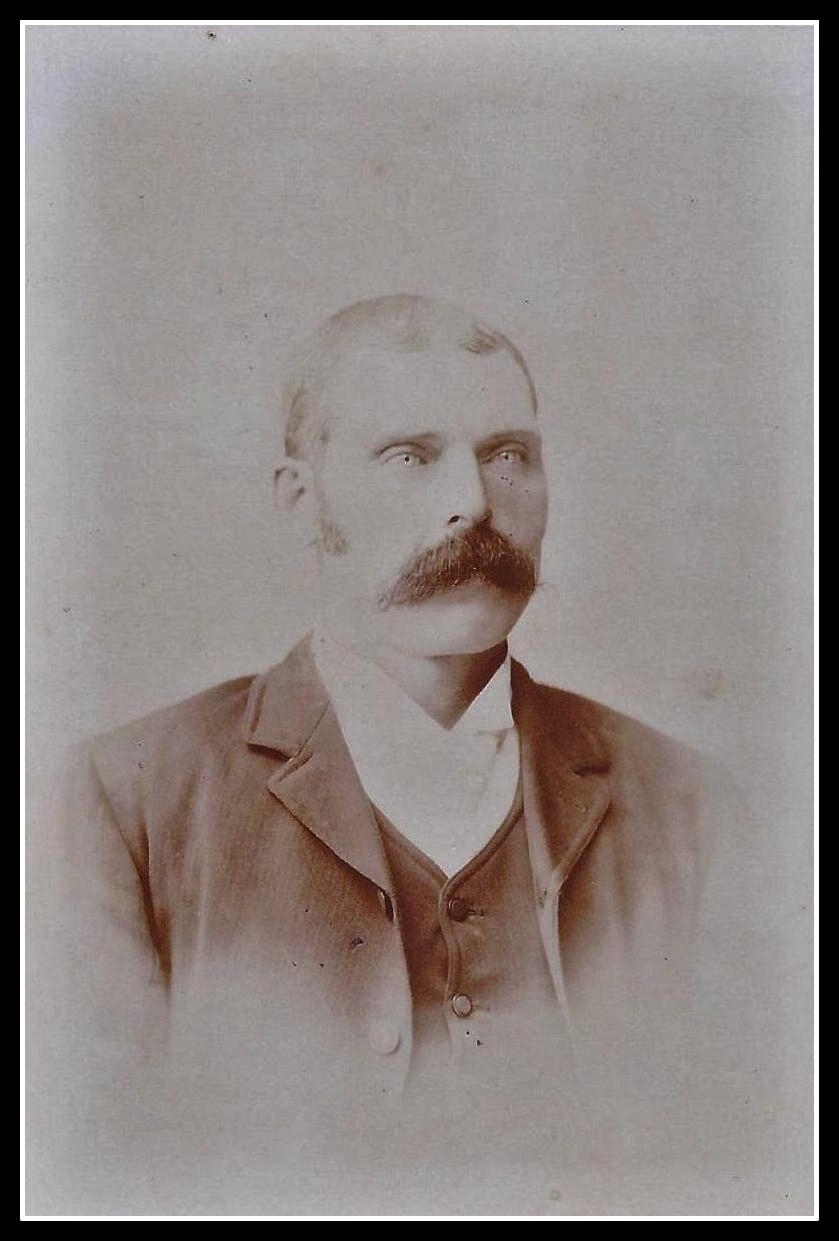
This was the case for my maternal great grandfather, Edmond O'Donnell, an Irish immigrant who began and lived out his Australian life in Toowoomba, Queensland.  


I knew that my great grandfather had died in Toowoomba in 1893 as I had his death certificate which stated clearly he was buried at the "Toowoomba Cemetery".  

There are now actually 19 cemeteries across the Toowoomba region, but research led me to find out that the most likely cemetery where Edmond was laid to rest would have been the Drayton & Toowoomba Cemetery, a heritage-listed cemetery in Harristown, a suburb of Toowoomba.   It was surveyed in May of 1850 and the first registered burial was in 1866, so it was highly likely my great grandfather would have been buried there in 1893.

I scoured the records on sites such as Ancestry.com, Find-A-Grave and the Australian Cemeteries Index, without any luck.  I could find no record of a burial plot for an Edmond O'Donnell who had died in 1893 in Toowoomba. 

There was a record for an Edward O'Donnell who had died in 1893, but there was no recorded birth date, country of birth, age or any other information that related at all to my great grandfather, so I dismissed that record fairly quickly.  


I then did the next best thing and tried to find the grave of my great grandmother, Edmond's wife, Bridget O'Donnell / O'Brien nee Burke.  


I was hoping this might lead me in a roundabout way to the burial plot of Edmond.


Bridget had re-married after the death of my great grandfather and had lived for another 44 years until her death in 1937, but her death certificate stated she was also buried at the "Toowoomba Cemetery".  

Her second husband had been buried elsewhere and seemingly had disappeared from Bridget's life many years before her death.  I thought perhaps Bridget had been buried with Edmond instead!  As the informant was Bridget's and Edmond's daughter Mary Margaret, I thought maybe Mary Margaret had arranged for her mother and father to be buried together, which may have been a rather romantic notion but I was hoping was a possibility.

Anyway, I did find a record of Bridget's burial at the Drayton and Toowoomba Cemetery, but again there was no indication of where her final resting place was actually located.  That left me rather deflated and despondent, as I had hoped to travel to Toowoomba one day and pay my respects to the great grandparents I never knew about until around thirteen years ago, when I began my family tree research!

So, all of this failure in finding burial plots for my great grandparents happened a while ago now, and just recently I decided to try another tack.  Of course, looking back I now know I should have done this years ago, but hindsight is such a beautiful thing!

About a month ago, I was surfing the net and decided to see whether the Toowoomba Regional Council had any information about the Drayton & Toowoomba Cemetery.  Sure enough, there was a link - 'Deceased search & family history'.  Worth a try, I thought. 


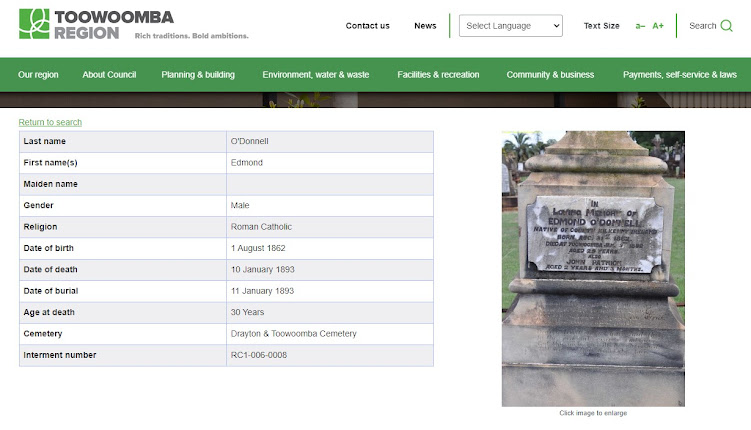
I used the online deceased search tool, typing in the name Edmond O'Donnell ... nothing!  Then for some reason, totally inexplicably, I typed in Edward O'Donnell and clicked 'go'!  This is what popped up.


What the!!!!  The entry was for an Edward O'Donnell, but the plaque on the massive memorial clearly stated Edmond O'Donnell!  


Not only that, it stated that Edmond was a native of County Kilkenny, had been born on August 31st, 1862 and had died on January 9th, 1892.  I was completely taken aback and got a bit emotional!  This information was a very close match for my great grandfather - the birth date was out, but only by 2 days, and the date of death was out by 1 day.  There was also mention of John Patrick who buried in the plot.  He had passed away at the age of 2 years and 3 months.  This was an exact match for my great uncle, the deceased male listed on my great grandfather's death certificate!

There had never been a photo on any of the other sites, so I had always believed that Edward O'Donnell was a completely different person to my great grandfather Edmond.  This photo however was proof that the person buried in this spot was indeed my great grandfather, but some some reason the name on the record was Edward, not Edmond.

It was at this point that hindsight reared its beautiful head!

When I had started my family tree research way back when I received a message on Ancestry.com, completely out of the blue, from Doreen in the U.S. who wondered if we might be related on the O'Donnell sides of our families.  She provided me with a great deal of information about the O'Donnell family and was positive that I was the descendant of one of the sons of John O'Donnell and Catherine Joy who had been tenants of a farm in Killonerry, County Kilkenny.  At the time I was unsure about the connection, but DNA results proved it to be true.

The reason I originally had some doubts was that Doreen had my great grandfather's name recorded as Edward or Ned, based on information that had been handed down orally over the generations.  Contact had been lost between my great grandfather and his family who had remained in Ireland, along with the members of his family who had emigrated to the U.S.  Following generations therefore had rather sketchy knowledge of this man who had left for Australia.

It does seem however that my great grandfather was most likely known as Edward by his wife, my great grandmother Bridget.  She had been the informant for his death certificate and would have been the person responsible for organising his burial.  It's likely that Bridget identified her husband as Edward when talking with the cemetery staff and this information may have been recorded on the cemetery register, although obviously she also shared that he had been baptised as Edmond.  Hence the confusion and misunderstanding on my part about who was buried at the cemetery.

Once I had realised all of this, I immediately emailed the Toowoomba Regional Council asking if the name could be changed on the cemetery record. I wasn't expecting much I have to admit, but I got a reply from a wonderful guy named Jacob, the Customer Service Officer, who let me know my email had been received and was being passed on to an appropriate person who would follow-up my request.

Unbelievably, I got an email the following day from the equally wonderful Loretta, the Administration Officer for the Cemeteries Services Team.  She let me know that she had indeed followed up by checking details with the Queensland Government's Registry of Birth, Deaths & Marriages and could confirm that the person's name was Edmond.  She stated that she had updated the council's records and this would be evident on the website in 24 hours.  It was!!!!

This is what appeared on the Toowoomba Regional Council's website the very next day.

Simply amazing!  In the space of a week I had gone from not knowing whether or not Edmond had indeed been buried at this cemetery, to having photographic proof that he was indeed laid to rest in the Drayton & Toowoomba Cemetery and his burial plot was marked with a rather magnificent looking memorial!

I then went to Find-A-Grave, suggested some edits and added the memorial photos from the Toowoomba Regional Council's website, and  ....


... this is what can be found now on Find-A-Grave, linked to Ancestry.com, for everyone to see.  I worked at linking in as many of the family as possible - Edmond's parents in Ireland, his siblings in Ireland and the U.S., his wife and his children.  

My great grandfather's final resting place is now visible to all, ensuring his memory lives on, and I owe that in large part to those two wonderful employees of the Toowoomba Regional Council who oversee the records of the Drayton & Toowoomba Cemetery.  They have my eternal thanks!


I've also found out that Edmond's daughter Catherine, my grand aunt, was buried alongside her father and there is a plaque in her honour on another side of the memorial.

My great grandmother Bridget was indeed interred with her first husband Edmond, in the same plot.  Sadly, there is no plaque for her on the family memorial, but I'm so very pleased to know she is there.


Tuesday, 14 March 2023

Memories ... March 15

In Remembrance

(For my 'Family Anniversaries' page)


Today is the anniversary of the passing of my maternal Great Grandfather, Owen McCane (Muckian).

I've told Owen's story before, with as many facts that I was able to discover from records and information from extended family.  If you're interested, you can read more about Owen by following this link:  


Owen McCane - all photos taken in the early 1920s

Up until three years ago I had never sighted a photo of  my great grandfather.  I then had the fortuitous  experience of receiving an email from a distant relative who thought I might like to have copies of some old family photos.

Finally I had the privilege of seeing the face of this person I'd been researching for around 10 years.  It's a heartwarming experience, putting a face to a name that had not been known to you until you are halfway through your own lifetime!


All three photos I now have of Owen show, what I think, is a gentle countenance.  He was, I believe, a man who worked hard all his life to support his family and greatly valued his family life. 

A few facts to remember about Owen on this important day of remembrance:

  • He was born in Ireland and his family name was Muckian.

  • He was born in the townland of Ballintemple (Baile an Teampuill), in the Parish of Killevy / Killeavy, in the county of Armagh.

  • Muckian was the surname recorded on his birth record

  • He was the middle child of five siblings.

  • Upon leaving his family and home in Ireland, he still stayed in contact and remained close to his youngest sister Anne (known as Nancy).
Owen's sister Anne (Nancy) Barry nee Muckian
remained in Ireland


  • Owen's surname was recorded as McCane upon his emigration to Australia, and his descendants were all registered upon birth with the surname of McCane.

  • He worked as a miner and a railway construction worker in the first few years after arriving in Queensland, Australia

  • Owen married an immigrant English girl, in Charters Towers, Queensland, Australia, when he was 32 years old.
Owen's wife, Margaret McCane nee Farrell


  • They went on to have seven children, although their boy Edward William died when he was a young boy.
Owen's family


  • After his marriage, Owen took on employment as a 'fireman' working at the Burdekin River Pumping Station, helping to keep the steam engines that powered the pumping machinery working.

  • He worked at the Pumping Station for around 20 years, and he and his family lived for many years in a cottage close by, on the banks of the Burdekin River.

  • Owen and his family moved from Charters Towers to property near Molongle Creek, in the Gumlu area, establishing a family farm known as 'El Rita' where he grew sugar cane, pineapples and bananas.

  • Owen had the family house from Charters Towers railed to the site.

  • Owen paid for his grand nieces' passage to Australia (daughters of his younger sister Anne / Nancy) in the early 1920s, and they both stayed on the family farm for a while before they both married.
Owen's sister Anne Barry nee Muckian, her husband Patrick Barry and family
Owen's nieces Rose (back row left) and Bridget (back row right) came and stayed on Owen's farm


  • Owen worked the family farm for over 15 years and his sons Jack and Jim stayed and worked the farm as well.

  • Owen passed away at the age of 70, in 1930.

  • The remains of the ancestral family farm back in Ireland can still be seen today, as well as the church where the family members were baptised.


I am resolved to get there one day and walk around the area my great grandfather left over 130 years ago!  There are still many distant relatives living close by and I would love to hear their stories and learn even more about this side of my family.


Monday, 9 January 2023

Memories ... January 10

In Remembrance

(For my 'Family Anniversaries' page)


Click on this link  The Story of James O'Donnell  if you want to read more about James.


Click on this link  The Story of Edmond O'Donnell  if you want to read more about Edmond.


My maternal grandfather James and his father, my maternal great grandfather Edmond, both died on January 10th, which is a coincidence I've only just become aware of recently.  It seems sad in a way that my grandfather died on the same day in January as the father he barely knew, as Edmond died when my grandfather was only 5 years old.

Collating various bits and pieces of information about their lives showed that their day of passing seems to have been the only thing they really did have in common.


On my father's side of the family, January 10th is also the day my paternal Granduncle died.  Tragically he died by his own hands, having seemingly never recovered from the trauma of witnessing the gruesome death of his younger brother.  Life can be cruel sometimes!


I've told the stories of both John Edgar and his brother James Alfred in this post:  Fire!


Friday, 16 November 2018

Lifespans Of My Great Grandparents

Family Patterns in the Lifespans of My Great Grandparents

Continuing with a slightly different post format again, I’ve been looking at the lifespans of my great grandparents, following on from last week’s post about the lifespans of my 2x great grandparents.


In that earlier post, I found that most of my great great grandparents lived unusually long lives for people born in the early 1800s. Given that average life expectancy at the time was only around 50 to 55 years, that was a striking discovery.


This week, I moved forward one generation and turned my attention to my maternal and paternal great grandparents. I was curious to see whether any family patterns might begin to emerge. Would there be similarities between the two sides of the family? Would one branch tend towards longer lives than the other? And which of my great grandparents had the shortest lifespan?


A Wide Range of Lifespans

Out of my eight great grandparents:

  • three lived into their 80s
  • two lived into their 70s
  • one reached the age of 60
  • one lived until her late 50s
  • and one died at only 30 years of age

That is quite a spread within a single generation of direct ancestors.


The 3 great grandparents that lived into their 80s included:


died aged 89  (wife of Owen McCane / Muckian)


died aged 86  (husband of Ellen Cusack)


died aged 85  (wife of Edmond O'Donnell)


The 2 that lived into their 70s were:


died aged 79  (wife of Richard Brown)


died aged 70  (husband of Margaret Farrell)


The 1 great grandparent that lived until the age of 60:


died aged 60  (husband of Susannah Fullagar Hukins)


The great grandparent that lived to her 50s was:


died aged 58  (wife of Thomas Connors / Connor)


Then there is the one figure who stands apart from all the others. The great grandparent that died at the youngest age was:


died aged 30  (husband of Bridget Burke)


That is the shortest lifespan not only among my great grandparents, but also across both my great and great great grandparents. And what makes it all the more striking is that Edmond was the son of John O’Donnell, my 2x great grandparent who lived to be the oldest in that earlier generation of direct ancestors.


That contrast immediately caught my attention. A long-lived father and a son whose life was cut so tragically short. It is one of those family-history details that reminds me how unpredictable life could be, even within the same family line.


Looking for Family Patterns

When I began gathering these ages together, I think I expected to see a more obvious pattern — perhaps one side of the family generally living longer than the other, or perhaps a tendency toward either longevity or early death.


Instead, what I found was something more human and more complex.


There are signs of longevity in this generation, with several ancestors living well beyond what might have been expected for their time. But there are also reminders of fragility, hardship, and the uncertainty that shaped earlier lives. The result is not a neat pattern, but rather a family story marked by both endurance and loss.


That, in itself, feels like a pattern worth noticing.


The Pattern of Becoming Parents

Another interesting comparison emerged when I looked at the ages at which my great grandparents became parents for the first time.


On my paternal side, my great grandparents began family life relatively young.

Thomas Connors and Susan Hukins were aged 24 and 23 when they became parents.

Richard Brown and Ellen Cusack were aged 23 and 22.


On my maternal side, however, the ages were generally older.

Owen McCane (Muckian) and Margaret Farrell were aged 33 and 27 when they became parents for the first time.

And while Edmond O’Donnell was just 22 when he became a father, his wife Bridget Burke was 33.


This was another pattern that stood out to me. On the paternal side, there seems to have been an earlier start to married and family life. On the maternal side, things unfolded later, or at least less uniformly.


These details may seem small, but they begin to suggest differences in circumstance, timing, and perhaps even outlook between the branches of the family. They hint at lives shaped by different settings and different experiences.


Australian-Born and Overseas-Born

Place of birth also reveals a clear family pattern.


All four of my paternal great grandparents were born in Australia, and in fact all were born in New South Wales.


My maternal great grandparents, by contrast, were born overseas. Three came from Ireland, while one was born in England.


This gives the generation an especially interesting character. My paternal side represents families already established in Australia, while my maternal side still carries those stronger connections to migration and arrival from elsewhere.


Again, there is a pattern here — not only in geography, but in family experience. One side was Australian-born for at least another generation, while the other was closer to the immigrant story itself.


A Generation of Contrasts

The more I looked at this group of great grandparents, the more I felt that the strongest family pattern was not sameness, but contrast.


There are long lives and short lives. There are early starts to parenthood and later beginnings. There are Australian-born ancestors and those born in Ireland and England. There are stories of continuity, and stories marked by sudden loss.


Perhaps that is what makes family history so compelling. Families do not move through time in tidy, even lines. Even within one generation, there can be enormous variation in fortune, health, opportunity, and circumstance.


And yet, taken together, these differences still form a pattern of their own — one that speaks of resilience, adaptation, and the many different ways a family line is carried forward.


A Closing Thought

Looking at these lifespans has reminded me again that family history is never just about dates. It is about the shape of lives — how long they lasted, when new chapters began, and how differently each story unfolded.


Some of my great grandparents were given long lives. Others were not. Some had time to grow old and see their families expand, while others left this world far too soon. And yet all of them, in their different ways, helped form the family that came after them.


That is perhaps what I find most moving in an exercise like this. Beneath the numbers and comparisons are real people, each with their own measure of joy, sorrow, endurance, and hope. The patterns are interesting, certainly — but it is the lives behind them that linger most in my mind.


Tuesday, 21 August 2018

The Story of Ellen Cusack

This week I'm telling the story of my paternal great grandmother Ellen Cusack  (1862 - 1942).

In the year of Ellen's birth, the first railway opened in New Zealand, Victor Hugo's French historical novel 'Les Miserables' was published, Westminster Bridge was opened in London, and the Scottish explorer John McDouall Stuart successfully crossed the Australian continent from north to south on his third attempt.


Born in July of 1862 in New South Wales, Ellen's father Patrick Cusack (an Irish-born convict) was 31 years old and her mother Eliza Exton (an English-born immigrant) was 24.  Ellen's birth certificate states she was born in a place known as Rose Hill in the Richmond River region.

At the time Ellen's father was working as a cedar cutter and Rose Hill would have been a cedar cutters' camp beside one of the Richmond River creeks where the cedar was being felled, cut and transported down the river to be sold.


Ellen's father, Patrick Cusack, was part of the second wave of cedar cutters that came to the Richmond River region.  These men settled with their families in the areas where they were working.  

The easily accessible trees, close to the river, would have all been harvested by this time, and the second wave of cedar cutter's would have had to move further inland into the thick forests beyond the river.  

The families of these cedar cutters were living in temporary camps set up in the forests. The Rose Hill camp was located about halfway between the townships of Goolmangar and Blakebrook, north-west of Lismore in New South Wales.


It's interesting to note that Ellen's maternal grandmother, Susannah Exton, was listed as a witness on the birth certificate.  At that time Ellen's maternal grandmother Susannah, maternal grandfather James Exton, her parents Patrick and Eliza, and several of her maternal aunts and uncles were living close by.


There were already five children in the family when Ellen was born.
Thomas had come along in 1853.
Susannah came along in 1855.
James was born in 1856.
Then came Patrick in 1858.
Ann was born in 1860.

After Ellen was born, there were another five children added to the family.

Eliza was born in 1864, when Ellen was 2 years old.
Julia was born in 1867.
William came along in 1869.
Sarah was born in 1871.
Then finally, Mary was born in 1874, when Ellen was aged 12.


Ellen and her siblings grew up in cedar cutter's camps, which would have been a harsh way of life for the families of the men who spent long days sawing wood.


This photo shows an example of a cedar cutters home in one of these camps.  


Sadly, in May of 1876, when Ellen was only 13 years of age, her father died.  Her sister Mary, who was only 2 years of age, also died the same year; as did her Grandfather James.


I haven't been able to find out what happened to Ellen, her widowed mother and her siblings in the immediate aftermath of all this tragedy.  I imagine that Ellen's mother Eliza would have found comfort and support within her extended family, the Extons, during this time.


In 1883, at the age of 21, Ellen married Richard Gordon Brown in Lismore, New South Wales.  He was aged 22.  As a point of interest, Richard's occupation was listed as 'timber cutter', which had been Ellen's father's occupation as well.


It's also interesting to note that details on the marriage certificate indicate that Ellen and Richard were married at the residence of one Rev. Hugh Livingstone, according to the rites of the Presbyterian Church.  They were not married in a church or chapel, but that was quite commonplace in those days in the Richmond River area, where churches/chapels were very light-on-the-ground.

What's so interesting though is that Ellen was the daughter of a Catholic father and a mother baptised in the Church of England faith.  Her husband had been baptised in the Anglican faith, so was it a case of just going with whichever priest/pastor/clergyman was available at the time, or was it a deliberate choice to be married in the Presbyterian faith?  Food for thought!

It's also very interesting to note that Ellen's younger sister Eliza, aged 18 at the time, had married the brother of Richard in July that same year.  


Ellen and Richard went on to have four daughters during their marriage.

My paternal Grandmother Grace was born in 1885, when Ellen was 22 years old.
Lillian was born in 1887, when Ellen was aged 25.
Elsie came along in 1890, when Ellen was 28.
Marcella was born in 1892, when Ellen was 30.


By 1885 Ellen's husband was no longer working as a timber cutter.  On the birth certificate of their first daughter, Richard's profession was recorded as 'labourer' and the family were living in the township of  Lismore.  


Ellen and her husband Richard lived in Lismore until around 1912, at which time they moved further south-east to Broadwater, a small town in the Richmond Valley area of New South Wales.


Sadly for Ellen she experienced quite a deal of loss from the time of her marriage until her own passing.

She lost her brother Thomas in 1886 when she was 24 years old.

Her brother William died in 1901 when she was 38 years old.

Ellen's eldest daughter Lillian died in 1911, when Ellen was aged 49.  It was shortly after this that Ellen, her husband Richard and daughter Marcella moved to Broadwater.  (Her other two surviving daughters had married by then).

Ellen's mother Eliza passed in 1914.  By this time Ellen was 52.

Ellen's brother James died in 1915.

Ellen's nephew Ernest Thomas Cusack died of influenza while he was overseas fighting during World War 1.

Ellen's sister Eliza died in 1921.

Ellen's brother Patrick died in 1924.

Her sister Ann died in 1941.

Ellen herself died in 1942 at the age of 79.


Obituary -The Northern Star Jun Mon 29 Jun 1942 p6 


The cause of death listed on her death certificate was 'cancer'.


Ellen was survived by her husband Richard, three of her daughters and three of her sisters.  She was privately interred at the Rookwood Catholic Cemetery and Crematorium in Sydney, New South Wales.  Unfortunately I have not yet been able to locate the site of her internment at this location. 


Special Note to any family members:  If you have and further information to share, can I graciously ask that you do so.  Please use the comments box below or email me.  It may prove to be invaluable to the story and provide future generations with something to truly treasure.