Showing posts with label lonely first names club. Show all posts

Saturday, 11 March 2023

The Story of Tobias Burke

This is the story of my maternal great grand uncle, Tobias Burke (1843 - 1917), the brother of my great grandmother Bridget Burke. 

Our Common Ancestors are:  James Burke and Catherine Crotty. 


Tobias is not at all a common name on my family tree.  As a matter of fact, my great grand uncle is the one and only family member on my extensive family tree with that name.


Apparently, the name Tobias is of Greek origin and means God is Good. Tobias is the Greek form of the Hebrew name Tobiah.

I have yet to uncover why my great grand uncle, born in Ireland, was given this name. I suspect it may have been a family name further back in the generations before him, but records from that period in Irish history are so difficult to find that proving such an idea may never be possible.

The name does not appear in any of the Burke generations that followed him, at least none that I have found in my research.


Interestingly though, the meaning of his name seems to sit rather well beside the life Tobias chose as an adult.


Until fairly recently, I had very little knowledge about the life of Tobias.  I had collected only a handful of records and scraps of information from other family members and from family trees compiled by others.


The facts I had found included these:


Tobias Burke was born in 1843.  He was the third-born son of James Burke and Catherine Crotty, my 2x great grandparents.  When Tobias was born, James was 32 and Catherine was 29 years old.  


Tobias was baptised on the 18th of April in the Carrick-on-Suir Parish, in County Waterford.  He was born in the area known as 'Three Bridges' between the town of Carrick-on-Suir and the townland Tibberagany (also spelt as Tybroughney).


He grew up in this area, along with his older sister (my great grandmother), two older brothers and three younger brothers.  


When Tobias was 21, in 1865, his older brother William left home, bound for Australia and he never returned.  By that time, all of Tobias's siblings would have been considering their own futures, as the small tenant farm on which they had grown up would not have been able to support them all into adulthood.


It appears that Tobias left home sometime around 1870 to begin a religious vocation and receive the Sacrament of the Holy Orders in the Catholic Church.  At least, that was the story handed down orally through the generations. 


Then .......


I stumbled across a source of information I had previously under-used: the “Directories & Member Lists” filter on the Ancestry search page for an individual. I noticed there were hundreds of entries for a Tobias Burke, and I began clicking through them, looking for matches in dates and places.


That led me to the city and regional directories of Ireland, particularly Thom’s Irish Almanac and Official Directory of the United Kingdom of Great Britain and Ireland for the year 1871.  


It was there I found the name Tobias Burke in the index of the clergy of the Roman Catholic Church.


This Tobias was listed on page 1202, and the entry states he was a "curate" near the town of Carrick-on-Suir in the Diocese of Waterford and Lismore.  The year, the district, and the name all pointed to the strong possibility that this was my Tobias Burke, and that the family story had indeed been grounded in truth.


From there, I followed the trail and found out quite a bit about the adult life of Tobias.


All of a sudden, my Ancestry page for Tobias Burke exploded with details I had never expected to uncover.


A Vocation, Not Simply a Livelihood

What strikes me most as I follow Tobias through these records is that his life was not simply a career path in the modern sense. Religious life was traditionally understood, and fundamentally lived, as a calling — a vocation — rather than a job designed to make a living.


Of course, a priest worked. His days were filled with responsibilities, duties, travel, administration, prayer, teaching, and the care of parishioners. But the work was only one part of something much larger. At its heart, religious life was a total commitment to God and to the service of others.


For men like Tobias, this meant giving up the ordinary patterns of family life that most of their brothers and sisters would go on to know. It meant not marrying, not raising children of their own, and in many ways stepping away from the intimate rhythms of home and kinship in order to belong more completely to the Church and to the people they served.


That kind of life was not without sacrifice. Tobias would have watched siblings emigrate, marry, grow older, and die, all while he moved from parish to parish within the Diocese of Waterford and Lismore. He remained connected to his family, of course, but his life followed a different path — one shaped not by inheritance, marriage, or farming, but by vocation.


Seen in that light, the records that list Tobias as curate or parish priest are not merely occupational entries. They are markers of a life given over, step by step and year by year, to a calling he believed came from God.


Tobias's World

In the 1870s, at the time of Tobias’s first entry in Thom’s Directory, a Roman Catholic curate in Ireland was a newly ordained priest assigned to a parish, but subordinate to the parish priest. The parish priest carried canonical responsibility for the parish and was installed by the bishop of the diocese. The curate was there to support him in all aspects of parish duties.


I found a short passage in a text titled The Rise and Fall of Stations in Ireland that offers a small glimpse into the life of a curate. 

"The story opens with the local parish priest announcing from the altar before the end of mass on Sunday that he will hold Stations Monday through Friday at the houses of five of his more substantial and respectable parishioners, whom he then proceeds specifically to name. On the appointed day, the parish priest and his curate arrive early in the morning, by which time the near neighbours have gathered. The priests then hear the confessions of the assembled penitents, men and women, while their clerk sets up the portable altar for the celebration of mass. When the confessions are heard, one of the priests celebrates mass, and the people receive communion. After mass, the priests and their clerk take their breakfast with their host, his family, and some of the more respectable of the neighbours, who have also been invited. After breakfast, the priests examine and catechize the children, and hear the confessions of those they had not been able to attend to in the morning. The parish priest then proceeds to collect his dues and any arrears that may have accumulated from the head of each household present. This period of religious instruction, additional confessions, and collection of dues continues until dinner time. At three o'clock, the clergy, the host, his family, and a number of specially invited local notables, clerical and lay, sit down to dinner, and for three or four hours there is considérable eating, drinking, and merry-making, which takes the form of spirited conversation, storytelling, and singing, usually fuelled by generous libations of whiskey punch. The routine was repeated at each house during the week, and the Stations usually continued from some six to eight weeks, depending on the extent and population of the parish. They were, moreover, normally held twice a year, just before Christmas and after Easter. Finally, it should be noted that Stations were essentially a rural phenomenon because in the cities and larger towns they were not held in private houses but in the parish churches and chapels. Such then is the barebones of the custom of Stations that evolved into a national system between 1750 and 1850."


From: "The Rise and Fall of Stations in Ireland, 1750 - 1850" pp.19-32 in 'Chocs et ruptures en histoire religieuse' by Michael Lagree.


Turning back a few pages in this 1871 edition of Thom's Directory, I found an exact location for Tobias, along with the name of the Parish Priest and the nearest town.  


He was curate at Ballyneale Parish, near Carrick-on-Suir, under Parish Priest, John Dee.  Tobias would have been 28 years old at this time.   From this time onward, Tobias spent his religious life in the Diocese of Waterford & Lismore.


I was able to follow his movements around this diocese by searching through later editions of Thom's Directory.  


In 1872, I found him in the parish of Ballylooby, near the town of Clogheen.


There, Tobias was curate under Parish Priest Stephen Lonergan, and this time he was not the only curate. That likely suggests the parish had a busier life than the previous one.


It appears Tobias spent another two years in that parish. During this time, his mother Catherine Burke, née Crotty, died, and his youngest brother James left home for the United States. His younger brother John married and began his own married life near Pilltown in County Kilkenny.


By 1875, Tobias was curate in the neighbouring parish of Clogheen, under Parish Priest Patrick Meany.


In the following year, 1876, he can be found in the Parish of Rathcormack and Clonee, near Carrick-on-Suir once more.  


He was still there in 1877,


and 1878.


The Parish Priest was Timothy Dowley, and again there was another curate, John Power, working in the parish alongside Tobias.


In 1879, Tobias moved to the parish of Passage, also known as East Passage. He was to remain there for 15 years, from 1879 to 1894.


During the years 1879 to 1881, he worked with a parish priest named Edmund O’Donnell, which is another interesting detail, as I am descended not only from the Burke family, but also from the O’Donnell family. I do not yet know if there is a connection, but it feels like a possibility worth keeping in mind.


Edmund O’Donnell appears to have moved on, or perhaps died, in 1882, because Tobias was then working under Parish Priest John Crotty and remained under him from 1882 to 1887 in that same parish.


Crotty, of course, was Tobias’s mother’s maiden name, which raises the possibility that the parish priest may have been a relative. Once again, that is something I cannot yet prove, but it is a thread I would very much like to follow further.


From 1888 to at least 1894, Tobias worked under Parish Priest Maurice Flynn. During those years, Tobias's older brother William, who had emigrated to Australia, died, as did their younger brother Maurice, who had remained on the family farm in County Kilkenny.


In 1896, things changed significantly for Tobias when he became a parish priest himself in the parish of Kilgobinet.


Tobias had acted as a curate for 25 years, which seems a rather lengthy period of time to remain in a subordinate role. Of course, given the times, the diocesan bishop may have had a very long list of priests awaiting appointment whenever a parish became vacant.


By the time Tobias was appointed parish priest, he was 53 years old.


As previously noted, Tobias was parish priest in Kilgobinet, near the town of Dungarvan. He remained there for about four years, and perhaps not surprisingly, he chose a man named Michael Burke as his curate. A relative? Very likely.


Tobias then moved on from the Parish of Kilgobinet.  Information gleaned from the book titled  'Waterford & Lismore - A Compendious History of the United Dioceses'  (published in 1937 and written by Patrick Power) states that the Reverend Tobias Burke became parish priest of the Parish of Aglish, upon the death of the Reverend Matthew Walsh in 1899.


Tobias was then 57 years old, and that is where he remained until his death at the end of 1917.


Tobias Burke died on 27 October 1917 at the age of 74, in the townland of Curraghmoreen, County Waterford. By then, all of his siblings had passed away. His two younger brothers, John and James, had died in 1902 and 1904 respectively.


In the 9 March 1918 edition of the Dungarvan Observer, a statutory notice to creditors appeared mentioning the Reverend Tobias Burke, who had died on 27 October 1917. The notice refers to a Tobias Burke, a John Burke, both farmers, and Rev. William Ormond as executors of the will.


This other Tobias Burke was likely a relative of my Tobias, though I have no idea yet where he fits into the family tree. Fingers crossed that answer appears one day.


The John Burke mentioned as an executor was also likely another relative, though again I cannot say for certain.


Reverend William Ormond is described as hailing from Kinsalebeg, Youghal, County Waterford. I find myself wondering about that connection too.


There was also an interesting item in the Dungarvan Observer dated 16 March 1918.


In his will, Tobias left charitable bequests to selected religious figures — the Abbot of Mount Melleray and Rev. William Ormond — so that they might offer prayers during Masses for his soul, the souls of his deceased family members, and the souls in purgatory. He also left a small amount to the Convent of the Sisters of Charity in Dublin to support their work among the poor.


That final gesture feels fitting.


The records I have uncovered show Tobias moving from parish to parish, year after year, quietly carrying out the duties of religious life. They do not tell me everything about the man himself, but they do reveal the shape of his life: one marked by devotion, service, and perseverance.


For a man who left behind no wife, no children, and no direct descendants to remember him in the ordinary way, these traces matter all the more.


They allow him to step forward again, not just as a name on my family tree, but as a real person — a son of James Burke and Catherine Crotty, a brother to my great grandmother Bridget, and a man who gave his life to the service of God and others.


Special Note to any family members:  If you have information to share, can I graciously ask that you do so.  Please use the comments box below or email me.  It may prove to be invaluable to the story and provide future generations with something to truly treasure.


Monday, 7 March 2022

The Story of Iris Belle Barrow

This post will be an attempt to tell some of the story of Iris Belle Barrow (1921 - 1966), my paternal 3rd cousin once removed.  

Our Common Ancestors are:  James Exton and Susannah Lancaster.

I never met Iris or any of her family, and have only come to know about her through the limited information shared by extended relatives on Ancestry.com and the research I've done about the events of the relevant time span.  I admit this story may be a little sketchy and not fully correct, so if any better informed relatives do read through this and can offer clarification, please do so.

I've been intrigued with Iris ever since I first saw this photo shared on Ancestry.  

Photo originally shared by cbroughton195 (my 4th cousin) on Ancestry.com


My family tree is full of very resilient women who lived quite tough lives and certainly never lived a life of luxury or experienced what I would call, a prosperous life.  


This photo of Iris could give the impression that she was the exception though ... given the luxurious fur coat she is wearing and that stunning hat!


That was the very first thing that drew my attention in this photo ...  that magnificent looking hat.  I thought all those black spots were imperfections on the photo, but then I realised the hat comes complete with a net / veil that comes down over the front of her face.  Perhaps this was a fashion trend in Australia at the time, which would have been the late 1930s.  


The beautiful flowers atop her curls are such a stylish addition as well.  That is not an everyday hat!  Not many of my extended relatives ever got to wear a fur coat either.  This young woman emanates poise, elegance and style.  I wondered where she was going on this day, dressed so fashionably.  What grand event was she attending?


When I discovered her name was 'Iris', it seemed a perfect match somehow. 


Iris is a girl's name of Greek origin, meaning "colourful" or "rainbow".  Iris was the name of the Greek goddess of the rainbow, and she served as a messenger to the gods.


As I looked more deeply into the details of Iris's life however, it soon became apparent that she did not live a life of luxury and extravagance at all!


Iris Belle Barrow was born in December of 1921 in a small settlement known as Goonellabah, in New South Wales, Australia. It was located outside Lismore, and is now an eastern suburb of that city.  Iris was the youngest of four children born to Alfred Barrow Jnr. and Mary Ellen (Nell) McCann and was their only daughter.  She arrived two days after Christmas, like an additional Christmas present.


Her eldest brother was Harold Allan Barrow, born in 1910.  Her second eldest brother was John Alfred (known as Jack) Barrow, born in 1913.  Her other older brother was Charles Neville Barrow, born in 1915 (although he was known as Neville Charles throughout his lifetime).  


I wonder what Iris's childhood would have been like, growing up with three older brothers?  There was an 11 year age gap between Iris and her oldest brother Harold.  The middle brother John (known as Jack) was 8 years older, and the youngest of the brothers was 6 years older than Iris.  Did they treat her as a princess or as a tomboy? 

I have limited information about life for Iris between her birth and her tenth birthday, but jumping ahead a little I know her teenage years coincided with the Great Depression, a time when many experienced enormous hardships and challenges.  


Here in Australia, there was a surge in unemployment rates at the start of the 1930s and many people's lives changed drastically as a result.  I know that Iris's father, Alfred Barrow, worked as an employee of the Railway Department throughout the depression years, so that must have been a saving grace for the family. given that in 1932 the official unemployment level reached a peak of 32%.

Census records for the period between 1929 and 1940 show where Iris's father Alfred and mother Mary Ellen were living.  As Iris was only 8 years old in 1929 and turned 18 in 1940, she would have been living with her parents during these years.  The census records show that Iris's parents moved around a bit during this time, and I would suspect that was because of her father's job.

In 1930, when Iris would have turned 9,  the family was living at 10 Peate Street in Lismore.  Iris's father Alfred's occupation was listed as 'fettler'.  Iris's uncle, her father Alfred's brother, William and his wife were living in the same street.


A 'fettler' was an employee of the Railways whose job it was to maintain a section of a railway line.  They had to walk, or ride a trolley, along a 10-15 mile long section of the railway line every day to inspect it for any possible problems that needed repair work.  It was hard physically exhausting work.  


Fettlers would have to replace decaying sleepers and worn rails, check all the bolts on fishplates and tighten these whenever needed, as well as clear the line of fallen trees, and in the flood-prone Lismore area, they would have to clear flood debris and repair damaged sections of the line after major flooding events.  Iris would have witnessed first-hand the toll that such physical work must have taken on her father.


Fettlers worked in small gangs under the supervision of a ganger, and most usually lived in railway tents in camps next to the line.  As Iris's family was living in town, that meant either her father was working a section of track close to the town itself or he would spend weeks at a time away from home living and working with his fettler gang.  Either way, I think that Iris probably spent more time with her mother and brothers, than she did with her father while she was growing up. 


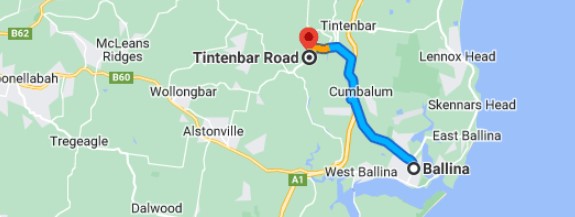
By 1932, the family had re-located to Ballina, situated in the Northern Rives Region about 34 kms (21 miles) from Lismore, and closer to the coast.  


Iris was now 11 years old and the family was living at 356 River Street in Ballina, which would have been on the outskirts of the town at the time and quite close to the mouth of the Richmond River.  Iris's brother Harold Allen Barrow had married Florence Robertson in 1931 and they were living in Ballina East.  I'm assuming that Iris's other brothers, John aged 19 and Neville aged 17, were living with their parents as well.


By 1934, Iris aged 13, was living at 1 Fox Street with her parents and (again, I'm assuming) her brothers John and Neville. Fox Street was closer to the centre of the town.  Iris's oldest brother Harold and his wife Florence were still living in Ballina East and had a little daughter.


By the following year, 1935, Iris and her parents had moved once again.  They were living at 32 Tintenbar Road, about 12 km (6 miles) to the north-west of Ballina.  It's likely the move was a requirement of her father's job at that time.

Iris's brother John Alfred Barrow remained living at 1 Fox Street (presumably with brother Neville) in Ballina, and olderst brother Harold Allen and his wife Florence May were still living in Ballina East, and were expecting another child.


In 1937, Iris, now aged 16, and her parents were back living back in Ballina, at 1 Fox Street with John Alfred and Neville Charles.

Photo originally shared by cbroughton195 (my 4th cousin)
on Ancestry.com


Soon Iris was of an age when she could start attending dances and balls.  


Apparently her brother John loved ballroom dancing and his favourite partner was his sister Iris.  They were reportedly both very fine ballroom dancers.


This photo, likely taken sometime between 1939 and 1940, shows Iris and her brother John Alfred attending such an occasion.


Of course, by this time there were events happening overseas that would change the course of world history, and the lives of the Barrow family.

One of the most often mentioned causes of World War 11 was the rise of dictatorial governments with extreme political views and military ambitions during the Great Depression, in the countries of Germany, Italy, Spain and Japan.  The Depression had also distracted the democratic powers of Britain, France and the United States as they paid more attention to affairs at home and not international developments.

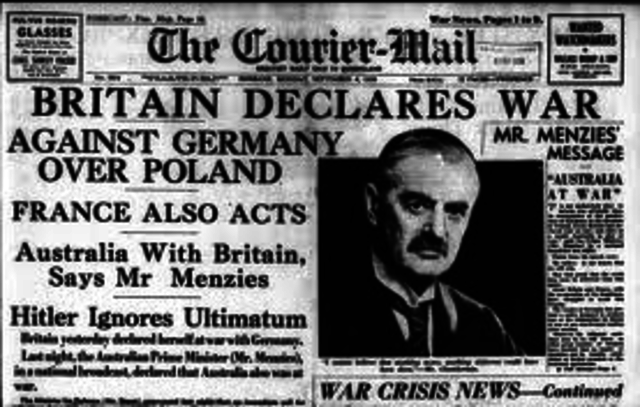
When the Germans invaded Poland in September of 1939, driving Great Britain and France to declare war on Germany, Iris was just 3 months away from celebrating her 18th birthday.  


Iris would have read about what was happening in Europe and read the Australian Prime Minister, Robert Gordon Menzies's statement made on September 3rd, 1939:

"Fellow Australians, it is my melancholy duty to inform you officially, that in consequence of a persistence by Germany in her invasion of Poland, Great Britain has declared war upon her and that, as a result, Australia is also at war."


Alfred Barrow (far left), John Alfred Barrow (middle) and Douglas Charles Fitzsimmons (right)  c. 1940
Photo originally shared by cbroughton195 (my 4th cousin) on Ancestry.com

In March of 1940 Iris, aged 18, married Douglas Charles Fitzsimmons, aged 23, in Ballina, New South Wales.  Of course at that time many young couples found the urge to get married just too compelling to resist, given that so many young men were preparing to march off to war.

The photo above shows Iris's husband Douglas Charles Fitzsimmons on the right, with her father Alfred Barrow (left) and her brother John Alfred (sitting).

The following year, 1941, saw the start of the impact of the Second World War on the Barrow family.

Iris's oldest brother, Harold Allan Barrow, enlisted in March of 1941.  He served as a Private in the Australian Army.

Iris's second eldest brother, John Alfred Barrow, enlisted in September of 1941.  He also served as a Private in the Australian Army.

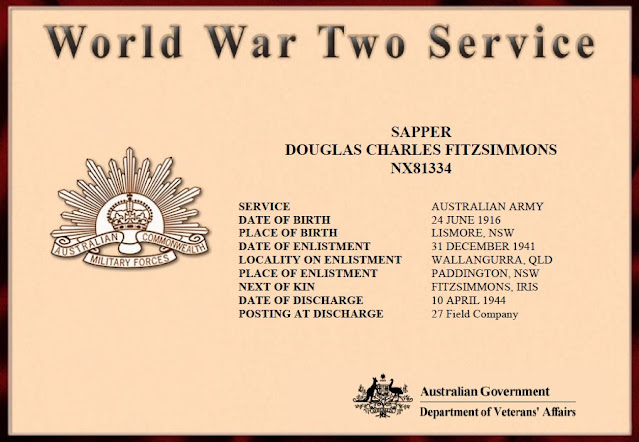
Iris's husband Douglas enlisted in December of 1941.  He served as a Sapper in the Australian Army.

Interestingly, when Douglas was enlisting he listed 'Wallangurra, Queensland' as being his residential address at that time.  Wallangurra is quite a considerable distance inland from Ballina, where Iris's family lived and where she and her husband had married.  It's north-west of Tenterfield, and just over the border in southern Queensland.  I'm assuming Douglas was away working.  I wonder, what type of work was he doing that took him away from his new wife?


Australian women, at the start of the war, were encouraged to take the same sorts of roles they had held during the first world war - knit, sew, pack parcels, encourage enlistment and maintain the home.  As war came closer to Australia though, this all changed.  

From late 1940, women were encouraged to join the services.  Whilst some served as nurses in one of the branches of the armed forces, the majority joined the auxiliary services such as the Women's Auxiliary Australian Air Force (WAAAF), the Australian Women's Army Service (AWAS) and the Women's Royal Australian Naval Service (WRANS).  


Iris Belle enlisted with the WAAAF as an Aircraftwoman.  She enlisted in late 1942.  


This is the enlistment photo taken of Iris in 1942.


Photo originally shared by cbroughton195 (my 4th cousin)  
on Ancest
ry.com

This is not a photo of Iris.

It's a shot of her sister-in-law Beryl, who married Iris's brother, John Alfred, in late 1941.


Beryl enlisted as an Aircraftwoman in the WAAAF the year after Iris did.  


There's likely to be a similar photo of Iris in uniform, very much like her sister-in-law.


Initially, women in the forces served as cooks, clerks and kitchen orderlies, but that quickly changed.  They were manning anti-aircraft and coastal artillery gun sites, working in ordinance, cipher, electrical, mechanical and intelligence units.  They maintained and armed aircraft, operated radars, drove trucks and instructed in drill ... but they did not fly.

Aircraftwomen: top row left -  checking aircraft engine components, top row right - working on an aircraft engine,  bottom row left - checking the instruments in a bomber cockpit, bottom row - right - loading practice rockets onto a Beaufighter ... some of their varied tasks.

Women also became a crucial part of the RAAF communications system and staffed Radio Direction Finding Stations to guide aircraft home.  Large numbers of serving women were radio-telephone operators, and the majority of the telephone and teleprinter operators were WAAAF.  The coastline was screened by radar, and operators were often on duty 24 hours per day.

According to Iris's service record her first duties were as a "messwoman", but by early 1943 her role was listed as "telephone operator".  She served in that role for the remainder of the war. and had various postings - from Bundaberg to Evans Head.

Iris's posting upon discharge was listed as "6 Aircraft Depot". The location of the RAAF's No. 6 Aircraft Depot was at the Army Aviation Airfield at Oakey, on the Darling Downs in Queensland.  

The No. 6 Aircraft Depot's primary function was to relieve, repair and carry out overhaul work passed on from No. 3 Aircraft Depot at Amberley Airfield.  No. 6 Aircraft Depot was also a forward depot for aircraft operating from New Guinea and northern Australia.  The Depot serviced, assembled and conducted test flights of Beaufort, Mustang Norsemen, Wirraway and Spitfire aircraft and also serviced large quantities of communications equipment and radio compass receivers.  The site was 934 acres in size, comprising a 400 feet landing strip and 2 hard surfaced runways.  The population of personnel was around 2000.  Iris must have had an interesting service life.  I wonder if she was living on site?

Photo originally shared by cbroughton195 (my 4th cousin)
on Ancestry.com


By this time Iris had become a mother, having given birth to her son Douglas Terry back in mid 1941 before she enlisted.  How did Iris juggle her service and different postings as well as motherhood until her discharge in 1945?


Thankfully Iris's brothers and husband all survived the war years.  


Brother John Alfred had been discharged as medically unfit in November of 1941, a couple of months after his enlistment.  He had been diagnosed with "fibrositis", now known as fibromyalgia, a disorder of musculoskeletal pain and aching.


Brother Harold Allan was discharged in November of 1943.  


Husband Douglas was discharged in April of 1944 after service overseas.


Just a few months after welcoming her husband home from war service, Iris had to say goodbye to her father, Alfred Barrow, who died in November of 1944.


Then tragically, Iris's husband died not long after, in March of 1945, at the age of 28.   His death notice, seen above, mentions that he had been ill for quite some time and was living in Queensland at the time of his death.  This makes sense as Iris was still serving with the RAAF, and as I have mentioned would have been living in Queensland.  She was not discharged until May of 1945, and was discharged on compassionate grounds. 

Iris, widowed at the age of 23, after having been married for just five years, was now a single Mum with a child about 5 years old; and it seems she moved back to Ballina after her discharge.  There she re-married the following year, in October of 1946.  Her second husband was a man named Mervyn Arthur Anthony (Tony) Alvos.  They were married for nearly 50 years. 

Photo originally shared by cbroughton195 (my 4th cousin) on Ancestry.com

This photo would have been taken around the time of Iris's second marriage.  She is with her sister-in-law Beryl Barrow nee Wilson.  Sitting on the ground are Beryl's daughter Colleen Joan, and Iris's son Douglas Terry.  Iris stands out once again in this photo, with her pretty flower-bedecked top and embellished dark skirt.  She would have been about 25 years of age.

Iris was to spend the early part of her second marriage, through the late 1940s and 1950s, still living in Ballina, New South Wales.


Sadly, Iris's mother Mary Ellen passed away in 1962. 


It was around this time that Iris and her husband Mervyn moved to Queensland.  Iris's son, who was now Douglas Terry Alvos, remained living in Cronulla for a time but by 1968, according to the census, they were all living in Acacia Ridge in Queensland.


Iris's life through the 1970s, 80s and 90s was spent living in that same area - Acacia Ridge.


Both of Iris's brothers, Harold and Neville, passed away in 1971.  


Iris's brother John Alfred passed in 1988.  


Iris herself passed away in January of 1996, aged 74, having outlived her parents and all her brothers.


Special Note to any family members:  If you have memories to add, photos or information to share, can I graciously ask that you do so.  Please use the comments box below or email me.  It may prove to be invaluable to the story and provide future generations with something to truly treasure.