Saturday, 11 March 2023

The Story of Tobias Burke

This is the story of my maternal great grand uncle, Tobias Burke (1843 - 1917), the brother of my great grandmother Bridget Burke. 

Our Common Ancestors are:  James Burke and Catherine Crotty. 


Tobias is not at all a common name on my family tree.  As a matter of fact, my great grand uncle is the one and only family member on my extensive family tree with that name.


Apparently, the name Tobias is of Greek origin and means God is Good. Tobias is the Greek form of the Hebrew name Tobiah.

I have yet to uncover why my great grand uncle, born in Ireland, was given this name. I suspect it may have been a family name further back in the generations before him, but records from that period in Irish history are so difficult to find that proving such an idea may never be possible.

The name does not appear in any of the Burke generations that followed him, at least none that I have found in my research.


Interestingly though, the meaning of his name seems to sit rather well beside the life Tobias chose as an adult.


Until fairly recently, I had very little knowledge about the life of Tobias.  I had collected only a handful of records and scraps of information from other family members and from family trees compiled by others.


The facts I had found included these:


Tobias Burke was born in 1843.  He was the third-born son of James Burke and Catherine Crotty, my 2x great grandparents.  When Tobias was born, James was 32 and Catherine was 29 years old.  


Tobias was baptised on the 18th of April in the Carrick-on-Suir Parish, in County Waterford.  He was born in the area known as 'Three Bridges' between the town of Carrick-on-Suir and the townland Tibberagany (also spelt as Tybroughney).


He grew up in this area, along with his older sister (my great grandmother), two older brothers and three younger brothers.  


When Tobias was 21, in 1865, his older brother William left home, bound for Australia and he never returned.  By that time, all of Tobias's siblings would have been considering their own futures, as the small tenant farm on which they had grown up would not have been able to support them all into adulthood.


It appears that Tobias left home sometime around 1870 to begin a religious vocation and receive the Sacrament of the Holy Orders in the Catholic Church.  At least, that was the story handed down orally through the generations. 


Then .......


I stumbled across a source of information I had previously under-used: the “Directories & Member Lists” filter on the Ancestry search page for an individual. I noticed there were hundreds of entries for a Tobias Burke, and I began clicking through them, looking for matches in dates and places.


That led me to the city and regional directories of Ireland, particularly Thom’s Irish Almanac and Official Directory of the United Kingdom of Great Britain and Ireland for the year 1871.  


It was there I found the name Tobias Burke in the index of the clergy of the Roman Catholic Church.


This Tobias was listed on page 1202, and the entry states he was a "curate" near the town of Carrick-on-Suir in the Diocese of Waterford and Lismore.  The year, the district, and the name all pointed to the strong possibility that this was my Tobias Burke, and that the family story had indeed been grounded in truth.


From there, I followed the trail and found out quite a bit about the adult life of Tobias.


All of a sudden, my Ancestry page for Tobias Burke exploded with details I had never expected to uncover.


A Vocation, Not Simply a Livelihood

What strikes me most as I follow Tobias through these records is that his life was not simply a career path in the modern sense. Religious life was traditionally understood, and fundamentally lived, as a calling — a vocation — rather than a job designed to make a living.


Of course, a priest worked. His days were filled with responsibilities, duties, travel, administration, prayer, teaching, and the care of parishioners. But the work was only one part of something much larger. At its heart, religious life was a total commitment to God and to the service of others.


For men like Tobias, this meant giving up the ordinary patterns of family life that most of their brothers and sisters would go on to know. It meant not marrying, not raising children of their own, and in many ways stepping away from the intimate rhythms of home and kinship in order to belong more completely to the Church and to the people they served.


That kind of life was not without sacrifice. Tobias would have watched siblings emigrate, marry, grow older, and die, all while he moved from parish to parish within the Diocese of Waterford and Lismore. He remained connected to his family, of course, but his life followed a different path — one shaped not by inheritance, marriage, or farming, but by vocation.


Seen in that light, the records that list Tobias as curate or parish priest are not merely occupational entries. They are markers of a life given over, step by step and year by year, to a calling he believed came from God.


Tobias's World

In the 1870s, at the time of Tobias’s first entry in Thom’s Directory, a Roman Catholic curate in Ireland was a newly ordained priest assigned to a parish, but subordinate to the parish priest. The parish priest carried canonical responsibility for the parish and was installed by the bishop of the diocese. The curate was there to support him in all aspects of parish duties.


I found a short passage in a text titled The Rise and Fall of Stations in Ireland that offers a small glimpse into the life of a curate. 

"The story opens with the local parish priest announcing from the altar before the end of mass on Sunday that he will hold Stations Monday through Friday at the houses of five of his more substantial and respectable parishioners, whom he then proceeds specifically to name. On the appointed day, the parish priest and his curate arrive early in the morning, by which time the near neighbours have gathered. The priests then hear the confessions of the assembled penitents, men and women, while their clerk sets up the portable altar for the celebration of mass. When the confessions are heard, one of the priests celebrates mass, and the people receive communion. After mass, the priests and their clerk take their breakfast with their host, his family, and some of the more respectable of the neighbours, who have also been invited. After breakfast, the priests examine and catechize the children, and hear the confessions of those they had not been able to attend to in the morning. The parish priest then proceeds to collect his dues and any arrears that may have accumulated from the head of each household present. This period of religious instruction, additional confessions, and collection of dues continues until dinner time. At three o'clock, the clergy, the host, his family, and a number of specially invited local notables, clerical and lay, sit down to dinner, and for three or four hours there is considérable eating, drinking, and merry-making, which takes the form of spirited conversation, storytelling, and singing, usually fuelled by generous libations of whiskey punch. The routine was repeated at each house during the week, and the Stations usually continued from some six to eight weeks, depending on the extent and population of the parish. They were, moreover, normally held twice a year, just before Christmas and after Easter. Finally, it should be noted that Stations were essentially a rural phenomenon because in the cities and larger towns they were not held in private houses but in the parish churches and chapels. Such then is the barebones of the custom of Stations that evolved into a national system between 1750 and 1850."


From: "The Rise and Fall of Stations in Ireland, 1750 - 1850" pp.19-32 in 'Chocs et ruptures en histoire religieuse' by Michael Lagree.


Turning back a few pages in this 1871 edition of Thom's Directory, I found an exact location for Tobias, along with the name of the Parish Priest and the nearest town.  


He was curate at Ballyneale Parish, near Carrick-on-Suir, under Parish Priest, John Dee.  Tobias would have been 28 years old at this time.   From this time onward, Tobias spent his religious life in the Diocese of Waterford & Lismore.


I was able to follow his movements around this diocese by searching through later editions of Thom's Directory.  


In 1872, I found him in the parish of Ballylooby, near the town of Clogheen.


There, Tobias was curate under Parish Priest Stephen Lonergan, and this time he was not the only curate. That likely suggests the parish had a busier life than the previous one.


It appears Tobias spent another two years in that parish. During this time, his mother Catherine Burke, née Crotty, died, and his youngest brother James left home for the United States. His younger brother John married and began his own married life near Pilltown in County Kilkenny.


By 1875, Tobias was curate in the neighbouring parish of Clogheen, under Parish Priest Patrick Meany.


In the following year, 1876, he can be found in the Parish of Rathcormack and Clonee, near Carrick-on-Suir once more.  


He was still there in 1877,


and 1878.


The Parish Priest was Timothy Dowley, and again there was another curate, John Power, working in the parish alongside Tobias.


In 1879, Tobias moved to the parish of Passage, also known as East Passage. He was to remain there for 15 years, from 1879 to 1894.


During the years 1879 to 1881, he worked with a parish priest named Edmund O’Donnell, which is another interesting detail, as I am descended not only from the Burke family, but also from the O’Donnell family. I do not yet know if there is a connection, but it feels like a possibility worth keeping in mind.


Edmund O’Donnell appears to have moved on, or perhaps died, in 1882, because Tobias was then working under Parish Priest John Crotty and remained under him from 1882 to 1887 in that same parish.


Crotty, of course, was Tobias’s mother’s maiden name, which raises the possibility that the parish priest may have been a relative. Once again, that is something I cannot yet prove, but it is a thread I would very much like to follow further.


From 1888 to at least 1894, Tobias worked under Parish Priest Maurice Flynn. During those years, Tobias's older brother William, who had emigrated to Australia, died, as did their younger brother Maurice, who had remained on the family farm in County Kilkenny.


In 1896, things changed significantly for Tobias when he became a parish priest himself in the parish of Kilgobinet.


Tobias had acted as a curate for 25 years, which seems a rather lengthy period of time to remain in a subordinate role. Of course, given the times, the diocesan bishop may have had a very long list of priests awaiting appointment whenever a parish became vacant.


By the time Tobias was appointed parish priest, he was 53 years old.


As previously noted, Tobias was parish priest in Kilgobinet, near the town of Dungarvan. He remained there for about four years, and perhaps not surprisingly, he chose a man named Michael Burke as his curate. A relative? Very likely.


Tobias then moved on from the Parish of Kilgobinet.  Information gleaned from the book titled  'Waterford & Lismore - A Compendious History of the United Dioceses'  (published in 1937 and written by Patrick Power) states that the Reverend Tobias Burke became parish priest of the Parish of Aglish, upon the death of the Reverend Matthew Walsh in 1899.


Tobias was then 57 years old, and that is where he remained until his death at the end of 1917.


Tobias Burke died on 27 October 1917 at the age of 74, in the townland of Curraghmoreen, County Waterford. By then, all of his siblings had passed away. His two younger brothers, John and James, had died in 1902 and 1904 respectively.


In the 9 March 1918 edition of the Dungarvan Observer, a statutory notice to creditors appeared mentioning the Reverend Tobias Burke, who had died on 27 October 1917. The notice refers to a Tobias Burke, a John Burke, both farmers, and Rev. William Ormond as executors of the will.


This other Tobias Burke was likely a relative of my Tobias, though I have no idea yet where he fits into the family tree. Fingers crossed that answer appears one day.


The John Burke mentioned as an executor was also likely another relative, though again I cannot say for certain.


Reverend William Ormond is described as hailing from Kinsalebeg, Youghal, County Waterford. I find myself wondering about that connection too.


There was also an interesting item in the Dungarvan Observer dated 16 March 1918.


In his will, Tobias left charitable bequests to selected religious figures — the Abbot of Mount Melleray and Rev. William Ormond — so that they might offer prayers during Masses for his soul, the souls of his deceased family members, and the souls in purgatory. He also left a small amount to the Convent of the Sisters of Charity in Dublin to support their work among the poor.


That final gesture feels fitting.


The records I have uncovered show Tobias moving from parish to parish, year after year, quietly carrying out the duties of religious life. They do not tell me everything about the man himself, but they do reveal the shape of his life: one marked by devotion, service, and perseverance.


For a man who left behind no wife, no children, and no direct descendants to remember him in the ordinary way, these traces matter all the more.


They allow him to step forward again, not just as a name on my family tree, but as a real person — a son of James Burke and Catherine Crotty, a brother to my great grandmother Bridget, and a man who gave his life to the service of God and others.


Special Note to any family members:  If you have information to share, can I graciously ask that you do so.  Please use the comments box below or email me.  It may prove to be invaluable to the story and provide future generations with something to truly treasure.


Thursday, 19 January 2023

The Story of James Patrick McCane / Memories ... January 19

This is the story of my maternal Grand Uncle, James Patrick (Jim) McCane  (1904 - 1982).

Our common ancestors are:  Owen McCane (Muckian) and Margaret Farrell.

I'm publishing it on the anniversary of his birth.

Anniversary of a Birthday:

(also for my 'Family Anniversaries' page)


James Patrick McCane, on the day of his sister Sarah's wedding in 1921, aged 17.


  • My maternal grand uncle, James Patrick (Jim) McCane, was born in Charters Towers, Queensland, on January 19th 1904.

  • He was the sixth-born child of Owen McCane (Muckian) and Margaret Farrell.

  • At the time of his birth he had two sisters and three brothers.  His eldest brother Edward William died the following year in tragic circumstances, so sadly, James Patrick never knew his eldest brother.  Another sibling was born three years later, and was named Edward Joseph.

  • The McCane family moved to a farm near Gumlu around the time James turned 10 years old.

  •  James spent most of his life in this area working as a farmer.

  • At the age of 26, James married Marie Sybil Crofton.  


An article was published in both the Bowen Independent (Sat 19 July 1930) and the Townsville Daily Bulletin (Thurs 10 July 1930) stating:


"Rocky Ponds, Wakala, home of the bride's parents, was the scene of a very pretty wedding at 2.30 pm on Tuesday, June 24th, when Miss Marie Sybil, eldest daughter of Mr. and Mrs. H. W. Crofton was united in the bonds of matrimony with James Patrick, third son of the late Owen and Mrs. McCane of 'El Rita', Broadlands."


The bride "wore a handsome gold wrist watch, the gift of the bridegroom" and she presented her husband with a "pair of gold sleeve links."


After the "dainty wedding breakfast", the couple "motored to Ayr en route to Cairns and the Barron Falls."


  • James and Marie married in 1930 and went on to have five children - Marie, James Owen (known as Owen), Jean, Lawrence and Rita.


  • This photo shows the extended McCane / O'Donnell / Bidgood family in 1935.  James, his wife Marie and their son James Owen (known as Owen) and daughter Marie are all circled.


  • City Directories Records show that James was still living and working on his farm in 1947 when he was 43 years old.

  • By 1980, Electoral Records show he had left the farm and moved into the nearby town of Home Hill.  


  • He was living on Tenth Avenue with his wife Marie.  By this time James was aged 76.

  • Their eldest son James Owen was further down the street, also living on Tenth Avenue with his wife Shirley.  James's older brother, John Michael, was living on Fourteenth Street with his wife Myreen.


  • James passed away in 1982 at the age of 78.


Saturday, 14 January 2023

Memories ... January 14

In Remembrance

(For my 'Family Anniversaries' page)


Today is the anniversary of the passing of my maternal great great grandmother, Susan Muldowney / Downey or Downie.  


I'm still not sure which surname is the one that would have been on her baptism record or indeed would have the been the actual family name of her father.


I've told Susan's story before, with as many of the known facts I was able to uncover.  If interested, you can read that by following this link - The Story of Susan Muldowney / Downey or Downie  


That previous post covers some of the story from her wedding day in 1865, in Scotland, to the day she passed away in 1919, in Queensland, Australia.


There are however still a few pieces of the puzzle missing:

  • I'm still unsure of Susan's exact date of birth.  
Her 1919 death certificate listed her age as 69, which means she wold have been born around 1850.   Of course this information would have been provided by the informant, her son Thomas, and he may not have been in possession of correct information.

Her 1865 marriage certificate stated she was 22, which means she would have been born around 1843.  

The 1871 England Census lists her age as 27 and her birth year as 1844.

The 1881 England Census lists her age as 39 and her birth year as 1842.

The 1887 passenger list from the assisted immigration records listed her age as 37, which puts her birth date back to 1850.

In the end, I plumped for 1842, just because .... well, just because!

  • It's also interesting to note that the age she would have been on her wedding day is different on various records.
On her death certificate it was stated she was 18 years old when she married, but on the marriage registration it was noted she was 22 years old.  According to the date of birth surmised from her death certificate, she would have actually been 15!  Who knows!!

  • I have also not yet been able to find a record of Susan's baptism in Ireland despite the fact that the names of her mother and father were listed on her marriage certificate.  
Her place of birth was recorded as Leitrim on the 1887 passenger list, but was then recorded as Roscommon on her death certificate.  I've researched as far as I can in both counties at this point in time, but without success.

  • Finally, there's the issue of her maiden name.  
On the marriage registration document her name was recorded as Susan Downie.  Her parents were listed as Patrick Downie (labourer) and Elizabeth Downie, formerly Reynolds.

On her death certificate the names of her parents are missing.

On both her sons' Michael's and Matthew's death certificates, and her daughter Margaret's death certificate, her surname was recorded as Muldowney.  Margaret's marriage certificate however, had her mother's maiden name recorded as Muldowney. Her daughter Elizabeth's death certificate had her mother's maiden name recorded as Downey, but Elizabeth's marriage certificate had her mother's maiden name recorded as Muldowney just like Margaret!

The assumption I have gone with is - her maiden name was anglicised a little when she was living in Scotland and England, but then once she was settled into her life in Australia, her family started using what may have been the original spelling of her maiden name in Ireland when she was a child.


Friday, 13 January 2023

The Story of Mable (Mary) Morrison and Francis McQuilty

Unlike most of my previous posts titled "The Story Of ...", this one will be about not one, but two people.  Their names are Mable Morrison  (1805 - 1879), known as Mary throughout her lifetime, and Francis McQuilty  (1801 - 1875).  I am only related to them both through marriage, but I would love to share their rather interesting stories.

Here's the connection I have to Mable (Mary) and Francis:

My paternal 2nd great-grandaunt, Elizabeth (known as Betsy) Exton, married a man named Francis Thomas McQuilty.  They married in 1866 when Elizabeth was only 16.

Elizabeth's older sister (also my 2nd great-grandaunt), Sarah Emily Exton, married a man named Edward Banner McDonough back in 1853.  He was the step-brother of  Francis Thomas McQuilty.

Elizabeth's younger sister (my 2nd great-grandaunt), Lucy Exton, married a man named James McDonough in 1868, who was also a step-brother of Francis Thomas McQuilty.


These three Exton sisters (my 2x great-grandaunts marked in yellow and blue in the diagram above) married men who were all the sons of a woman named Mable (Mary) Morrison.

Elizabeth (circled in yellow) married a son from Mable's (Mary's) second marriage.

Sarah Emily and Lucy (circled in blue) married sons from Mable's (Mary's) first marriage.

Now that my connection to both Mable (Mary) and Francis, through my relationship to the Exton sisters, has been established, I'll move onto their individual stories.

Firstly, here's Mable's story:

Lisnaskea High Cross
By Wanfried-Dublin - Own work, CC BY-SA 4.0,
https://commons.wikimedia.org/w/index.php?curid=66216443


Mable (Mary) Morrison was born in the small town of Lisnaskea, in County Fermanagh, Ireland.  She was born in 1805 to parents Edward and Mary Morrison.


By the time she had turned 25, Mable (Mary) had married Bernard McDonough.  They had three children together, all born in County Fermanagh in Ireland.


Edward was born in 1834.  Owen came along in 1837.  James was born in 1840.


Soon after the birth of their third son, Mable (Mary) and her husband made the life-changing decision to emigrate to Australia as bounty settlers.  That meant their passage had been paid for and they were expected to work for that person / company once they arrived in Australia.  Mable and husband Bernard, along with their sons, were bought out to work in Australia by Robert Howe & Company.


Assisted Immigrant Passenger Lists - 1842 Jan - ship 'Ann Milne'
Name recorded as "Mable McDonagh"

The immigration record shown above has the surname for Mable and her husband recorded as "McDonagh", but upon arrival in Australia this surname was recorded as "McDonough" from then on.

Mable, aged 36, her husband Bernard, aged 37, their sons Edward, aged 8, Owen, aged 5, and James, aged 2, boarded the ship 'Ann Milne' in September of 1841.  Records show that Mable's occupation was that of "a farm servant".  She was a Roman Catholic and could not read or write.


Assisted Immigrant Passenger List - ship 'Ann Milne' Jan 1842


The family boarded the ship in Dundee on the 16th of September 1841 for a four-month journey to Port Jackson, in Sydney, Australia.  There were 248 other bounty emigrants aboard the barque named 'Ann Milne', and they would have suffered cramped, stifling hot and unhygienic conditions for the entire trip.


Assisted Immigrant Passenger Lists 1842 - ship 'Ann Milne'
Nominal List of Deaths on Board the Ann Milne

Tragically Mable's husband Bernard died on board the ship just four days after arriving in Australia.  Assisted Immigrant Passenger List records for January 1842 show that Bernard died on the 21st from "inflammation of the bowels".  Mable's life had literally been turned upside down in the blink of an eye.

Passengers on the bounty ships would not have disembarked immediately once the ship arrived in port.  They stayed aboard for a few days after arrival because regulations required that all immigrants had to be passed by the Colonial Immigration Board.  This meant that the colonists / settlers did not have to pay the cost of bounty passages until all passengers passed inspection and deemed healthy and a valuable source of labour.  This process took some time, and during this Mable would have been looking after a very sick husband.

It seems Mable's husband was ill upon arrival in port and then passed away four days later, whilst still on board.  Imagine the loss that Mable would have felt.  She had lost her husband of eleven years just days after arriving in a new country where she knew no-one and would have felt completely out of place.  She was left alone with three children under the age of nine, and she now had to take on the role of provider all by herself in a new country.  

How I wish I knew what Mable immediately did once she had disembarked in Sydney!  There are no records to provide that information and I can only make suppositions, but I assume she would have had to carry on to begin work with the employer who had paid for the family's passage to Australia.

One thing I am sure about though, is that she entered into a relationship with convict Francis Thomas McQuilty fairly soon afterwards, because they welcomed their first child into the world the following year, in 1843.  

I can not cast aspersions or make suppositions about the hastiness of forming a new relationship so soon after the death of her husband.  The choices available to Mable during those times would have been very, very limited indeed, and it would have been extremely difficult to thrive in this new country without the support of a man.

I have not yet found a marriage record for Mable and Francis.  Interestingly, Francis had previously been married as well.  His first wife was still living, but they had apparently separated and she had become the defacto of another man.  I have not yet been able to find any record of a divorce between Francis and his first wife, which may explain why I haven't yet been able to find a marriage record for Mable and Francis.


At this point, I'll digress a little and start Francis's story:


Francis McQuilty was born in County Waterford, in Ireland, in 1800.  In March of 1817, at the age of 17, things suddenly took a turn for the worse!  He was convicted of "stealing money" in the court at Kilkenny under the name of Francis Quilty, and was sentenced to 7 years gaol.


There was a period of almost eighteen months between the passing of his sentence and Francis's departure from his childhood home.  For most of that eighteen months he was likely to have been kept in Kilkenny, working on labour gangs in the area, until he had to walk the 150 kms or more to Cork where he would have been held on Spike Island in Cork Harbour.  


Francis was transported to Australia aboard the ship 'Earl St. Vincent' in late 1818, arriving in Sydney in December 1818 after a voyage of 131 days.  Convicts were kept on board for at least five days before they actually set foot on land. 


Settler and Convict List for males in New South Wales 1788-1819

Francis arrived in Australia under the surname of 'Quilty' and records pertaining to his life as a convict in the colony all have his name listed this way.


Colonial Secretary's Papers, New South Wales, 1814-1827


In a letter, sent from the Colonial Secretary's office on December 21st, 1818 to the local magistrates in the New South Wales colony, Francis Quilty was listed.

The letter stated that all men listed were to be distributed amongst the settlers of the colony.  Francis and the other convicts mentioned were to be distributed to settlers in the Windsor area, which was north-east of Sydney.


Certificates of Freedom, 1829, December


By 1828, according to the New South Wales Census record, he had moved on to the Illawarra area in New South Wales, which was to the south of Sydney.  He was then granted his certificate of freedom at the end of 1829, when he was aged 28.  At that point, he was employed by William Prior of Dapto.

Ten years later, in early 1839, Francis, aged 38, took a wife. This would turn out to be his first marriage. He married Sarah Foley, who was 17 years old.  Francis's surname was still recorded as 'Quilty' at this time, and the marriage took place in Dapto, in the Parish of Wollongong.  This area was a little further north of the Illawarra Region where Francis had been living back in 1828.

Francis and Sarah lived in the Dapto and Jamberoo areas for around a year.  Unfortunately, the marriage did not last, and it's possible they lost a baby daughter during that time.  While I have found no record of a birth or death, Francis's death certificate stated he had two daughters deceased.  One of those daughters was likely to have been born during his first marriage.

Sarah and Francis separated early in 1840, with Sarah becoming the defacto of another convict, a man named George Walker, in April of 1840.  Interestingly, George Walker had also been convicted in the court at Kilkenny and transported to Australia aboard the same ship as Francis!!  

There's no doubt in my mind that Francis knew George Walker and they had both ended up being transported to Australia and working in the Illawarra area.  Sarah Foley had grown up in this area and would likely have known both men.  I wonder why she married one and then ran off with the other not long after??  The mind boggles!

Francis, after his short-lived marriage to Sarah, appears to have remained around the Sydney area continuing to work as a labourer. 


Now for the story of Francis and Mable as a couple:

Francis was 41 years old when he and Mable began their life together in 1842.  Mable was 37. Francis immediately became the step-father to three boys -  Edward who was 8 years old, Owen who was 5, and James who was 2 - and then Francis and Mable had two children together.  

Around the time Francis and Mable welcomed their first child together, Francis was using the surname McQuilty, although it was at times recorded as McWilty.

Mable gave birth to son Francis Thomas McQuilty (McWilty) in October 1843 in Sydney.  It appears that the whole family moved to the Richmond River region not long afterwards, with the new surname McQuilty.  This was quite a big move as the Richmond River is located in the most northern area of New South Wales, around 900 km to the north of Sydney. 

It's likely the move was prompted by the possibly of better employment opportunities and Francis felt he would be able to better support the growing family.  He began working as a cedar cutter after the move to the Richmond River region, which was a growing industry at the time.

Another son, William Augustus McQuilty, was born to Mable and Francis in 1848.   By this time Mable and husband Francis were living in the Blakebrook area, outside Lismore in New South Wales.  It seems that Francis had acquired some land and had established a home for them all.  This is where they lived out the remainder of their lives together.  They were together for another 27 years until Francis passed away.  It seems that these two people finally found their place in the world.   

Francis McQuilty died in 1875, aged 74.  Mable McQuilty nee Morrison died in 1879, also at the age of 74.

Whilst I have only found birth records for two sons born to Francis and Mable, the death certificate for Francis lists 4 daughters and 1 son.  That doesn't match, and has raised a few questions, so there's more research to be done. 

Mable gave birth to five children in her lifetime, but her family line grew enormously.  As the mother-in-law of the three Exton sisters who married into the McDonough / McQuilty family, she became grandmother to their 21 sons and daughters (my 1st cousins 3x removed).   

For a woman who would have felt out of place upon arrival here, she went on to forge a special place in the branches of a large family tree.


Special Note to any family members:  If you have memories to add, photos or information to share, can I graciously ask that you do so.  Please use the comments box below or email me.  It may prove to be invaluable to the story and provide future generations with something to truly treasure.


Thursday, 12 January 2023

The Story of Thomas Owen McCane / Memories ... January 13

This post tells the story of my maternal Grand Uncle, Thomas Owen McCane  (1899 - 1967).  

Our common ancestors are:  Owen McCane (Muckian) and Margaret Farrell.

I'm publishing his story on the anniversary of his birth.

Anniversary  of  a  Birthday:

(also for my 'Family Anniversaries' page)


Thomas Owen McCane  c.1920


  • My maternal grand uncle, Thomas Owen McCane (known as Tom) was born on January 13, 1899 in Charters Towers, Queensland, Australia.

  • His parents were Owen McCane (Muckian), an Irish immigrant, and Margaret Farrell, an English immigrant.  Both emigrated to Australia in the late 1880s and married in Charters Towers.  


  • Thomas had six siblings, two older sisters, an older brother and three younger brothers.


  • He grew up in the small community that was established at the Pumping Station, the site of the steam powered water pumping station on the south bank of the Burdekin River, about nine miles north of the town of Charters Towers.

  • His family lived in one of the workers' cottages and he attended the provisional school (a temporary structure) built to provide basic education to the children of the men employed at the pumping station, as well as children of the local farmers and woodcutters who lived nearby. 

  • Thomas and his family moved to the town of Charters Towers briefly around 1912, but then the entire family moved in 1914 to a parcel of land on Molongle Creek, near Gumlu, where they worked together to establish a farm.

  • Like his two older sisters, Thomas became a teacher.  


  • In 1919 Thomas was admitted into the Education Department.  He took over as teacher of Molongle Creek State School, near Gumlu, when his older sister Susan married and was no longer able to continue teaching.  At that time regulations stated women could not continue teaching after they had married.   (See Susan's story here:  The Story of Susan Mary McCane)

  • Just before Thomas began his teaching career at Molongle State School, it had been a provisional school.  These were set up at the request of parents, who would generally provide the building and some of the essentials requirements like slates.  The Education Department supplied the teacher and some basic essentials such as books.   Thomas was to spend many years teaching at provisional schools during his early career. 

  • In the case of the Molongle Provisional School, the Education Department originally procured a tent building in 1913 from the railway department and the parents had to erect the structure.  Tenders were called for the construction of furniture and the erection of water tanks among the local residents, and they also provided a parcel of books and slates.   It became a state school in 1915, but the building was still very basic by the time Thomas became the teacher there.


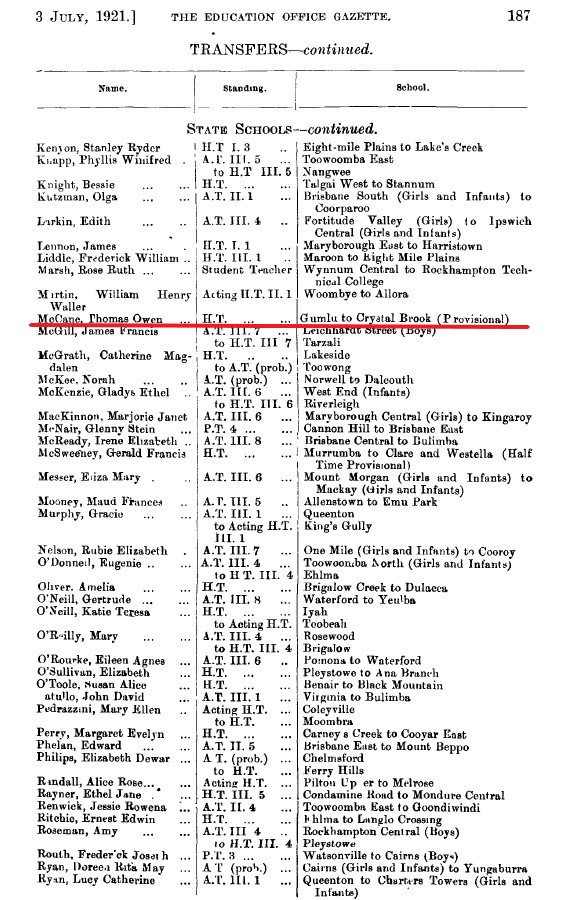
  • Thomas spent almost two years at that one-teacher school, 1919 to mid 1921.  The name was changed to Gumlu State School in 1920, during his time.  He was then transferred in July of 1921.

McCane family gathered for my grandmother's wedding day 1921.
Thomas is second from the left in the back row.

Back row L-R:   Tom's brothers -  James Patrick, Thomas (Tom), John Michael, Edward Joseph
Front row L-R:  Tom's sisters and parents - sister Sarah Mary (my grandmother), father Owen, mother Margaret, sister Susan Mary   

Thomas Owen McCane 1921


  • In mid 1921 he moved to a provisional school over two hundred kilometres from Gumlu.  Crystal Brook Provisional School was near Proserpine, in Queensland.  


  • His time there was short, as he was transferred to another provisional school in the same area.  


  • In 1923, Thomas was transferred to Eden Lassie Provisional School, which was closer to Longford Creek in the Proserpine area.


  • In between these two years, Thomas married Agnes Therese Parnell.  They went on to have two sons.  


  • Unlike his two older sisters, he was allowed to continue with his profession after marriage.


  • He returned to teach at Gumlu State School once more in mid 1924, and remained there for over 14 years.

  • This photo shows Gumlu State School (previously known as Molongle Creek Provisional School) as it existed in 1925. The children in the photo were all Thomas's pupils that year.
  •  The building was totally inadequate for the increased attendance in the 1930s, when Thomas was there.  He was the only teacher and student numbers ranged between 35 to 45.  Unfortunately that little wooden building with one room was Thomas's school when he returned to the area, and it remained the school until just after he moved on, 14 years later.
  • Thomas's students came to school on horseback, on the train, on push bikes, on foot.  They played marbles and cricket during their lunch breaks and were barefoot most of the time.  The younger students would often be sent outside to sit under a tree to learn their spelling or tables, while Thomas taught the higher classes in the school room.  The 'Manners Chart' was brought out at least once a week.  Singing lessons were part of the learning and "My Bonnie Lies Over The Ocean" was one of the most-often heard tunes. 


  • There was a large group of the McCanes, O'Donnells and Bidgoods living in the area around Gumlu, all related and working mixed farms.  The photo above was taken sometime in 1935 and includes Tom's mother, sitting on the chair in the middle of the group, his sisters and brothers and brothers' wives, along with children of his siblings and his own two boys.


  • At the end of 1938, Thomas was transferred to Sybil Creek State School at Finch Hatton, which was near Mackay in Queensland.  


  • The local newspaper described the sendoff he was given upon news of his transfer.

  • Thomas spent the remainder of his teaching career at Sybil Creek State School.


  • During his life time he experienced two world wars.  

  • When war broke out in mid 1914, Thomas was 15 years old.  He would have been keenly aware of the war, as they was a group of young men living in the Gumlu area who went off to fight in the great war, and never returned.  

  • His oldest sister married the only soldier who returned home in 1919, and Thomas would have been at the wedding.

  • Twenty years later, world war broke out once again.  Thomas had been teaching for that twenty years and was 39 years old.  He had just begun teaching at Sybil Creek State School the year before and he and his family were living in the school house at Finch Hatton.

  • In 1942, at the age of 43, Thomas enlisted and served nearly three years with the Citizen Military Forces (CMF).  His posting at the time of his discharge in late 1945 was with 15 Battalion Volunteer Defence Corps.


  • At the age of  68, Thomas died suddenly.  


  • He was by that time living in Mackay, Queensland.  

  • He was survived by his widow, Agnes and two sons, Edward Joseph and Kevin Thomas.  Edward Joseph followed in his father's and his aunts' footsteps by becoming a teacher as well.


I'm joining Amy Johnson Crow's 52 Ancestors in 52 Weeks 2023 Challenge  (even though so many of my posts now are not about my direct ancestors).


This time I'm catching up with the prompt for Week 4  - ''Education".

You can join by blogging or posting on social media with the tag #52Ancestors.

Check out Amy's FB pages:  Generations Cafe  or  Amy Johnson Crow


Monday, 9 January 2023

Memories ... January 10

In Remembrance

(For my 'Family Anniversaries' page)


Click on this link  The Story of James O'Donnell  if you want to read more about James.


Click on this link  The Story of Edmond O'Donnell  if you want to read more about Edmond.


My maternal grandfather James and his father, my maternal great grandfather Edmond, both died on January 10th, which is a coincidence I've only just become aware of recently.  It seems sad in a way that my grandfather died on the same day in January as the father he barely knew, as Edmond died when my grandfather was only 5 years old.

Collating various bits and pieces of information about their lives showed that their day of passing seems to have been the only thing they really did have in common.


On my father's side of the family, January 10th is also the day my paternal Granduncle died.  Tragically he died by his own hands, having seemingly never recovered from the trauma of witnessing the gruesome death of his younger brother.  Life can be cruel sometimes!


I've told the stories of both John Edgar and his brother James Alfred in this post:  Fire!