Monday, 1 April 2024

The Stories of Laurine Florence Farrell and Myreen Catherine Farrell / Memories ... April 2

Today I'm telling the stories of twin sisters Laurine Florence Farrell  (1916-2015) and Myreen Catherine Farrell  (1916-1995).   

Our common ancestors are:  Michael Farrell and Susan Muldowney/Downey.

I'm publishing this post on the anniversary of their birthday.

Anniversary of two Birthdays  

(For my 'Family Anniversaries' page)


These twin sisters were my maternal 1st cousins 2x removed.  Myreen however was also the wife of my maternal grand uncle, making her my grand aunt as well.  This is the first instance I've uncovered where I have two different relationship paths to a relative.  


Discovering that Myreen had a twin sister was a recent find and set me off on a frantic research effort so I could tell both their stories today, on the anniversary of their birth.


  • Laurine Florence and Myreen Catherine were born on the 2nd of April 1916 to parents Michael Farrell and Hannah Margaret Hynes.  Laurine was the first born of the twins.  The girls were born in Charters Towers, Queensland.


  • They were the youngest of the seven children born to Michael and Hannah, and entered a family already scarred by loss.  Their eldest sibling Myreen Florence has passed away tragically just a month short of her second birthday.  In her honour, Michael and Hannah gave one of the twins her name.

  • Laurine and Myreen's siblings included:

- Myreen Florence born in 1902 (died in 1904)

- Muriel born in 1904

- John Michael born in 1905

- Arthur Thomas born in 1907

- Edward Francis born in 1911.


  • It appears that the children had a rather chaotic upbringing.  Father Michael Farrell ran a busy auctioneering business and was a well-known figure in the business community.  Mother Hannah (although she was also known by her middle name of Margaret) was a licensed victualler and ran The Australian Hotel in Charters Towers.


  • With both parents engrossed in their extremely busy working lives, the children appear to have spent a lot time being cared for by their grandparents in Charters Towers initially, and then by their aunt Margaret McCane nee Farrell and their uncle Owen McCane (Muckian), on their farm near Gumlu.


Enrolment No 42 should read 'Muriel Farrell' not 'Murill Farrell'
(William Patrick Farrell is from a different family)
Source:  Gumlu State School Centenary Booklet


  • The older siblings, Muriel aged 14, and Edward Francis (Ned) aged 7, appear to have been dispersed to their aunt and uncle first.  In 1918 they were both enrolled at the Molongle Creek Provisional School (later it became the Gumlu State School).  That is a clear indication that they were living with their aunt and uncle, and no longer living in Charters Towers.


(An interesting side note: The teacher at the school from 1914 to 1919 was Susan Mary McCane.  She was an older cousin to Muriel and Edward, as she was a daughter of Owen and Margaret McCane.  Susan was also living on the McCane family farm at the time.)


  • Tragically, in mid-1918, when the twins were only two years old, their father Michael died rather unexpectedly leaving their mother Hannah widowed at the young age of 36.  It seems Hannah struggled to manage the children still under her care, and more went to stay with their aunt and uncle. 


Source:  Gumlu State School Centenary Booklet


  • At the start of the following year, 1919, older brother Arthur Thomas, aged 12, was also enrolled at the Molongle Creek Provisional School (later the Gumlu State School). 


  • In a heartbreaking twist of fate, the twins' mother died in 1923, leaving the Farrell children orphaned - Muriel was 19 at the time, John Michael was 17, Arthur Thomas was 16, Edward Francis was 12, and the twins were just 7 years old.


Source:  Gumlu State School Centenary Booklet

  • At the start of 1924 the twins, Laurine and Myreen were enrolled at Gumlu State School as well.  (The school had been re-named in 1920).


(Another interesting side note:  In mid-1924 the teacher at what was then Gumlu State School, Thomas Owen McCane, was another of Laurine's and Myreen's cousins.  He was also a son of Owen and Margaret McCane, and brother to Susan Mary McCane who had taught the twins' older siblings.)


Source:  Admission Register for Molongle Creek Provisional School (later Gumlu State School)
13 Oct 1913-6 Feb 1950

  • The 1924 admission register for Gumlu State School shows that their uncle, Owen McCane, was recorded as their "guardian".  Laurine was enrolled in Second Class, while Myreen was enrolled in First Class.  I wonder why the twins were enrolled in different year levels?  Was there a difference in their intellectual level or ability to learn?  The record also shows that both girls were absent from school in 1925, but returned at the start of 1926.  Both girls left school in December of 1927, Laurine having completed Fourth Class and Myreen completed Third Class.


  • Laurine and Myreen's early childhood years had unfolded against a backdrop of familial upheaval but after the move to the McCane farm at the age of 7, they were then living and seemingly thriving in a more stable family home.  Their education, initially disrupted by family circumstances, regained momentum and their talents began to shine.


  • Their names appeared in newspaper items in local newspapers a few times in the late 1920s and early 1930s.  By that time they had both moved to the Catholic Convent Boarding School in Bowen, and were attending the Catholic Convent School.  They were excelling in their studies and showcasing talents in drawing and music.


  • In 1929, when they were both aged 13, they were winning prizes in the local show competitions for drawing:


  • Laurine won second prize in the 'Best Drawing Book, 12 drawings shaded' competition and won 2 shillings.  Myreen won first prize in the 'Best Group of 5 drawings in free-hand design, shaded large'.  She won 5 shillings.  I wonder if they pooled their winnings and spent it on something special?


  • In 1930, aged 12, they completed their Australian University College board examinations for piano, as well as examinations for commercial subjects:


  • Laurine achieved a credit on her Grade V piano examination, and Myreen achieved a credit on her Grade V1 examination.  They were impressive results!  They both passed Elementary Typewriting, Elementary Bookkeeping and Junior Shorthand, typical subjects offered to girls in their final years of schooling paving the way to a career in secretarial work. 


(Note:  There was a misprint in the newspaper - under the results for Elementary Typewriting the name 'Kathleen Farrell' should have read 'Laurine Farrell'.  There was no Kathleen Farrell enrolled that year!  There was a Kathleen Caldwell and a Laurine Farrell.) 


  • In 1931, aged 15, the twins were completing their last year of schooling.  The Queensland school leaving age had been raised from 12 years to 14 years, back in 1912.  It's likely the girls had missed a year or so of their education during their younger years, so then stayed in school until they completed their final year, even though they were probably older than their peers.


  • As reported in this end-of-year newspaper item, their commercial subject examinations results were rather good:


  • Laurine and Myreen passed the Advanced Bookkeeping, Intermediate Shorthand and Speed Typewriting subjects.


  • As they approached adulthood, Laurine and Myreen faced diverging paths.  While one pursued a career, the other embraced married life and motherhood at a young age.  Their lives took them to opposite ends of the country where they carved out their individual stories.


Laurine Florence Farrell

After completing her education and honing her skills as a typist, Laurine sought opportunities away from home.


The 1937 Australian Electoral Record shows Laurine living and working in Brisbane, Queensland.  Her occupation was listed as:  typist.


Her name was recorded on the Supplemental Roll for the Division of Toowong.  The original roll showed her older sister Muriel and brother John Michael also living in Brisbane.


It seems that these three siblings had all embarked on a journey southward seeking employment and independence.  They were all living together in a boarding house / property on the corner of Milton Road and Ridley Street in the Brisbane suburb of Auchenflower.  


By 1939 Laurine's career had flourished and she was working for Butler Brothers in Brisbane.  Her photo (third from the left) appeared in a local newspaper in late 1939, attending the first annual staff ball for that company.


War was now looming and Laurine answered the call to serve her country.

Enlistment Photo 1942

In March of 1942, a month before her 26th birthday, Laurine enlisted with the Royal Australian Air Force.  


She served at various wireless / telegraphic stations in Melbourne, Victoria; and in Townsville and Brisbane, in Queensland.  After the war, Laurine's life took a new turn.  She was discharged in Victoria, where her beloved older sister Muriel and brother John Michael were then living.  So it was that these three siblings moved even further away from the rest of the family, and continued their life journeys in Victoria.


By 1949 Laurine was living with her older sister Muriel in South Yarra, Victoria, and was now working as a stenographer.  The role of a stenographer is to record spoken words using a stenography machine, typically at legal proceedings, and this is the career that Laurine continued for the remainder of her working life. 

Older brother John Michael had remained in Victoria after serving during the war years, also living in Melbourne. 


In 1952, at the age of 36, Laurine married Ronald Vincent John McInnes, aged 30, at St. John's Catholic Church in East Melbourne.  


The marriage certificate shows that Laurine's husband was a soldier with the Australian Armed Forces and Laurine herself was working as a stenographer.  


Laurine and Ronald were married for 23 years, until Ronald passed away in 1975.


Laurine and Ronald spent their married life living in one of Melbourne's eastern suburbs.  They had no children.


Laurine outlived her siblings by many, many years.  Her twin sister died 20 years before Laurine passed away.

The two older brothers Arthur Thomas and Edward Francis died in Queensland.  They had remained living on their aunt and uncle's farm for many, many years; then as they grew older moved a little further away.  Arthur Thomas Farrell died in Mareeba, Queensland, in 1961, aged 54.  Edward Francis Farrell died in Bowen, Queensland, in 1977, aged 66.


The two eldest siblings, who had moved to Victoria, never returned home to Queensland.  Eldest sister Muriel Farrell died in Victoria in 1984, aged 80.   She was cremated and her ashes were scattered at the Springvale Botanical Cemetery in Melbourne.  Eldest brother John Michael Farrell also passed away in Victoria in 1989, aged 83.  He was cremated at the same crematorium as his sister Muriel.  His ashes were interred at the Springvale Botanical Cemetery.  His memorial plaque is located at the A.C. Downard Lawn, Bed 19, Position 57.  John Michael also has a memorial plaque at the Victorian Garden of Remembrance.


Laurine died on the 29th of April 2015, aged 99!  


She was cremated and her remains were collected from the Springvale Crematorium, situated within the Springvale Botanical Cemetery in Melbourne, Victoria.  I have no other information, but I'm assuming her remains would have been collected by a family member, possibly a relative of her husband.


Myreen Catherine Farrell

Myreen married not long after she had completed her education.  In 1933, at the age of 17, Myreen married John Michael (known as Jack) McCane.  


(Yes, Myreen's husband's Christian names are the same as her brother's - John Michael - so in order to avoid confusion I'll refer to Myreen's husband as John Michael (Jack) from now on.)


Myreen (in the middle) standing beside the car that her sweetheart had won!


John Michael (Jack) is on the far left of this photo.
The photo was taken on his father's farm. 
Owen McCane, John's father (and Myreen's uncle), is far right.


John Michael (Jack) McCane
Photo taken at his sister Sarah's wedding in 1921
John was 20 years old

John Michael (Jack) McCane was the son of Myreen's aunt Margaret and uncle Owen McCane, so he was Myreen's cousin.  


Obviously, Myreen and John Michael (Jack) had spent a lot of time in each other's company after Myreen had moved to her aunt's and uncle's home, and it seems a romantic relationship had developed.


At the time of their marriage John was 32 years old, so there was a considerable age difference between them.  Permission to marry was needed as Myreen was under the age of 21 at the time.  It was her older sister Muriel who provided that permission, as she was Myreen's legal guardian. 


Myreen's uncle, and John Michael's (Jack) father, Owen McCane had passed away by the time they were married. After Owen's death, John Michael (Jack) and his brother James (known as Jim) stayed on the family farm with their mother Margaret.  They had spent years and years helping their father work the farm, and had now taken up residence on the property.  Settling into life as a farmer's wife, Myreen embraced her role with determination and she remained living on the farm where she had spent many of her childhood years.


Myreen and John Michael (Jack) were married for 52 years, until John died in 1985.  They had three children together over a period of sixteen years.

- Margaret was born in 1933, when Myreen was still 17 years old.

- Florence was born in 1940, but sadly passed away the following year.

- Ailsa Janice was born in 1949.  Myreen was 33 years old at the time.


Myreen, husband John Michael (Jack) and baby Margaret are all circled in orange


The photo above shows the large family unit that enveloped Myreen with love throughout her lifetime.  The McCane farm served as the heart of this tight-knit family as they all either lived close to the McCane family farm or indeed on the family farm for many, many years through the 1930s, 1940s, 1950s and some into the 1960s.


In the middle of the photo is Myreen's aunt, and John's mother, Margaret McCane nee Farrell.  Around the matriarch of this close family are Margaret's children (Myreen's cousins), Margaret's daughters-in-law (including Myreen) and Margaret's grandchildren.  This photo was taken the year after Myreen had married on the McCane family farm, and I think shows a very happy and contented Myreen.


As the years passed, her life would have revolved around the rhythms of farm life and the warmth of frequent family gatherings and celebrations.  


Myreen and her husband bid farewell to the family farm that they had called home for decades in the late 1970s.  The electoral record for 1977 shows them living at 38 Fourteenth Street in Home Hill where they were still surrounded by members of the McCane clan.


In 1985 husband John Michael (Jack) passed away at the age of 83.  Myreen was widowed at the age of 68, and then sadly, she died after a stroke in 1995 when she was 79 years old.


Myreen was buried at the Home Hill Cemetery alongside her husband John.  She was survived by her daughters Margaret and Ailsa, and her twin sister Laurine.  I do so hope that the twins had kept in touch over the years and that the bond between them had remained unbreakable.


Thursday, 7 March 2024

The Story of John (Jack) Browning / Memories ... March 8

This post tells the story of my paternal 1st cousin 3x removed, John (Jack) Browning  (1885 - 1917).

Our common ancestors are:  William Henry Browning and Anne (Nancy) Littlejohns.

I'm publishing this post on the anniversary of his passing.


 In Remembrance

(For my 'Family Anniversaries' page)


John (known as Jack) Browning


  • John was born on the 4th of November 1885, on the family farm Rosehill, near Blakebrook, in the Northern Rivers region of  New South Wales.

  • His first name was recorded as John on his birth certificate.  He was however more commonly known as Jack for most of his life.


  • The names John and Jack were used interchangeably on various records throughout his lifetime, which made research quite difficult.  During this post I will combine the names and refer to him as John (Jack).

  • According to the information recorded on John's (Jack's) birth certificate, he came into the world as the 11th child born to Joseph Edward Browning and Elizabeth (Eliza) Browning nee Wilson.

  • There had apparently been seven children living when John (Jack) was born and three that had passed away.  I have only found records pertaining to nine children born before John (Jack) came into the world.  

  • Those nine siblings and the two who were born after John (Jack) were:
         - Henry Joseph born in 1864
         - Mary was born in 1866 and tragically died that same year
         - Susanna born in 1867
         - Joseph born in 1870, but sadly died six years later
         - William born in 1873
         - Amelia born in 1875
         - Sarah Ann born in 1878
         - James born in 1881
         - Samuel Joseph born in 1883
         - Francis born in 1889
         - Robert Albert born in 1892

  • Growing up on the family farm near Blakebrook amidst his siblings, John (Jack) not only learned the intricacies of farm life, but also the trade of a teamster, following in the footsteps of his father who plied that trade well into his 60s.  

  • As a young adult, John (Jack) and his brothers Henry, Samuel, and William left the family farm and took charge of the family teamster business; work that was vital to the timber industry in the region.

  • Teamsters had a team of either horses or bullocks and carried items/goods from one place to another for a living.  At that time, the timber industry was flourishing and was, by far, the most important industry in the district. John (Jack) and his brothers, like many teamsters in the area, obtained felled and sawn timber from the timber cutters, and hauled it to the sawmill in nearby Lismore.


  • The 1913 Electoral Record shows that John (Jack), aged 28, was living in Nimbin, north of Lismore, in the Northern Rivers region of New South Wales and his occupation was listed as 'teamster'.

  • The following year bought news from overseas that was about to change the course of John's (Jack's) life significantly.  Mid-1914 saw the beginning of the global conflict known as The Great War.

  • The outbreak of World War 1 prompted John (Jack) to answer the call of duty.  He enlisted on the 16th of November, 1915.


  • John (Jack) enlisted under the name of Jack, not John, at the age of 30 (although his attestation papers listed him as 26 years old).

  • After enlistment, John (Jack) was sent to training camp at Enoggera in Queensland where training lasted for several months.

  • When friends discovered that John (Jack) would be given leave to spend the 1916 New Year with his parents, they organised an enormous farewell celebration.  A rather detailed account of this farewell was published in a Lismore newspaper after the event (and both names - John and Jack - were used in this account!).


  • The article mentions that "in three days sufficient donations were received to enable (the) ... purchase (of) ... a handsome wristlet watch.  Invitations were issued, and fully sixty people availed themselves of the opportunity of attending this pleasant function, which was held in the spacious dining room, kindly lent by Mr. and Mrs. Jos. (Joseph) Browning, Sen. for the occasion."   So. the dining room of John's parents' home was decorated and turned into a function room for around sixty people.  It must have been a rather spacious room!
         It's also noted that around "33 members of the Browning family" attended! It sounds 
          to me as if it was a very close family and they took the chance to spend precious time 
          with John before he shipped off to fight overseas.

  • The article goes on to state "The chairman spoke of the great respect and esteem in which the guest was held, and then called on Miss May Browning to fasten the watch on Jack's wrist."  I think the degree to which John was respected in the community was made clear in the last part of the article.  After the dancing and merriment ended around midnight, the chairman "called on all present to assemble together as he still had another pleasant duty to perform.  The residents of Blakebrook and districts had subscribed a very nice autograph album to be present by Private Browning to his parents as a keepsake.  Mr. Maher called on all present to sign their names in the book, and in a neat speech asked Jack to hand this book to his aged parents as a memento of the pleasant evening he had spent with parents and friends."

          What a deeply moving gesture!   


  • During his training period, John (Jack) appears to have moved through various battalions, according to his active service record. 
    • Soon after enlistment John (Jack) joined the 34th Battalion "D" Company.
    • On February 2nd 1916 he moved to the 36th Battalion "A" Company.
    • John (Jack) then moved to the 42nd Battalion "A" Company on the 16th of February 1916.
    • He was taken on strength by the 42nd Battalion "A" Company of the 15th of April 1916.

HMAT A30 Borda  (photo taken 1916)
Description:  Troops on board HMAT Borda prior to departure, with well-wishers on the wharf 
holding paper streamers connecting them to the men on the ship.
Photo sourced from the Australian War Memorial website
Copyright expired - Public Domain


  • After the completion of training at Thompson's Paddock Camp, at Enoggera Barracks in Queensland, John's (Jack's) unit embarked from Sydney, New South Wales, on board HMAT A30 Borda on the 5th of June 1916.

  • John (Jack) disembarked at Southampton, England on the 23rd of July 1916.  There was a further training period in England at the Lark Hill training camp, on the Salisbury Plain, before he proceeded overseas to France on the 25th of November 1916.  By this time, John was 31 years old.

  • In the trenches of France, John (Jack) became a member of a Lewis Gun Team, a crucial role in the evolving tactics of semi-open warfare.

A Lewis Gun Team on a duckboard trail 1917
Source:  Australian War Memorial
Copyright expired - Public Domain


From 'The Interplay between Technology, Tactics and Organisation in the First AID', Ross Mallett.  MA (Hons) Thesis, Australian Defence Force Academy 1999.  Chapter 4 'Semi-Open Warfare'
"Important tactical and organisational developments occurred over the winter (1916-1917).  One major tactical and organisational change was the organisation of the infantry.  ... the original allocation of Lewis guns of four per battalion was gradually increased to twelve at the of July 1916.  ... In December, enough Lewis guns became available to give each infantry battalion sixteen guns and BEF GHQ decided to allocate one to each platoon while still allowing for them to be pooled at company level if need be. 


A Lewis gun section (of a platoon) consisted of nine fully trained Lewis gunners, although there was only one Lewis gun.  The section leader was a sergeant or corporal.  He allotted fields of fire, arranged reliefs, and recorded ammunition expenditure and breakages.  Each squad had a gunner, the man who carried the gun into action and fired it.  ... An assistant stuck close to the gunner, ready to replace the gunner if he was hit and helping the gunner in any way possible with loading and breakages.  ... In action, the assistant lay beside the gunner ... From this position, he could also provide the gunner with moral support and take over more quickly if the gunner became a casualty. 


The rest of the team were riflemen doubling as ammunition carriers, scouts and observers.  Each rifleman carried 50 rounds of rifle ammunition.  One rifleman carried four to eight Lewis gun magazines and maintained close touch with the gunner and assistant, ready to replace the assistant if either the assistant or gunner became a casualty.  Two were lightly loaded scouts, moving ahead of the gun, locating targets and observing for the gun when necessary while the second scout could be used as a messenger when the gun was in position.  The remaining three were ammunition carriers with six magazines each."


  •  Each Lewis Gun Team accounted for 1 Lewis gun and 2068 rounds of ammunition.
           No. 1, the man who fired the Lewis gun, carried the gun which weighed over 12                     kilos.

           No. 2, the loader, carried 4 magazines, a tool kit and spare parts.

           No. 3, the main ammo supplier / retriever, carried 4 magazines.

           Nos. 4 & 5 were scouts.
 
           Nos. 6, 7 & 8 were extra ammo suppliers and carried 12 magazines each.

           (Nos. 1 & 2 also had a pistol.  The others carried their full kit and a rifle.)

           This team-based system meant that the Lewis gunners were able to operate almost 
           as independent units, acting both in defensive positions within a trench or in               
           support of a raid on enemy tranches by giving covering fire from no-man's land. 


  • John (Jack) was the No. 1 in his team, a position that required skill, courage and precision.


  • Despite being wounded in action on the 2nd of February 1917, he remained on duty.  I have not yet found any details about the type of wound he suffered, and the family, who received this news via telegram on the 20th of February, were none the wiser either.

  • Whilst John (Jack) had seemingly been fortunate in February, his fate took a tragic turn the following month. On the 8th of March 1917, John was killed in action near Armentieres, France.

  • The Browning family, who had bid a heartfelt farewell to John just a few months earlier, received the devastating news of his sacrifice.


  • A notice appeared in the local Lismore newspaper a couple of weeks later.  It mentioned Mrs. Roy Hancock, John's sister Sarah Ann, and Mr. and Mrs. Joseph Browning, John's parents.  Interestingly, the paragraph relating to Sarah Ann has John's name recorded as 'Jock', but then the following paragraph relating to John's parents has his name recorded as 'John'.  Perhaps he was also affectionately known to some as Jock!!


  • A little gem that appeared in the same local newspaper a few months later was the publication of a letter received from Private Harley on the front line in France.  In this letter, Harley mentions the death of John (Jack):
"The river boys (meaning the Richmond River near Lismore) have been pretty lucky in our battalion so far, only one that I know of being killed, and that was Jack Browning, from Lismore, one of the biggest and best."

          Just another reminder of the esteem in which John was held by those who knew him.


  •  The letter of sympathy written by Major A. R. Heron, on behalf of the Commandant of the 42nd Battalion, and sent to John's (Jack's) parents was published in the Lismore newspaper in May of 1917.  That letter presented information about the nature of John's (Jack's) death, which I did not find included in his war service record.
John was "killed instantly by a shell which hit him in the chest during a bombardment."

The words "He was a valuable man and was employed on a special branch of the service, which demanded coolness and courage in the face of great danger, a duty which he always performed very satisfactorily" speaks to the good character of this man.


  • John (Jack) was buried at the Cite Bonjean Military Cemetery in Armentieres, France.


  • His headstone can be found in Plot IV, Row F, Grave No. 7.


  • John's (Jack's) name is also commemorated on the Wall of Honour at the Australian War Memorial in Canberra.


         While visiting the War Memorial recently, I stopped at Panel 135 to pay my respects.

  • John's (Jack's) name is commemorated in a couple of other places as well ....


  • It appears on the front panel of the Nimbin District War Memorial in Nimbin, New South Wales.


Opening of the Nimbin District War Memorial on the 24th of May 1921
Photo sourced from the Virtual War Memorial website
(https://vwma.org.au/explore/memorials/8305)

  • This memorial in Nimbin was unveiled in 1921, and I have no doubt some of his family were there that day and likely in the photo that was taken.


  • John's (Jack's) name also appears on the Great War Wall of Honour at St. Mark's Anglican Church in Nimbin, in the Lismore Municipality.  You can see it top left in the photo above.

  • John (Jack) was survived by both his parents(although his father passed away just eight months later, in November 1917) and all nine siblings who had survived into adulthood.

Northern Star Sat 8 Mar 1919 p. 8  Family Notices


  • John (Jack) was obviously remembered with love and missed dearly as his family were placing notices in local newspapers on the anniversary of his death for a number of years. 

  • One of John's (Jack's) siblings also enlisted and served in WW1.  His youngest brother, Robert Albert Browning, enlisted just a month after the death of John (Jack), in April of 1917. He headed overseas in August that year, but by April of 1918, Robert was reported as suffering with neurasthenia and identified for an early return home.  Whilst the war did not claim the life of this sibling, it left its mark on his emotional health, as was often the case. 


Saturday, 24 February 2024

The Story of Erice Sylvester Connors

This is the story of my paternal Grand Uncle, Erice Sylvester Connors  (1892 - 1916).

Our Common Ancestors are: Thomas Edgar Connors and Susannah (Susan) Fullagar Hukins.


  • Erice was born on the 24th of January 1892 at the family farm named 'Far Meadow' outside Berry, in the Shoalhaven Region of New South Wales.  The birthplace is recorded as Meroo, as that was the nearest small town to the family farm.

  • He was the youngest of ten children born to Thomas Edgar Connors and Susannah (Susan) Fullagar Hukins.

  • The children born before Erice were:
           - Mary Ellen born in 1874
           - John Edgar born in 1876
           -William Adolphus born in 1878
           - George Thomas (my grandfather) born in 1880
           - Alice Adelaide born in 1882
           - James Alfred born in 1884
           - Percy Jerome born in 1886
           - Cyril Ernest born in 1888
           - Frederick Augustus born in 1890

  • The name Erice stands out as an intriguing anomaly in our family's history.  At the time of his birth, it was neither a common first name nor a familiar family name, making its choice by my great-grandparents all the more curious.  This decision becomes even more puzzling when considering the conventional names given to all his siblings.

  • Throughout his lifetime, Erice was rarely called by his given name.  Most people knew him as Eric, a more conventional variant, while friends affectionately referred to him as Ted.  It seems the unusual nature of his Christian name led many to adopt these alternatives, and Erice remained a seldom-used curiousity.

  • In my attempts to uncover the origins and significance of the name Erice, I found little clarity.  The name appears to be quite rare, with conflicting claims about its usage and origin.  Some sources suggest it is a female name, others a male or unisex name.  Some attribute it to English origins, while most remain noncommittal.  The scarcity of reliable information left me both dazed and fascinated, wondering what inspired my great-grandparents to choose it!

  • Interestingly, my research uncovered a couple of potential connections.  There is an ancient Greek name, Eryx, associated with a legendary Greek hero.  However, it seems highly unlikely that my great-grandparents would have had an awareness of ancient Greek mythology.

  • Another possibility is the historic town named Erice in Sicily, which sits atop Mount Erice.  The town adopted this name in 1934 though, long after my great-grandparents had passed away, ruling out any direct link to their choice.

  • Ultimately, the reasoning behind my paternal grand uncle's distinctive name remains a mystery, one likely lost to history.  Despite this, Erice holds a special place in our family's story.  His name, unique and enigmatic, ensures his memory endures as a cherished part of our lineage.

Here's his story:
  • Growing up on the family dairy farm ' Far Meadow' near Berry, Erice and his siblings would have learned all the ins and outs of farm life, supporting their father with the work involved in running a dairy farm.

  • Erice would have tended to all his chores before and after school, making for very long days indeed.


  • Erice was an active participant in local and school events as well.  In 1906, at just 14 years of age, Erice showcased his athleticism by placing 1st in the '75 yard sack race' and the 'wheelbarrow race' during the Public Schools Carnival, held in Nowra.  He placed 2nd in the 'throwing at wicket' competition.  His name appeared as Eric in several newspapers at the time, including the Shoalhaven Telegraph (dated Oct 3 1906) and The Kiama Independent & Shoalhaven Advertiser (dated Oct 5 1906).

  • Tragically in December of that same year, Erice faced the loss of his older brother William Adolphus.  William had been suffering tuberculosis for at least three years and unfortunately, he died as a result of this terrible disease when he was just a young man aged 28.

  • The following year brought more sorrow to the family.  In 1907, When Erice was 15, his older brother James Alfred died as a result of burns inflicted by a fire that broke out at his workplace.  (I've written about James in this previous post:  Fire and its Tragic Consequences.  For those interested, scroll to Story 2).

  • In 1910 the Connors family experiences further heartbreak.  Erice's mother Susan died in May and then his father passed away in August.  Erice had just turned 18 at the start of that year.

  • By this stage, Erice found himself amidst a family that had dispersed, with most of his siblings leaving the family farm.  In the face of such personal loss and family change, Erice made his way to the north coast of New South Wales, joining his older brothers John, Cyril and Frederick (Fred) who had established themselves in the Richmond River area.  His eldest sister wasn't too far away either, as she was living in Brisbane with her husband John George Bates. 

  • By 1914, Erice was living with his siter Mary Ann and her husband John George on Gotha Street in Fortitude Valley, Brisbane, Queensland.  Erice was working as a bread carter.

  • The spectre of World War 1 was now looming menacingly, and when England declared war on Germany, Australia was thrown into a worldwide conflict that would alter the lives of millions.

Cyril Ernest Connors, older brother of Erice
Photo taken around time of enlistment - 1914


  • Erice's older brother Cyril Ernest had enlisted early, in October of 1914.


  • Erice himself answered the call for duty, enlisting for the Great War on the 28th of September 1915.   He signed his attestation papers with the signature 'E. S. Connors'.  Despite the fact that his name was recorded at the top as 'Erice Sylvester Connors', when I was searching for his war service record I found it had been created under the name of 'Eric Sylvester Connors'.

(The following details of Erice's war service were sourced from his War Service Record & "Stories of the Somme: The Soldiers of the Great War", a Weebly webpage written by Micheal & Donna Fiechtner).

HMAT Wandilla
Description:  Troop Transport HMAT Wandilla (A62) preparing to sail from Pinkenba Wharf on Jan 1916 with Australian troops onboard. Relatives and friends farewell the troops from the dockside.
Copyright expired - in public domain
Sourced from the Australian War Memorial website


  • Erice joined the 9th Battalion 14th Reinforcements, embarking on the HMAT Wandilla from Brisbane on the 31st of December 1915. 

Active Service Record of Erice Sylvester Connors


  • His journey initially led him to Alexandria, Egypt, where the Australian Imperial Force (AIF) were preparing for deployment to France.  He disembarked at Alexandria on the 5th of March 1916.

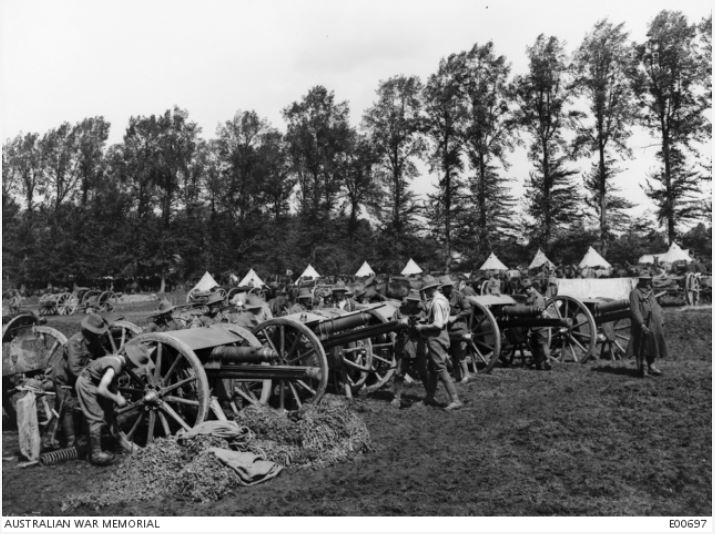
11th Field Artillery Brigade
Description:  11th Field Artillery Brigade, near Bailleul, France 1917
Copyright expired - in Public Domain
Source:  Australian War Memorial website


  • On the 21st of April 1916, at Serapeum, Erice was taken on strength by the 11th Field Artillery Brigade, assigned the rank of 'gunner', and posted to the Brigade Ammunition Column. The 11th Field Artillery Brigade had only just been formed in February, and was attached to the 4th Division.  


  • On the 1st of June 1916, Erice sailed for France aboard the HMT Haverford, marking the beginning of his active service.  The ship docked in Marseilles on the 10th of June, and at 2.00 pm that afternoon Erice boarded a train for a three-day train ride to Le Havre, near Paris.
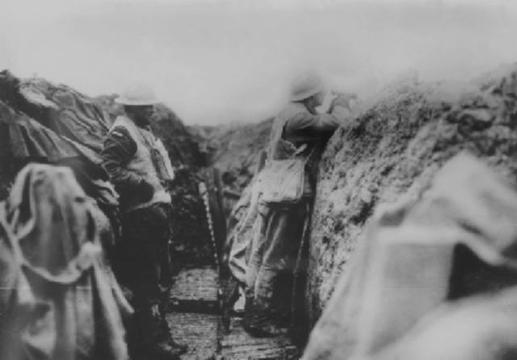
  • After this train journey, the brigade arrived in a relatively quiet "nursery" sector near the town of Armentieres in northern France.  The early battalions were engaged around Armentieres first as it was regarded as a good place to prepare soldiers for future engagement on the Western Front.

  • On the 17th of June 1916, Erice was transferred to the 11th Field Artillery Brigade Headquarters where he took on the role of a signaller withing the Brigade Ammunition Column.  He would have been responsible for communications within the Brigade, possibly laying signal lines between HQ and the various batteries.

  • Erice was involved in major action involving Australians on the Western Front throughout the remainder of 1916.

  • The Brigade first entered the line at Fleurbaix in the Fromelles sector on the 4th of July 1916 and two days later had its first taste of battle when shelled by enemy artillery for two hours.  The Brigade returned fire during the next few days.  On the 13th of July 1916 the Brigade retired to billets at Croix du Bac, but returned to its former position in the lines within a few days.

The battlefield of Fromelles
A view from the German observation post on Fromelles church that gives an idea of the complete domination the enemy had over the battlefield on 19 July 1916.
Copyright expired - in public domain
Sourced from the Australian War Memorial website


  • Between the 19th and 20th of July, the Brigade supported the 5th Division AIF in its attack at Fromelles, and on the 22nd of July it was attached to the New Zealand Division and moved north to Armentieres where it stayed in the line until the 3rd of August.  (Information about the Battle of Fromelles can be found here:  Fromelles (Fleurbaix) 19/20 July 1916)

  • The Brigade undertook further training until the 23rd of August 1916 when it proceeded to Dickebusch near Ypres to take over from the 6th FAB of the Canadian 2nd Division.  This area was in the vicinity of Pozieres which had been taken by AIF troops in the previous weeks.

  • The 11th FAB stayed in the line until the 18th of September when it was relieved.  On the 8th of September, Erice had been invalided to the Australian Field Ambulance for a short while, as his teeth were giving him trouble.

  • The next couple of months represented a similar affair for the unit, with stints in and out of the lines.  

  • On the 14th of November 1916 the Brigade undertook a six day march from Boeschepe to Naours, returning to the Somme, where it would eventually be held in reserve until the 21st of December 1916.

Front line at Flers 1916


  • At that time his battalion took the line just north of Flers, not far from Pozieres on The Somme.  The Germans welcomed them promptly with a heavy bombardment on the 22 of December 1916.  Shrapnel fire was sustained, and the Brigade subsequently engaged in an artillery duel with the enemy on Christmas Eve.                                                                                                      (Information about the Flers/Gueudecourt Battle can be found here:  'The Winter Offensive' - Flers/Gueudecourt /Gueudecourt Winter of 1916/1917)

  • By Boxing Day, the enemy had accurately registered its guns on the Brigade and the Australians were convinced their own gun flashes were visible to the Germans except in extremely foggy weather.

  • The conditions on the Somme were horrendous, with the winter of 1916/1917 being the worst in 40 years.  In the short time Erice had been in France, he had experienced and endured the extremely harsh conditions of the Western Front, engaging in battles and facing relentless enemy fire.

  • On the 28th of December 1916 an enemy airplane attacked the Brigade, firing its machine guns into the Batteries.  Two days later, on the 30th of December 1916, the Germans opened fire on the Brigade, whose positions it had ranged.  The fire around HQ was very heavy throughout both the morning and evening that day. 

  • At 4.00 pm a shell hit one of the HQ dugouts that functioned as a cook house where Erice was sheltering with a number of soldiers.  Erice was killed instantly along other soldiers, including Kenneth (Ken) Taylor and John (Paddy) McGrath.  In all, 344 other Australians would be killed that month.

  • The Red Cross Wounded and Missing Files have a number of records concerning Erice's death.  This suggests that enquiries were made by relatives back home in Australia, after hearing the devastating news of his death.

  • It had taken some time before family and friends knew about Erice's death.  Death notices did not appear in local newspapers until February the following year.


  • The Red Cross Wounded and Missing File indicated that Erice, acting as a Signaller for Brigade HQ, was sheltering in a dugout, reportedly having a cup of coffee with comrades Ken Taylor and John (Paddy) McGrath, when a 5.9 inch shell hit their location.  The explosion claimed Erice's life, along with the lives of his comrades and at least one other soldier, and left little evidence behind.  Erice's death was instantaneous.

  • These files included a statement by an eye witness who assisted in the burial of what remained of the all the soldiers into one grave, with a cross erected above the grave.  There were other reports stating that the soldiers were indeed buried together.

  • Burials often occurred in a field or an available clear space near where the soldiers died, but sadly these graves would often be destroyed later, as the war ravaged on.  This appears to be the case for Erice's burial place and his remains, as they have never been found. 


Erice's name on the Australian Memorial at Villers Brettoneux


Erice's name on the Wall of Honour at the Australian War Memorial


  • Erice Connors, like many others, became one of the countless soldiers with no known grave.  His sacrifice is however commemorated on the Australian Memorial at Villers Brettoneux and the Roll of Honour Wall at the Australian War Memorial, a testament to a life cut short on the brutal battlegrounds of World War 1.


  • Erice's name is projected onto the exterior of the Hall of Memory at the Australian War Memorial four times a year, ensuring his name lives on.  The next name projection is scheduled for Monday, May 13 at 12.54 am.