Saturday, 7 January 2023

The Story of Susan Mary McCane

This week I'm telling what I know about my maternal Grand Aunt, Susan Mary McCane  (1891 - 1974).  

Our Common Ancestors are:  Owen McCane (Muckian) and Margaret Farrell.

Susan was my grandmother's only sister and according to family connections, they were very close throughout their entire lives.  There were many parallels in their lives, and while I've told my grandmother's story before, I've never posted about Susan, so I think it's time.

Just this past year, I received a batch of photos of Susan and her family, from a second cousin.  I've never seen any of these photos before, and this prompted me to look a little more deeply at Susan's life. There was one particular shot which quickly became a favourite out of all the photos sent to me.

Photo shared by my second cousin Therese Olsen


Here's my grand aunt Susan trying to pose with all her grandchildren at a birthday party, sometime in the 1950s.  I just love the informality of this photo and the fact that Susan is not even looking at the camera at all, while most of the children are, apart from a couple of what appear to be upset babies at the back who are the focus of Susan's attention!   I'm sure the point of getting all the kids together was to have a record of this special day with their grandmother and it looks like the photographer just gave up on getting Susan looking the right way.  I wonder if the occasion was her birthday?  I was also left wondering where this photo was taken, as that looks like an old wooden bridge that they're all standing beside!  Where were they celebrating?  It looks like most of the grandchildren are wearing swimmers, so perhaps they're all near a great swimming spot, like a creek or river.  I want to know more!

Not long after my second cousin sent her collection of photos, I was sent a digital version of a book celebrating the 100th anniversary of Gumlu State School by a third cousin, in which Susan was mentioned as one of the very first teachers at the school.  As I am now coming to the end of a 40-year career in education myself, it always peaks my interest when I find out that particular relatives were also teachers, so this was an extra prompt to delve further into the events of Susan's life.


So, here I go with my attempt to tell my grand aunt's story ...  (if any of Susan's descendants read this post and have more information, I would very much appreciate it if you would share this with me)


Susan Mary McCane was born in November of 1892 in Charters Towers, Queensland, Australia.  Her parents were Owen McCane (Muckian), an Irish immigrant, and Margaret Farrell, an English immigrant.  

Susan was the eldest of seven children, who were all born in Charters Towers.  After Susan's birth in 1892,

Sarah Mary Josephine (my grandmother) was born in 1894, when Susan was aged 1.

Edward William came along in 1896, when Susan was 4.

Thomas Owen (known as Tom) was born in 1899, when Susan was 6.

John Michael (known as Jack) was born in 1901, when Susan was 8 years old.

James Patrick (known as Jim) came along in 1904, when Susan was 11.

Sadly, the eldest son, Edward William, died in 1905.  Susan was 12 years old at the time. (I have told the tragic story of Edward in a previous post).

The last of her brothers, Edward Joseph, was born in 1907, when Susan was 14. 


Photo shared by my 1st cousin 1x removed, Lawrence (Lawrie) McCane

This photo shows Susan with her mother and father and all her siblings on the occasion of her sister's wedding in 1921. 

Back row L to R:  James Patrick McCane (known as Jim), Thomas Owen McCane (known as Tom), John Michael McCane (known as Jack), and Edward Joseph (known as Eddie).

Front row L to R:  Sarah Mary Josephine McCane, father Owen McCane, mother Margaret McCane nee Farrell, and Susan McCane.  (Susan was 28 years of age in this photo, married and the mother of a young son).

Map showing the location of the Pumping Station, the workers' cottages and the provisional school.

Susan and her siblings grew up in the small community that lived at the site of the steam powered water pumping station, on the south bank of the Burdekin River, about nine miles north of the town of Charters Towers.  The pumping station, with its boilers, engines, pumps and inlet shaft, had opened in 1889 as the first phase of a water scheme planned by the Charters Towers Water Board.

There were several cottages also built at the pumping station for the twenty or so men employed there, along with a 'provisional school'.  Susan and her family lived in one of the small cottages, and the children attended the school when they reached the appropriate age.

Provisional schools were a means of providing education in areas where the expense of building a full State School was unjustified (primarily because the population in the area was small, unstable and/or itinerant).  As the name implies, provisional schools were intended as a temporary solution that would eventually be replaced by a standard State School, if deemed necessary.  Quite often the provisional school buildings were often of a very low standard in terms of the building materials and limited furniture provided.

The Pumping Station Provisional School was built as a temporary solution to provide education not just for the children of the pumping station workers, but also for the children of local farmers around that area, and the children of the woodcutters' families who lived in temporary accommodation in the bush.  The school opened with an enrolment of 22 students, and had an average of around 27 students in any given year. 

Susan's father, Owen McCane (Muckian) worked at the pumping station as a 'fireman', which meant he worked as part of a team of men who kept the steam powered engines working.  He worked there from around 1892 to 1912.  

At this time, it was compulsory for children to attend school from the age of 6 until the age of 12. Susan attended this provisional school from 1899, when she turned 6, until 1904 when she reached the leaving age of 12.


I found an item in the newspaper Northern Miner that listed Susan's achievement when she was in Class V in 1904.  She had won a prize for coming first in her class for "general proficiency".  It seems she was a bright student. 

At the end of seven years of compulsory attendance, students did not have the opportunity for further education unless they came from quite wealthy families.  Given that Susan grew up in a small community outside a regional town in northern Queensland, her options were limited.  Becoming a teacher was one of these limited choices for women at the time, and that's what she did.

It's highly likely that she became what was then known as a 'pupil teacher' and worked alongside the teacher of the provisional school as a sort of apprentice. The pupil-teacher system was the main method of recruiting and training teachers  during the late 1880s to early 1900s in Queensland.  It was not until 1914 that a teacher training college was established, and that was in Brisbane, in southern Queensland.  Eventually the pupil-teacher system was phased out between 1923 and 1935.

I'm assuming Susan became a pupil-teacher for a number of years at the Pumping Station Provisional School, as that is where her parents and siblings were still living until around 1914.  After that, her father and mother moved to a farm on the banks of Molongle Creek, near Guru, which was about 70 miles away from Charters Towers, nearer to the coast.

Usually it's hard to find records for women during the 19th and early 20th century, apart from birth, marriage and death certificates, and you have to engage in a lot of guesswork about their lives.  In Susan's case however, I found her name in a few places. 

I found Susan's name in the Queensland Education Office Gazette in both 1914 and 1919.

The primary role of the Education Office Gazette was to provide instructions and information to the staff of government schools.  As the Queensland Education Department was quite a large organisation and had schools spread across the state from the most remote settlements to the inner city of Brisbane, this gazette was the most effective line of communication at the time.

It was a monthly publication that covered all the necessary items of interest for teachers, including admissions, promotions, transfers and resignations.

The 1914 gazette listed her admission to the teaching profession.


Susan was appointed as head teacher at the Molongle Creek Provisional School in May of 1914.

Her appointment was also mentioned in a local Charters Towers newspaper at the time as well.

Northern Miner, Friday 1 May, 1914, p 7.

The Molongle Creek Provisional School had only just opened in October of 1913, after the local residents had "erected a tent near the railway station, about 24ft long by 12ft wide, (which is) is cool and airy, and will do excellently as a temporary building"  (excerpt from the North Queensland Register, dated Wed 7 May, 1913) and a teacher named "Miss Dean, from the Burdekin Bridge tent school has been transferred here as school teacher"  (excerpt from the North Queensland Register, dated Tues 4 Nov, 1913).  The enrolment at the time was 9 pupils.

School broke up for the holidays on December 20th 1913, and Miss Dean went home to Charters Towers.  Unfortunately, Miss Dean fell ill and never returned.  She passed away in May of 1914, and Susan then took over.

I am in absolute awe of these women!  Teaching under tents, during the excruciatingly long, hot and humid summers, with almost no teaching materials or resources, apart from a few slates and books.  Susan's teaching career was relatively short, from 1914 to August of 1919, when she married.  At that time married women were not allowed to continue teaching and had to resign, and this is what Susan did.

 This was recorded in the 1919 edition of the Education Officer Gazette.


An outbreak of bubonic plague at the time forced the continued closure of the Molongle Creek Provisional School, after Susan's resignation.  Good reason to keep the school closed, I think!

During Susan's time as teacher, the school remained a provisional school until 1915, when it then became a State School.  Its name was eventually changed to Gumlu State School in 1920, the year after Susan had left.

There were some notable improvements during Susan's time.  The original tent building was replaced in 1916 and the new school was built "on blocks, 24 by 18 feet, boarded up to 4 feet with blinds on three sides" (excerpt from the 100th Anniversary of Gumlu State School book)!

This photo (taken from the book mentioned above) shows that newer building as it looked in 1921.


Susan's name also appeared in Pugh's Almanac & Queensland Directory in 1915, 1916, 1917, 1918 and 1919.


This publication covered everything from events on that year, to shipping and railway information and obituaries.  


It also contained a country towns directory with details about the services and trades in those towns together with the names of those who ran or conducted the service/trade.  This included the name of the local school teacher.


Susan's name was listed as the teacher for the Gumlu area in ....

1915


1917


1918

Of course, during Susan's appointment to Molongle Creek Provisional School, World War 1 was raging and this impacted on the lives of the pupils and their families, as well as the teacher.

A newspaper item published in 1917 mentions the contributions made by Susan and her pupils to the Red Cross Society.

The article printed in the Bowen Independent, dated Saturday 10 November 1917, mentions that the Red Cross Society group which met in Bowen every fortnight

"resolved that a letter of thanks be sent to Miss McCane and the pupils of Gumlu School for their donation of tinned goods."

Further down in the article there is mention of the separate items donated by Miss McCane herself, as well as the items donated by the pupils.

"12 pillow slips, 4 tins tobacco, 2 tins jam" were donated by Miss McCane.

"School children:

L. Bradshaw, 2 tins jam, 1 tin cocoa;

Ethel Sibson, 1 tin tobacco;

Willie Sibson, 1 tin milk;

Harold Sibson, 1 tin fruit;

Jack Sibson, 3 tins ham and chicken paste;

Ashley Read, 2 lbs load sugar, 1tin sardines;

Eddie Northwood, 2 tins sardines;

Denis McLean, 1 tin cigarettes;

Pat McLean, 1 tin tobacco;

Jack Savage, 1 tin sardines."


Those 10 pupils must have been so impressed that their efforts were reported in the local newspaper!


Susan had met a young man named Frank Bidgood soon after she had moved to the area. Frank had taken up a small farm in the area near Wakala, not far from Gumlu.  He and five other young men from the area had enlisted and gone off to fight in the great war.  I wonder if Susan and Frank wrote to each other during the war?  

Frank had enlisted at Bowen in June of 1916, at the age of 32 and was shipped off to fight in France.  He was reported missing in April of 1917.  Imagine the agony Susan must have suffered worrying whether or not he would return, and return alive!  I imagine when she was organising donations for the Red Cross Society, she was thinking particularly of Frank!

As it turned out Frank had been captured by the German Army near Reincourt, and he then spent nearly 2 years as a prisoner of war in Germany.  He arrived back home to Australia in May of 1919.  Out of the other five young men who had enlisted with him, only two returned home.  Frank was the only one of the Gumlu group who had been taken as a prisoner of war.  Susan must have experienced sheer joy when she found out Frank was coming home!

Photo originally shared by T Bidgood on Ancestry.com


Susan McCane married Frank Alexander Bidgood in 1919 when she was 26 years old, and he was 36. Frank had only just returned from war four months previously.  


A newspaper item, published in the Bowen Independent in September of 1919, gave lovely details of the wedding, and the previous celebrations attended by residents of Gumlu and Susan's pupils:

"On 13th August, a wedding of much interest was celebrated at "El Rita", Gumlu, the residence of the bride's parents, when Miss Susan McCane was united in the bonds of holy matrimony to Mr. Frank A. Bidgood, Toowoomba (late A.I.F.)  (says the Townsville Daily Bulletin).

The bride wore an exquisite frock of ivory crepe de chene, beautifully hand embroidered and trimmed with orange blossoms.  She also wore a lovely veil, which was kindly lent by Mrs. W. Gorden, Proserpine (a recent bride).

The bride was attended by her sister Sarah, as bridesmaid.  The bridegroom was supported by Mr. John Lenanne, late A.I.F., as best man.  The bride's present to the groom was a handsome gold Albert.  The bridegroom presented the bride with a diamond and pearl pendant, and the bridesmaid with a pearl and emerald brooch.

The happy couple received many congratulatory telegrams and the presents, which included many cheques, were numerous and costly.  After the ceremony a reception was held at the residence of the bride's parents.

Previous to her marriage, Miss McCane, who has been head teacher of the Molongle Creek State School, Gumlu, for over five years, was entertained at a social evening, and presented with a beautiful silky oak duchess by the Gumlu residents.  The school children, at an afternoon tea, presented their teacher with a handsome eight-day clock, suitably inscribed."

I think it's fitting that the Gumlu residents recognised Susan's contribution to the community.  While technically she wasn't the first teacher of the provisional school (Miss Dean was there first, but only for 3 months), Susan really was the person who put in all the hard work in establishing the school and ensuring all children in that community received the education they deserved.


Susan and Frank set up home on their farm at Wakala, near Gumlu.  It was a mixed farm, where several different crops were grown, including sugar cane.


This photo would have been taken in 1921, and shows Susan's husband Frank standing amongst the cane on his farm.  He's the moustached man mid-shot. 

To his right stands Susan's father, Owen McCane, holding Susan and Frank's first born, Leonard.  On the far left of the photo stands one of Susan's brothers, John Michael McCane (known as Jack), and standing beside Frank in the middle of the photo is the youngest of Susan's brothers, Edward Joseph (known as Eddie).

Susan and Frank went on to have seven children over a period of eleven years.

Leonard Ashley (known as Lenny) was born in 1920.

Ernest Alfred (known as Ernie) was born in 1922.

c.1927 
Irene on the left, Lorna on the right.
Photo shared by Therese Olsen.

Susan then gave birth to two daughters, two years apart, just as her own  mother had done.


Lorna Margaret Alice came along in 1924.


Irene Alma (known as Bon) was born in 1926.


Frank Alexander (Junior) was born in 1930.

Neville Edward came along in 1931.

Alfred Owen (known as Fred) was born in 1932. 

Tragically, Susan became a widow that same year.  Frank died in February of 1932, at the age of 48.


Photo shared by my second cousin Therese Olsen

This family photo was actually taken after Frank's death.  His likeness was taken from the wedding photo and superimposed on the family photo, which was taken at the end of 1932. 

Susan was left widowed at the age of  39, with seven small children, ranging in ages from 11 to a few months old.  She continued to work hard to keep the farm for nearly 15 years following the death of her husband..  

She was listed on the City Directories for Queensland as a "farmer" living and working at Gumlu for the years:

1936


1937


1938


1941


  and 1942.


By this time, Susan was aged 50.

War had touched her life once again, with her two eldest sons, Leonard (Lenny) and Ernest (Ernie), enlisting in the CMF - Citizen Military Forces. 

Leonard enlisted in December of 1940, and was discharged in July of 1942.  His posting at discharge was with 31 Battalion D Company.  

Ernest enlisted in September of 1942 and was discharged in June of 1944.  His posting at discharge was with the 22 Battalion Volunteer Defence Corps.


Susan's children were now grown up and starting married lives and families of their own.  Leonard married in 1942, Ernest in 1943.  Lorna married in 1945, and Irene married in 1947.  Neville married in 1951 and both Frank Jnr. and Alfred married in late 1953.


By 1949 electoral rolls showed that Susan had left the Gumlu area, and had moved into a new home on Poole Street, in Bowen.  She was now 57 years old.


Photo shared by my second cousin Therese Olsen

This photo shows Susan surrounded by her children at Christmas time in Bowen, in the early 1960s.

Photo shared by my second cousin Therese Olsen

This photo was taken on the same day, but this time Susan is surrounded by her seven children and their wives or husbands.  Again, I love the informality of these shots and everyone seems so happy to be together.

Susan lived to the ripe old age of 81.  She had by that time moved to live with one of her daughters in Rockhampton, on the central coast of Queensland.  That is where she passed away, on the 30th of June, 1974.


She was however buried in the Home Hill Cemetery, south of Gumlu, beside her husband Frank.


Photos of Susan in the latter part of her life:

All photos kindly shared by my second cousin Therese Olsen


At the beginning of this post I mentioned that there were a number of parallels in the lives of Susan and her sister Sarah (my grandmother).  I'll finish this post by sharing a few of these:

Sisters Sarah (left) and Susan (right) McCane

Both sisters became teachers.

Susan's career lasted five years, while Sarah's lasted for ten.

Both sisters married when they were 26 years old.

Both sisters married farmers, and worked on these farms.

Both sisters only had 2 daughters in their large families, as their mother did.

Both sisters gave birth to their last child when they were in their early 40s.

Both sisters ended up living in Bowen after moving from the Gumlu area.

They both adored their families and remained close until the younger Sarah passed away in April of 1970.

Susan passed away, four years later, in 1974, which coincidentally was the same year that Sarah's husband (my grandfather) passed.


Special Note to any family members:  If you have memories to add, photos or information to share, can I graciously ask that you do so.  Please use the comments box below or email me.  It may prove to be invaluable to the story and provide future generations with something to truly treasure.


Saturday, 24 December 2022

The Story of William and Johanna Burke (Bourke)

My post this week will be telling the story of my maternal great granduncle William Burke (Bourke)  (1841 - 1891), and his wife Johanna McNamara (c1830 - 1906).  Theirs is a story of perseverance in the face of seemingly never-ending sorrow and adversity, and my research attempts to uncover the details of their lives has also been an exercise in perseverance.  

My Common Ancestors with William are:  James Burke and Catherine Crotty.

Memorial at the Drayton & Toowoomba Cemetery, Toowoomba, Queensland

I've been attempting to uncover their stories for about seven years now, ever since a distant relative, my maternal 3rd cousin, sent me a photo of this monument erected to their memory.  


My distant cousin and I knew we were related to the William Burke etched on the monument, but didn't know many of the details of his life, and we certainly knew nothing of his wife Johanna.  The only thing we knew for certain was that they had been born in Ireland and had lived all their married life in Toowoomba, Queensland, Australia.

So began my research efforts, and over time, a picture of these lives has started to emerge.


I started with the etching on the monument, which stated:

In Loving Memory of

our Dear Father

and Mother

WILLIAM BURKE

died 21st March 1891

aged 51 years

JOHANNA BURKE

died 10th July 1906

aged 76 years

R.I.P.


With that inscription I had some information to work with, dependent of course on the accuracy of the dates and years that had been provided by a family member  (later on I was to find out that it was their only surviving son who had paid to have the monument erected).

So, possibly William had been born in either 1840 or 1841; and Johanna had probably been born in 1830 or 1831.   Hmmm, a ten-year difference between their ages?  Certainly not unheard of, especially if it was the man who was older.  In this case however, it was Johanna who appeared to be older.  Food for thought!

I then went to our Queensland Registry of Births, Deaths and Marriages and searched for a marriage record for William and Johanna, hoping that they had been married in Australia after immigration from Ireland.  The family history research collection has records of marriages between 1829 and 1947, and I instantly found and purchased a record that matched both names.


I now knew for certain that their stories had begun in Ireland, as their place of birth was listed as County Tipperary.  


The marriage record also listed the names of both sets of parents, and this confirmed my connection with William, as his parents were indeed my great great grandparents - James Burke and Catherine Crotty

William was an older brother of my great grandmother Bridget Burke, who had also emigrated from Ireland and with her husband Edmond O'Donnell had started my particular Aussie branch of the O'Donnell / Burke family.

Transcript of the original Catholic Parish Register of Births.


I went on to find the baptism record for William, on the Roots Ireland website, using the parents' names listed on his marriage certificate, and the date of birth I had surmised from the marriage certificate.  I was able to then say with certainty that William was in fact born in 1841 in the area known as Three Bridges in County Waterford.  He was the second-born son of his father, James Burke and his mother Catherine Crotty (my great grandparents).  

The entry in the original Catholic Parish Register from the Waterford & Lismore Parish.


The name on his baptism record was Gulielmus Burke and he was baptised in Carrick-on-Suir, County Tipperary on the 22nd of March, 1841.


My next step was to scour a number of genealogy websites to find a record of baptism for Johanna, using her parents' names as listed on her marriage certificate - John McNamara and Catherine Sheehey.  

There was a problem straight away however, as I was uncertain about a possible date of birth.  The age listed on her marriage certificate led to a completely different possible date of birth than the calculation made after seeing the inscription of the cemetery monument.


If she was indeed 22 when she married in 1866, then her date of birth would have been 1843 / 1844, but the inscription on the cemetery monument stated that Johanna was aged 76 in 1906, which meant a date of birth in either 1830 or 1831.  Quite confusing, and quite a difference!

I went and purchased death certificates for both William and Johanna (again from our Queensland Registry of Births, Deaths and Marriages, which holds death records for the period 1829 and 1992), to confirm the names of both sets of parents, and possible confirmation of dates of birth. 

Both Johanna's marriage and death certificates confirmed that her parents' names were John McNamara and Catherine Sheehey / Shehey, but the death certificate had her age recorded as 74 at her time of death.  That meant a possible birth date of 1832!  I was starting to think that Johanna was a whole lot older that the age recorded on her marriage certificate, and was becoming more confident in relying on the information gleaned from the monument inscription and her death certificate.  

So far though, I have not been successful in uncovering any birth or baptism record for Johanna with those parents' names, or indeed any variants of the parents' and her name, and no success searching within that broad set of possible dates of birth - 1830 to 1844!  


Where to next?  I went in search of records that would indicate when both William and Johanna had arrived in Australia.  Given that they had married in Australia in 1866, then it was absolutely clear that they had emigrated before that.  Our Queensland State Govt. Archives holds immigration records kept by the Immigration Department for the years 1848 to 1912, and this was the place to start.

I begin searching for William's emigration record first, because there were likely to be less variants for his name - the surname could have been recorded as either Burke or Bourke - and I had a definitive date of birth.  I thought this search would be of short duration, and I could not have been more wrong!

Finding a record of William's emigration to Australia proved to be quite laborious and time-consuming.  It has literally taken years!  There have been many, many dead ends, as there were an inordinately large number of men named William Burke or Bourke, who were born around the same time and had emigrated during the period I was interested in - those years between my great grand uncle's birth and the year he married in Australia, 1841 to 1866. 

Each of the records that seemed more promising - ie. they had what I considered to be a more accurate age or place of origin - was not really helpful at all in the end, as they did not contain anything other than a name, nationality, port of departure and port or arrival.  None of that actually provided definitive proof it was my great grand uncle.

Finding a record of Johanna's emigration was even more difficult. There are quite a number of name variants that could have been recorded for her - Johanna, Johannah, Joanna, as well as McNamara, Macnamara, etc.  I once again used many genealogy sites to search for a Johanna McNamara, and all the variants of that name, who may have emigrated during the same time period I had been researching for my great grand uncle - 1841 to 1866.   

There was literally only one Johanna McNamara listed on the emigration records during all that time.  She was born in 1832, had emigrated to Australia in 1849 on her own, at the age of 17.  The problem with this possibility was that this Johanna would have led a single life in Australia for at least 17 years before getting married to my great grand uncle with her maiden name of McNamara.  That seemed extremely unlikely for those times.  The Johanna that had emigrated in 1849 had also came from County Limerick, not County Tipperary, so in the end, I dismissed this particular person as a match for my great grand aunt.

I essentially then gave up using their names to search these immigration records and took a break for a couple of years.  Recently however, a rather serendipitous event occurred.


I often randomly choose lists from the Queensland Registers of Immigrant Ships' Arrivals when I'm researching, without entering any particular names, and read through them just on the off chance I might recognise a name or two. 


Interestingly, I found a William Bourke and a J. McNamara travelling on the same ship and arriving in Australia in 1865.  The page was only part of the original record and there wasn't a great deal of detail on it, but my hopes rose!


You can see that the original book was intended to record the re-location of Pacific Islander labourers, but this title has been crossed out and the word "Melmerby" added.  These couple of pages then became the record of passengers who were aboard the ship Melmerby which left the port of Liverpool, in May of 1865, and arrived in Brisbane in September of 1865.

There were 14 first cabin (saloon) passengers, 8 second cabin passengers and 501 passengers in steerage.  The William Bourke and J. McNamara I found were both in steerage.  That was a good place to start a possible match.  Both William's and Johanna's parents were poor tenant farmers in Ireland, so they would definitely not be travelling in first or second cabin class on any ship.


The name, age and year of emigration appeared to match with William extremely well.  Although the surname was spelt 'Bourke', this was how it was sometimes spelt in Ireland.  The age certainly matches as William would have been 23 years old when the ship set sail in May.

Regarding Johanna, the 'J' in J. McNamara doesn't prove that it was actually Johanna, but I do think that if we accept that she was more likely born in either 1830/1831 or 1832 (as indicated on the cemetery monument / death certificate), then Johanna would have been close to 30 years of age, making it a possibility that this was indeed Johanna travelling with William the year before they got married in Australia.

If I accept that this was indeed my great grand uncle and his wife-to-be, that means they left Ireland and travelled aboard the ship Melmerby, bound for Australia the year before they were to be married, arriving in Brisbane, on September the 9th, 1865.  Of course, I can not say this is definitive evidence, but it has the right vibe!!!  Genealogy research can be a lot of guesswork at times.

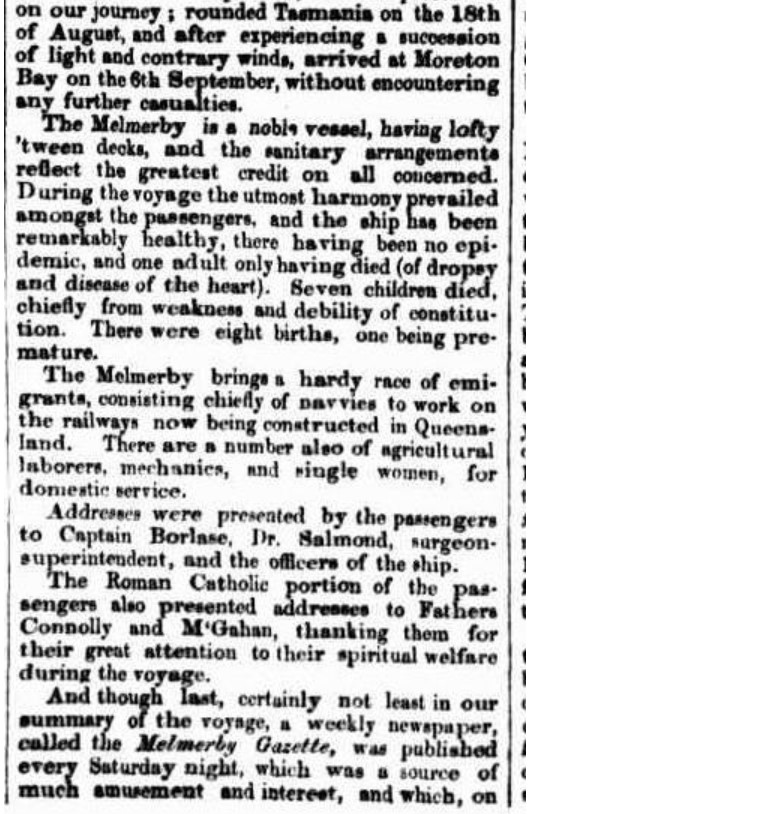
If I am correct, then William and Johanna had a rather eventful journey aboard the Melmerby.  Newspaper reports published in September of 1865 give a detailed account of the trip:


Apparently, the first half of the four-month voyage was relatively uneventful, consisting of light winds and beautiful weather.  The ship crossed the equator in June, passed the Cape of Good Hope in July and all appeared to be well.

Then on the morning of July 27 

"suddenly and without any warning the mainmasthead broke, bringing with it the mainyard, main-topmast, topgallant and royal masts, also the mizen top-mast, topgallant mast, and all the gear attached; also the foretopgallant mast, foretopsail yard, and all the gear belonging thereto, leaving the ship for the time being quite a wreck.

The captain, officers and crew displayed the utmost coolness at the time of the disaster, and proceeded with

great despatch to cut away the wreck of masts, sails, yards, etc. hanging over the side of the ship, which happily was effected before dark, without any accidents, and so saving the mainmast, which was tottering with the weight of wreck attached to it at every roll of the ship, and the vessel made as snug as the circumstances would allow of.

It seems difficult to account for the accident, as the wind was steady and not a gale, but the prevailing opinion is, that a whirlwind must have passed over the ship."


Imagine how the passengers would have reacted to all this happening, and the relief they would have felt once the crew had worked their magic!

That was not the end of their troubles however.

Just a few days later, on the morning of August 1st:

"about 8 a.m., during a violent gale, a heavy sea struck the vessel, and having fallen on the main hatch house completely smashed it in.  It was temporarily covered up and secured."

This was followed by another worrying event the very next day:

"Again, on the morning of Wednesday the 2nd, about 2 o'clock, a violent hurricane struck the vessel, lifting one of the quarter boats clean out of the davits, carrying it overboard.  The other one, with the heavy rolling of the ship, broke the poop rail, and split the covering board of the poop about eight feet, and to prevent further damage, the captain ordered it to be cut away."


According to the report, 

"the conduct of the passengers was very exemplary, they remaining calm, and not giving way to excitement, and providentially there was no accident to life or limb."


Interestingly, the report goes on to state that:

"The Melmerby brings a hardy race of emigrants, consisting chiefly of navvies to work on the railways now being constructed in Queensland."


This statement added weight to my supposition that my William and Johanna were indeed on this ship.  Even though William's occupation was listed as "saddler" on his marriage certificate, his death certificate listed his occupation as "railway employee".   I took this as an indication that I might be on the right track with my thoughts that there was a match between the two listed as passengers on the Melmerby and my great grand uncle and aunt.  


Now we get to the point where I can make an absolutely factual statement - William Burke married Johanna McNamara in Toowoomba, Queensland on the 26th of September, 1866.  Their life together had begun, but it was not going to be an easy one.


Making use once more of the Queensland Registry of Births, Deaths and Marriages, which holds birth records for the period 1829 to 1922, I found evidence of nine children born to William and Johanna, between 1866 and 1878.


In January of 1867 Johanna gave birth to a boy named James.  

Traditionally, the Irish named their first born son after the father's father, and this seemed to be the case with William and Johanna.

Their first born was named James, the name of William's father.

Sadly, the little baby was stillborn.


Johanna was pregnant again within four months and a second son, named John, was born on the 29th of February, 1868.  

Once again, the second born son was named according to the traditional Irish naming pattern - named after the mother's father.  Johanna's father was named John.

Both Johanna and William would have been overjoyed to see their little one survive the birth and start to thrive.  Tragically however, their second born son died on the 20th of January the following year, 1869, aged only 1 year.  


The cause of death listed on his death certificate was "dentition".  This means the little boy died as a result of teething!   Teething!  I know the infant mortality rates were quite high in the late 1860s, but I was completely unaware that an infant could die as a result of a seemingly ordinary part of their growth.  How does something so innocuous result in death?

I remember my two sons' experiences with teething.  There were periodic episodes of crying and irritability, drooling, high temperatures and sleepless nights, for both boys and parents!!  Bonjela and teething rings were essential, (the occasional sip of good quality whisky, for the parents!) as well as long car rides in the middle of the night.  At no time however, did teething present as life-threatening in those days.  


A third son was born on the 12th of January, 1869.  His name was David. 

Whilst traditionally, the third born son was usually named after the father, in this case William and Johanna appeared to have named this son after William's older brother. 

Sadly, baby David passed away on January 30th, aged 18 days. The cause of death on his death certificate was "Marasmus".  This was a form of severe malnutrition.  


Let's just stop for a moment and think about what's happened to Johanna and William within a period of just two years: 

- their first son James was stillborn

- Johanna fell pregnant four months later

- Johanna gave birth to their second son

- She became pregnant the following month

- Johanna gave birth to their third son 

- Johanna and William then lost their second born son, eight days after the birth of their third

- Then tragically, their third son David died just ten days later, aged 18 days

So by the end of January 1869, they had lost three sons.   What misery they endured at the start of their marriage, and sadly their grief would continue. 


Johanna gave birth to their fourth son Robert on the 4th of November 1870.  

Heartbreakingly, he died on December 23rd, before he reached the age of 2 months.  

The cause of his death was listed as "debility from birth".  This generally means he was born as a physically weak baby.

Can you imagine the depths of despair both Johanna and William must have reached with the passing of each child!  Miraculously Johanna was pregnant again within a month.


A daughter was born in October of 1871.  She was named Catherine.  

According to traditional Irish naming patterns, the first born daughter was usually named after the mother's mother.  This was the case with William and Johanna's first born girl, as Catherine was Johanna's mother's name.  Coincidentally, it was also the name of William's mother.

Perhaps this was an omen as daughter Catherine was the first of Johanna's and William's children to survive, thrive and outlive both her parents.


Five months after Catherine's birth, Johanna was pregnant once more.  

Another daughter, named Ellen, was born on December 15th in 1872.  Tragedy struck again, as Ellen died in the 29th of January 1873, aged only 14 days.  

The cause of death was listed as "Aptha / Diarrhoea". 


A son named William Patrick was born on the 21st of March 1874. He seems to have been given his father's name


William was the second child to survive infancy and went on to survive both his parents.


Johanna was pregnant once again a year later, and gave birth to a daughter named Mary Ann on the 1st of December 1875.  

Tragically, Mary Ann died at the age of 5 weeks.  The cause of death was listed as "Debility from birth".


I found one more record of a child born to William and Johanna in September of 1877, but once again the poor little one was stillborn. 


So, after giving birth to nine children within a period of ten years, Johanna would only see two of them make it through their childhood years.  This tells me that William and Johanna were likely living in poverty and deprivation, and nutrition was severely lacking.  I'm making assumptions, but it sounds as if poor Johanna was herself not strong and healthy, and was poorly nourished.


The impression I get is that William and Johanna lived a harsh life for a lengthy period at the start of their marriage, but perhaps things turned around for them by the time their two surviving children reached their teenage years.

Information gleaned from William's death certificate and Johanna's death notice indicates that William spent his working life as a Queensland Railways employee and worked in the railway goods shed at the Toowoomba Railyard.  He, Johanna and their children lived in a house near the railway yard gates.  It would have been a modest home as working for the railways would have only provided a modest living.

William and Johanna were married for 24 years, but then William passed away in 1891 at the age of 50 (according to the information on his death certificate).


The cause of death listed on William's death certificate was heart disease and dropsy.  The length of time in the Australian colonies was listed as 25 years.  Given that William had died in early 1891, this makes 1865 as William's arrival date in Australia, giving more credence to my supposition that he was aboard the ship Melmerby!

With William's death, Johanna was widowed at the age of 59, with two children.  Catherine was 19 years old and William Patrick was 17.  I have not been able to find out much about their lives at this point.  

I found Johanna in both the 1903 and 1905 census records for Toowoomba, in her 70s, living at North Street.  There's also a Catherine and William Patrick living at North Street, her daughter and son.  Neither had married and they were living with their mother in the family home. 


In 1903, Johanna would have been aged 72.


In 1905, Johanna was aged 74 and living with her children, who no doubt looked after her with care in her elderly years.


In 1906, Johanna passed away.  Her death certificate states she was 74 years old and the cause of death was mitral valvulas disease of the heart and chronic nephritis.  Secondary causes listed included bronchitis and exhaustion.  It does sound as though poor Johanna was very ill towards the end of her life.


Using the National Library of Australia's online resource Trove Newspapers, I was able to find a death notice for Johanna.  


Her married name was recorded as Bourke, not Burke as recorded on her death certificate; but as I've previously mentioned the spelling was interchangeable on different records. 


The newspaper item does mention that she had been born in County Tipperary and had arrived in Toowoomba in 1865.


This once again lends credence to the possibility that she did come to Australia aboard the ship Melmerby.


Both of William's and Johanna's surviving children lived well into old age.  William Patrick died in 1953, aged 78.  Catherine died in 1959 at the age of 87.  I have not been able to find any record of William Patrick marrying and his death notice (which I found by using the National Library of Australia Trove Newspaper collection) did not mention any spouse or children.  


Information in William Patrick's death notice did indicate that he was living in Southport, Queensland, but died in Brisbane, and it mentions he died at Brisbane Hospital.  I wonder if he had been suffering an illness at this time?  I noticed that he was buried at the Toowong Cemetery in Brisbane, and not with his parents. 

I also noticed that further down the column in this newspaper, there was a 'Return Thanks' item, which appears to have been written by Catherine.  Her address is listed as High Street, Southport, so I'm assuming she was living in the her brother's house by the 1950s.

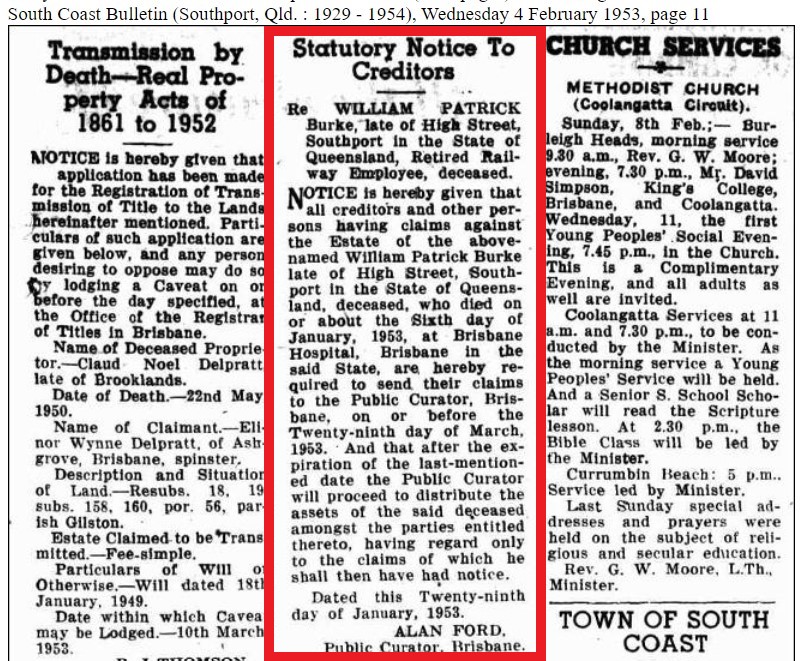
Using the Trove Newspapers online resource again, I then also found a notice for creditors who may have had a claim to make against the estate of William Patrick:


Catherine, as stated in her mother's death notice, had been unmarried at that time and it appears this was the case for the remainder of her life.  I found a notice of a Transmission of Title dated November 1953 (using the Trove Newspapers collection once again), which stated that Catherine Burke had claimed the title of the Southport property owned by her brother.  


This newspaper item stated that Catherine was a spinster in 1953 at the age of 81, so that provided additional confirmation that she had not married.

What seems so very tragic to me is that whilst the two surviving children of William and Johanna both lived long lives, it appears this particular family branch ended with them.  There were no grandchildren to continue the family name, and that seems such a desolate ending for a couple who appeared to be trying hard to have a large family.  


Catherine, the only daughter of William and Johanna, was buried at the Southport Cemetery, so as it happens, the two surviving children of William and Johanna were buried in separate places to their parents, and to each other.


The final tragic note to this story is that poor Catherine, the last of this family to pass away, was buried in an unmarked grave, as it appears there was no family member to arrange a headstone for her burial plot.