Monday, 7 March 2022

The Story of Iris Belle Barrow

This post will be an attempt to tell some of the story of Iris Belle Barrow (1921 - 1966), my paternal 3rd cousin once removed.  

Our Common Ancestors are:  James Exton and Susannah Lancaster.

I never met Iris or any of her family, and have only come to know about her through the limited information shared by extended relatives on Ancestry.com and the research I've done about the events of the relevant time span.  I admit this story may be a little sketchy and not fully correct, so if any better informed relatives do read through this and can offer clarification, please do so.

I've been intrigued with Iris ever since I first saw this photo shared on Ancestry.  

Photo originally shared by cbroughton195 (my 4th cousin) on Ancestry.com


My family tree is full of very resilient women who lived quite tough lives and certainly never lived a life of luxury or experienced what I would call, a prosperous life.  


This photo of Iris could give the impression that she was the exception though ... given the luxurious fur coat she is wearing and that stunning hat!


That was the very first thing that drew my attention in this photo ...  that magnificent looking hat.  I thought all those black spots were imperfections on the photo, but then I realised the hat comes complete with a net / veil that comes down over the front of her face.  Perhaps this was a fashion trend in Australia at the time, which would have been the late 1930s.  


The beautiful flowers atop her curls are such a stylish addition as well.  That is not an everyday hat!  Not many of my extended relatives ever got to wear a fur coat either.  This young woman emanates poise, elegance and style.  I wondered where she was going on this day, dressed so fashionably.  What grand event was she attending?


When I discovered her name was 'Iris', it seemed a perfect match somehow. 


Iris is a girl's name of Greek origin, meaning "colourful" or "rainbow".  Iris was the name of the Greek goddess of the rainbow, and she served as a messenger to the gods.


As I looked more deeply into the details of Iris's life however, it soon became apparent that she did not live a life of luxury and extravagance at all!


Iris Belle Barrow was born in December of 1921 in a small settlement known as Goonellabah, in New South Wales, Australia. It was located outside Lismore, and is now an eastern suburb of that city.  Iris was the youngest of four children born to Alfred Barrow Jnr. and Mary Ellen (Nell) McCann and was their only daughter.  She arrived two days after Christmas, like an additional Christmas present.


Her eldest brother was Harold Allan Barrow, born in 1910.  Her second eldest brother was John Alfred (known as Jack) Barrow, born in 1913.  Her other older brother was Charles Neville Barrow, born in 1915 (although he was known as Neville Charles throughout his lifetime).  


I wonder what Iris's childhood would have been like, growing up with three older brothers?  There was an 11 year age gap between Iris and her oldest brother Harold.  The middle brother John (known as Jack) was 8 years older, and the youngest of the brothers was 6 years older than Iris.  Did they treat her as a princess or as a tomboy? 

I have limited information about life for Iris between her birth and her tenth birthday, but jumping ahead a little I know her teenage years coincided with the Great Depression, a time when many experienced enormous hardships and challenges.  


Here in Australia, there was a surge in unemployment rates at the start of the 1930s and many people's lives changed drastically as a result.  I know that Iris's father, Alfred Barrow, worked as an employee of the Railway Department throughout the depression years, so that must have been a saving grace for the family. given that in 1932 the official unemployment level reached a peak of 32%.

Census records for the period between 1929 and 1940 show where Iris's father Alfred and mother Mary Ellen were living.  As Iris was only 8 years old in 1929 and turned 18 in 1940, she would have been living with her parents during these years.  The census records show that Iris's parents moved around a bit during this time, and I would suspect that was because of her father's job.

In 1930, when Iris would have turned 9,  the family was living at 10 Peate Street in Lismore.  Iris's father Alfred's occupation was listed as 'fettler'.  Iris's uncle, her father Alfred's brother, William and his wife were living in the same street.


A 'fettler' was an employee of the Railways whose job it was to maintain a section of a railway line.  They had to walk, or ride a trolley, along a 10-15 mile long section of the railway line every day to inspect it for any possible problems that needed repair work.  It was hard physically exhausting work.  


Fettlers would have to replace decaying sleepers and worn rails, check all the bolts on fishplates and tighten these whenever needed, as well as clear the line of fallen trees, and in the flood-prone Lismore area, they would have to clear flood debris and repair damaged sections of the line after major flooding events.  Iris would have witnessed first-hand the toll that such physical work must have taken on her father.


Fettlers worked in small gangs under the supervision of a ganger, and most usually lived in railway tents in camps next to the line.  As Iris's family was living in town, that meant either her father was working a section of track close to the town itself or he would spend weeks at a time away from home living and working with his fettler gang.  Either way, I think that Iris probably spent more time with her mother and brothers, than she did with her father while she was growing up. 


By 1932, the family had re-located to Ballina, situated in the Northern Rives Region about 34 kms (21 miles) from Lismore, and closer to the coast.  


Iris was now 11 years old and the family was living at 356 River Street in Ballina, which would have been on the outskirts of the town at the time and quite close to the mouth of the Richmond River.  Iris's brother Harold Allen Barrow had married Florence Robertson in 1931 and they were living in Ballina East.  I'm assuming that Iris's other brothers, John aged 19 and Neville aged 17, were living with their parents as well.


By 1934, Iris aged 13, was living at 1 Fox Street with her parents and (again, I'm assuming) her brothers John and Neville. Fox Street was closer to the centre of the town.  Iris's oldest brother Harold and his wife Florence were still living in Ballina East and had a little daughter.


By the following year, 1935, Iris and her parents had moved once again.  They were living at 32 Tintenbar Road, about 12 km (6 miles) to the north-west of Ballina.  It's likely the move was a requirement of her father's job at that time.

Iris's brother John Alfred Barrow remained living at 1 Fox Street (presumably with brother Neville) in Ballina, and olderst brother Harold Allen and his wife Florence May were still living in Ballina East, and were expecting another child.


In 1937, Iris, now aged 16, and her parents were back living back in Ballina, at 1 Fox Street with John Alfred and Neville Charles.

Photo originally shared by cbroughton195 (my 4th cousin)
on Ancestry.com


Soon Iris was of an age when she could start attending dances and balls.  


Apparently her brother John loved ballroom dancing and his favourite partner was his sister Iris.  They were reportedly both very fine ballroom dancers.


This photo, likely taken sometime between 1939 and 1940, shows Iris and her brother John Alfred attending such an occasion.


Of course, by this time there were events happening overseas that would change the course of world history, and the lives of the Barrow family.

One of the most often mentioned causes of World War 11 was the rise of dictatorial governments with extreme political views and military ambitions during the Great Depression, in the countries of Germany, Italy, Spain and Japan.  The Depression had also distracted the democratic powers of Britain, France and the United States as they paid more attention to affairs at home and not international developments.

When the Germans invaded Poland in September of 1939, driving Great Britain and France to declare war on Germany, Iris was just 3 months away from celebrating her 18th birthday.  


Iris would have read about what was happening in Europe and read the Australian Prime Minister, Robert Gordon Menzies's statement made on September 3rd, 1939:

"Fellow Australians, it is my melancholy duty to inform you officially, that in consequence of a persistence by Germany in her invasion of Poland, Great Britain has declared war upon her and that, as a result, Australia is also at war."


Alfred Barrow (far left), John Alfred Barrow (middle) and Douglas Charles Fitzsimmons (right)  c. 1940
Photo originally shared by cbroughton195 (my 4th cousin) on Ancestry.com

In March of 1940 Iris, aged 18, married Douglas Charles Fitzsimmons, aged 23, in Ballina, New South Wales.  Of course at that time many young couples found the urge to get married just too compelling to resist, given that so many young men were preparing to march off to war.

The photo above shows Iris's husband Douglas Charles Fitzsimmons on the right, with her father Alfred Barrow (left) and her brother John Alfred (sitting).

The following year, 1941, saw the start of the impact of the Second World War on the Barrow family.

Iris's oldest brother, Harold Allan Barrow, enlisted in March of 1941.  He served as a Private in the Australian Army.

Iris's second eldest brother, John Alfred Barrow, enlisted in September of 1941.  He also served as a Private in the Australian Army.

Iris's husband Douglas enlisted in December of 1941.  He served as a Sapper in the Australian Army.

Interestingly, when Douglas was enlisting he listed 'Wallangurra, Queensland' as being his residential address at that time.  Wallangurra is quite a considerable distance inland from Ballina, where Iris's family lived and where she and her husband had married.  It's north-west of Tenterfield, and just over the border in southern Queensland.  I'm assuming Douglas was away working.  I wonder, what type of work was he doing that took him away from his new wife?


Australian women, at the start of the war, were encouraged to take the same sorts of roles they had held during the first world war - knit, sew, pack parcels, encourage enlistment and maintain the home.  As war came closer to Australia though, this all changed.  

From late 1940, women were encouraged to join the services.  Whilst some served as nurses in one of the branches of the armed forces, the majority joined the auxiliary services such as the Women's Auxiliary Australian Air Force (WAAAF), the Australian Women's Army Service (AWAS) and the Women's Royal Australian Naval Service (WRANS).  


Iris Belle enlisted with the WAAAF as an Aircraftwoman.  She enlisted in late 1942.  


This is the enlistment photo taken of Iris in 1942.


Photo originally shared by cbroughton195 (my 4th cousin)  
on Ancest
ry.com

This is not a photo of Iris.

It's a shot of her sister-in-law Beryl, who married Iris's brother, John Alfred, in late 1941.


Beryl enlisted as an Aircraftwoman in the WAAAF the year after Iris did.  


There's likely to be a similar photo of Iris in uniform, very much like her sister-in-law.


Initially, women in the forces served as cooks, clerks and kitchen orderlies, but that quickly changed.  They were manning anti-aircraft and coastal artillery gun sites, working in ordinance, cipher, electrical, mechanical and intelligence units.  They maintained and armed aircraft, operated radars, drove trucks and instructed in drill ... but they did not fly.

Aircraftwomen: top row left -  checking aircraft engine components, top row right - working on an aircraft engine,  bottom row left - checking the instruments in a bomber cockpit, bottom row - right - loading practice rockets onto a Beaufighter ... some of their varied tasks.

Women also became a crucial part of the RAAF communications system and staffed Radio Direction Finding Stations to guide aircraft home.  Large numbers of serving women were radio-telephone operators, and the majority of the telephone and teleprinter operators were WAAAF.  The coastline was screened by radar, and operators were often on duty 24 hours per day.

According to Iris's service record her first duties were as a "messwoman", but by early 1943 her role was listed as "telephone operator".  She served in that role for the remainder of the war. and had various postings - from Bundaberg to Evans Head.

Iris's posting upon discharge was listed as "6 Aircraft Depot". The location of the RAAF's No. 6 Aircraft Depot was at the Army Aviation Airfield at Oakey, on the Darling Downs in Queensland.  

The No. 6 Aircraft Depot's primary function was to relieve, repair and carry out overhaul work passed on from No. 3 Aircraft Depot at Amberley Airfield.  No. 6 Aircraft Depot was also a forward depot for aircraft operating from New Guinea and northern Australia.  The Depot serviced, assembled and conducted test flights of Beaufort, Mustang Norsemen, Wirraway and Spitfire aircraft and also serviced large quantities of communications equipment and radio compass receivers.  The site was 934 acres in size, comprising a 400 feet landing strip and 2 hard surfaced runways.  The population of personnel was around 2000.  Iris must have had an interesting service life.  I wonder if she was living on site?

Photo originally shared by cbroughton195 (my 4th cousin)
on Ancestry.com


By this time Iris had become a mother, having given birth to her son Douglas Terry back in mid 1941 before she enlisted.  How did Iris juggle her service and different postings as well as motherhood until her discharge in 1945?


Thankfully Iris's brothers and husband all survived the war years.  


Brother John Alfred had been discharged as medically unfit in November of 1941, a couple of months after his enlistment.  He had been diagnosed with "fibrositis", now known as fibromyalgia, a disorder of musculoskeletal pain and aching.


Brother Harold Allan was discharged in November of 1943.  


Husband Douglas was discharged in April of 1944 after service overseas.


Just a few months after welcoming her husband home from war service, Iris had to say goodbye to her father, Alfred Barrow, who died in November of 1944.


Then tragically, Iris's husband died not long after, in March of 1945, at the age of 28.   His death notice, seen above, mentions that he had been ill for quite some time and was living in Queensland at the time of his death.  This makes sense as Iris was still serving with the RAAF, and as I have mentioned would have been living in Queensland.  She was not discharged until May of 1945, and was discharged on compassionate grounds. 

Iris, widowed at the age of 23, after having been married for just five years, was now a single Mum with a child about 5 years old; and it seems she moved back to Ballina after her discharge.  There she re-married the following year, in October of 1946.  Her second husband was a man named Mervyn Arthur Anthony (Tony) Alvos.  They were married for nearly 50 years. 

Photo originally shared by cbroughton195 (my 4th cousin) on Ancestry.com

This photo would have been taken around the time of Iris's second marriage.  She is with her sister-in-law Beryl Barrow nee Wilson.  Sitting on the ground are Beryl's daughter Colleen Joan, and Iris's son Douglas Terry.  Iris stands out once again in this photo, with her pretty flower-bedecked top and embellished dark skirt.  She would have been about 25 years of age.

Iris was to spend the early part of her second marriage, through the late 1940s and 1950s, still living in Ballina, New South Wales.


Sadly, Iris's mother Mary Ellen passed away in 1962. 


It was around this time that Iris and her husband Mervyn moved to Queensland.  Iris's son, who was now Douglas Terry Alvos, remained living in Cronulla for a time but by 1968, according to the census, they were all living in Acacia Ridge in Queensland.


Iris's life through the 1970s, 80s and 90s was spent living in that same area - Acacia Ridge.


Both of Iris's brothers, Harold and Neville, passed away in 1971.  


Iris's brother John Alfred passed in 1988.  


Iris herself passed away in January of 1996, aged 74, having outlived her parents and all her brothers.


Special Note to any family members:  If you have memories to add, photos or information to share, can I graciously ask that you do so.  Please use the comments box below or email me.  It may prove to be invaluable to the story and provide future generations with something to truly treasure.


Monday, 28 February 2022

The Story of Hannah Browning

This post tells the story of my paternal second great grand-aunt, Hannah Browning (1825-1883).  Many of my family tree stories tell of the most resilient, strong, loving, resourceful females whose lives may seem small to many, but I will never lose sight of their valuable roles as wives and mothers to my ancestors and their extended families.  Hannah Browning, one of my great great grandmother's older sisters, is one of those women.  She wasn't famous or indeed, all that well-known, but left a legacy that was remarkable.

Our Common Ancestors are:  William Henry Browning and Anne (Nancy) Littlejohns, my great great great grandparents, and Hannah's parents.

Transcription of Baptism Record 1825

Hannah Browning was born in July of 1825 in Launceston, Cornwall, England.  Whilst the information on her immigration record indicates she was born in 1824 and stating that she would be turning 16 on her birthday in 1840; the baptism transcription from the Cornwall Family History Society shows her baptism occurring in 1825.  

Unlike the experiences Hannah would go through trying to get her own children baptised in Australia, waiting sometimes for nearly a year or longer until a clergyman or priest would visit the area on horseback; in England, children were generally baptised quite soon after their birth because churches, clergymen or priests were close by and easily accessible.  I feel it's more accurate to say that Hannah was born in 1825.

At the time of her birth, Hannah's father William was aged 24 and her mother Anne (known as Nancy) was 23.  There was only one other sibling then, but over the following 22 years Hannah was to become an older sister to nine more. 


In 1825, Hannah's father was working as a labourer, and the family was living at the 'Fish Market'.  I don't think much imagination is needed to understand exactly what that meant!  Poverty!  Life would have been extremely difficult and it's likely they all experienced hunger and deprivation on a daily basis. 

The family had moved to Devon by the time Hannah's brother John Thomas was born in 1827.  It seems likely that Hannah's father had moved back to his birthplace, perhaps seeking assistance from his family and/or seeking work.  

Within five years however, the family was back in Launceston, Cornwall, where my great grandmother Caroline, Hannah's sister, was born in the poor house.  I guess that Hannah would have been living with her family in the poor house at the time, when she was only four years old.  Times were obviously extremely tough for the family and this no doubt left an indelible impression upon the young Hannah.

Hannah's parents remained in Launceston where they welcomed the birth of William Henry in 1832, when Hannah was 7.  At this time the family were living in Fore Street, Launceston and there's an extremely vivid picture of life on that street, written by a man by the name Richard Robbins in his text "Reminiscences of Launceston Town 1820 to 1830".   In the section titled 'Sanitation', Richard wrote:


Another daughter, Dinah, was born in 1835, when Hannah was aged 10;  and Mary Anne came along in 1837.  By the start of 1838, Hannah was twelve years old and had five siblings.  By this time it appears the family was once again living in the poor house, where three-year old Dinah died the day before Christmas.  Hannah was 13 years old, and I suspect her vision for her future was dire indeed.


Hannah's parents made the decision at the start of 1840 to look elsewhere for their future and the future of their six children.  This decision coincided with the introduction of the Bounty system of migration to Australia.  

The Browning family fitted the scheme very well as the colonial government was looking for healthy young couples with children, and preferably daughters of a marriageable age which would benefit a colony filled to the brim with young men looking for a bride.  In 1840, when the family arrived in Australia, they had two such daughters - Susannah, aged 16 and Hannah, aged 14.  

Hannah lived in an age when women were generally considered as property and their sole purpose was to breed, care for the family and the home (if they had one!).  I'm sure her father and mother made the decision to leave their home and family ties at great cost, firmly believing that there was a better future in the colonies.  No doubt, they knew that marriage prospects for their daughters were significantly better in the colonies, but I do wonder if Hannah fully understood the implications of the move to Australia.  

She did go on to make a very, very significant contribution to the populating of the expanding colony and went above and beyond the expectations that sat firmly on her shoulder when she disembarked the ship 'Premier' on July the 2nd, 1840, just a few days before her 15th birthday!


In January of 1842, Hannah married Thomas Norton, an employee of the A. A. Company.  Thomas was a convict and required the permission of the Government to marry as he was still serving his sentence, although he had received his ticket of leave during 1841 and was working on the same property as Hannah's family.


Permission was granted on December 17th 1841, and then the marriage took place at Stroud, in northern New South Wales, the following January. Thomas was 37 and Hannah was 16. Hannah's elder sister Susannah and her new husband Joshua Craven acted as witnesses.  

A year and a half later, sadly Hannah's beloved older sister Susannah died in late 1843. 


Not much is known about Hannah's life with Thomas apart from the fact they welcomed a baby daughter named Mary Ann in May of 1846, when Hannah was aged 20.  Hannah and Thomas were living in Singleton at this time, still moving around wherever Thomas's work with the pastoral company took him.  Tragically, Thomas died not long after and Hannah was widowed at the age of 21.

2nd husband, 
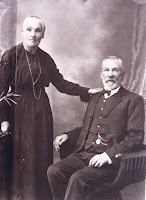
James Wright  c. 1870


Widowhood did not last long though, and Hannah married again in August of 1848.  Her second husband was James Wright, aged 26.  


They would have married at the sheep and cattle station where they were both employed.  It's highly likely they were married in an open-air ceremony as there was no nearby church or place of worship.  


The Anglican clergyman who performed the ceremony was a travelling minister, attached to the St. John Parish based in Brisbane.  He engaged in long pastoral tours around the Darling Downs region and people took advantage of his intermittent visits to arrange special events such as a wedding. 


Marriage Record 1848
James Wright and Hannah Norton nee Browning
Witnesses: Charlotte Sutton and William Browning (Hannah's father)
Celebrant:  Rev. Benjamin Glennie

Hannah and James had met while both were working at Maryland Station.  Hannah was working alongside her parents as shepherds on the station.  Shortly after her second marriage, Hannah moved to the neighbouring property, Ballendean, with her husband.  That's where she gave birth to her first set of twins ... yes, I said 'first', because there several more sets to come!!

Twins James and Jane were born in May of 1849, but by the time daughter Emily was born in 1850, Hannah and her husband were working in the Armidale district.  Throughout their married life, Hannah and James lived in several different places across the north of New South Wales and, what would later become southern Queensland.

In all, Hannah gave birth to 18 children, 17 of whom were fathered by James between 1849 and 1867.  Hannah gave birth to four sets of twins!!  That must have been some sort of record for those times.


Looking at the diagram above though, you can see that Hannah lost many of these twins.  Her twin sons, Francis and Joseph, died soon after their birth in 1862.  Another set of twins died in 1863 and were unnamed, so I suspect Hannah lost them before her due date.  Twin sons, Matthew and Thomas, died not long after their birth in 1864; and one of the twins born in 1867, Sarah, also died the year after her birth.  Hannah had already lost a daughter named Catherine in 1865.

I am at a lost for words at this point in Hannah's story!  Imagine being pregnant every year or two over a period of 18 years and losing 8 children, including three sets of twins, and two other children, one of whom was also a twin.  All that time she was moving around with her husband, no doubt working alongside him on the various properties where they found employment, and of course, looking after the surviving children.

By 1867, it appears that the Wright family were working in the western district of New South Wales, around Kangaroobi, Mudgee, and Cowra; finally settling in the Eugowra area.  Then, in 1875, Hannah's second husband, James Wright, died in a tragic accident.  

James's name was recorded as Frederick James Wright.  Having not found a record of birth or baptism, I have no definitive proof that his name was indeed Frederick James.  The name recorded on his marriage certificate was simply James.  Perhaps his children, when reporting his death, had more accurate information and evidence about his full name.


According to an entry in the Register of Coroners' Inquests, James died "from injuries accidentally received."  

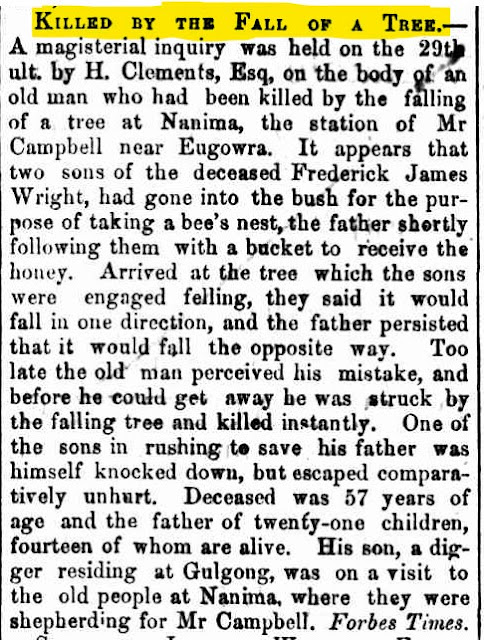
A newspaper article, titled "Killed By The Fall Of A Tree" and published in the Riverine Grazier on Wednesday, May 19, 1875 stated:

Newspaper article -Riverine Grazier Wed 19 May 1875 p4

(Again, James's name was recorded as Frederick James Wright!)

Poor James!  In an attempt to help out his sons when they were felling a tree to retrieve a bee's nest, James misjudged the direction of the fall and was killed instantly by the falling tree.  Hannah was 50 years old at this time, with 10 children still living (a contradiction to what was stated in the newspaper article above) ranging in age from 29 to 8.   I imagine she remained living at Nanima, the station where her husband and some of her sons were working on at that time.

At the age of 57, Hannah married for the third time.  She married Daniel Carr in October of 1882.  They were both living in Eugowra Creek at the time and Daniel was also a widower.  Sadly, this marriage was short-lived and only lasted eight months.

Hannah Carr / Wright / Norton nee Browning died in June of 1883, aged 58.  The cause of death listed on her death certificate was "inflammation of the liver".  She was survived by her third husband, nine of her children, and seven of her siblings - her brothers John, William (known as Bill), James, Joseph and Matthew; as well as her sisters Caroline (my 2x great grandmother) and Mary Anne.

The legacy of her small life included a generation of around 65 grandchildren: 
  • Eldest daughter Mary Anne married Henry Burne Little and they had nine children, eight of whom survived to adulthood.
  • Daughter Jane Caroline married Joseph Francis Cash. They went on to have nine children as well, all of whom survived to adulthood. 
  • Daughter Emily Elizabeth married Henry Wallace. I'm unsure how many children they had.

William Edward Wright
Photo shared by hlgsq2
on Ancestry.com


  • Son William Edward married Mary Jane Aspinall and six children resulted from that union.  Five survived to adulthood.


Hannah Maud Barber nee Wright
Photo shared by alanwingfield1
on Ancestry.com


  • Daughter Hannah Maud married William Henry Barber.  They had twelve children, eleven of whom survived to adulthood. 


  • Daughter Matilda Catherine married Thomas Lee and they went on to have nineteen children.  At least thirteen survived to adulthood.
  • Son Charles Wright married Emily Seddon.  I'm unsure about whether or not they had children.
  • Son Alfred John married Elizabeth Allbranch and went on to have five children, all of whom survived into adulthood.

Harriet Matilda Thomas nee Wright
Photo shared by helenmayne0
on Ancestry.com


  • Daughter Harriet Matilda married Andrew Thomas.  They had thirteen children together, ten of whom made it to their adult years.


  • Son Arthur George married Hannah Moore.  They went on to have at least five children who survived into adulthood.
I have still so much research to do to find out how many great grandchildren and great-great grandchildren followed, but I think it's a safe bet to say ... hundreds!


....  and dare I say it, we can underestimate the value of a small life!


I'm very appreciative of the family treasure, a book written by Esme Smith titled 'The Browning Story: Tracings From The Past', published in 2001; and I acknowledge this as the source of much of the information shared in this post.


Special Note to any family members:  If you have memories to add, photos or information to share, can I graciously ask that you do so.  Please use the comments box below or email me.  It may prove to be invaluable to the story and provide future generations with something to truly treasure.


Saturday, 5 February 2022

The Tale of Two 'Adelines' - Adeline Amelia Browning and Adeline Amelia Kean

Branching out from telling the stories of my direct ancestors has led me down some fascinating paths of family tree research. Along the way, I've sometimes been puzzled by the choices parents have made for the first names of their children, especially during the 1800s and early 1900s when it was usual practice to choose familiar family names. 

This post tells the story of two relatives named 'Adeline'. It's quite an unusual name on my family tree. Amongst the 2,700-odd individuals listed on my family tree so far, there are only two who have the first name of Adeline.  That makes them eligible to be added to a group I've created - The Lonely First Names Club!  

Curiously, not only are there only two women relatives on my family tree with the first name of Adeline, but both of these women have the same middle name as well.

The name Adeline is apparently of French and German origin, and means "noble, nobility."  It derives from the French name Adele, which comes from the Germanic root adal, meaning "noble."

Interesting random fact:   The famous British modernist author, Virginia Woolf, was actually christened Adeline Virginia.  


Adeline  Amelia  Browning  (1878 - 1953)

Adeline Amelia Crowley / Lumley nee Browning
(photo courtesy of Darrell Crowley)


Adeline Amelia Browning was my paternal 1st cousin, three times removed.


Common Ancestors: my 3x Great Grandparents, William Henry Browning and Anne (Nancy) Littlejohns


Adeline Amelia was born in 1878.  Her parents were William Henry (known as Bill) Browning (my 2nd great uncle), an English immigrant, and his wife Sarah Jane Chillingworth, born in Australia to convict parents.  Adeline was the youngest of eleven children born to William and Sarah, although by the time Adeline was born, only six of those children were still living. 


Having researched the Browning family line quite extensively, I have found no evidence of the name Adeline anywhere on that side of my family tree.  I wonder if perhaps the name came down from my 2nd great uncle's wife's family, the Chillingworths?

When Adeline was baptised many, many years later, in her adult years, she stated her birth place was Woods Reef, Barraba, which is where she grew up.  On her birth certificate however, her birth place is listed as Mount Lourie Creek, near Bundarra.  These places are not all that far apart, so it's likely Adeline was born during the family's wanderings whilst her father worked as a 'bushman'/ shepherd / grazier.

Gold was discovered at Woods Reef in the late 1850s, and a thriving village existed there for around ten years.  However, when many of the miners left in the late 1860s, the village's population declined significantly and there was a corresponding decline in shops and services.  

Adeline's parents however stayed on and raised their family there. In 1896, when Adeline was 18 years old, her father declared bankruptcy.  I'd venture to say that Adeline's early family life was likely rather impoverished.

Interestingly, in December of 1900, just a few years after Adeline's father had declared bankruptcy, both Adeline and her mother Sarah were convicted of sheep stealing!!  Yes, sheep stealing.  I think it's probably true to say that the choice to steal had likely been born out of utter necessity and I really do hope this event was a one-off!


Adeline and her mother Sarah really made a solid attempt at the stealing of sheep though.  They stole 10 of them!  Now that's a decent effort.  


Unfortunately, they were not all that successful.  They were caught, arrested and charged, although by the time they were arrested. there were only sheepskins left!!! 


I'd hazard a guess to say that the sheep were slaughtered for their meat, and then the ladies were intent on selling the sheepskins and fleece.  


Mother and daughter were arrested in December of 1900.  The Police Gazette, dated Jan 1901, recorded their apprehension and stated they were to be committed for trial in Bingara, New South Wales.


Adeline's sentence was to be twelve months light labour at Tamworth Goal.  This sentence was suspended however, under the provisions of a new Crimes Act, which had only just come into existence in 1900.


So, an entry appeared in the Police Gazette, published in March of 1901, stating that both mother and daughter had been granted bail.  What a lucky break.  It's interesting to note that this article identifies Adeline as Adelaide, which was probably a much more common name at that time.

What has made me chuckle about this whole episode in their lives is the fact that Adeline is related to a direct ancestor of mine, who also attempted to steal sheep and got caught.  My paternal Great Great Grandfather, Patrick Cusack, had been transported to Australia for the crime of sheep stealing.  He and his brother John were sent to Australia as convicts in 1848, just 30 years before the birth of Adeline. 


Patrick Cusack was the father-in-law of Adeline's 1st cousin, Richard Joseph Brown (my great grandfather).  Richard Brown married Ellen Cusack, the daughter of Patrick Cusack. 

Now while the Cusacks settled and lived in the Richmond River District, outside Lismore, and the Brownings lived in Barraba on the Manilla River, outside Armidale; there may have been a chance that the families got together and shared stories.

I wonder if Adeline and her mother knew about the sheep-stealing Cusack brothers from Ireland?

After her criminal experience, it seemed Adeline was intent on turning her life around, or at the very least, giving the impression she was off to a fresh start and on her best behaviour .  Just a couple of months after her release, she was baptised and married on the same day!  Impressive!

John Humphrey Crowley
(photo courtesy of Darrell Crowley)

She married John Humphrey Crowley in May of 1901 and they went on to have 10 children together.  Sadly their first born died in 1902 and then two of their children died in 1906, one aged 7 and the other aged 1.


By the time Adeline's last child was born however, in 1919, it seems that married life for Adeline was not at all happy.  John appears to have been a bit of a cad and a bounder, and there was a warrant out for his arrest for failing to support his wife and children. 


At that time their children were aged from 15 to a newborn, and Adeline was caring for at least four of them at home.  Her mother Sarah had died the year before, and her father had died back in 1905.  Many of her brothers and sisters were still living in the Barraba area, where her parents had been buried, so hopefully they were of some support for Adeline through these tough years.


Adeline's husband John was arrested in 1920, but even after his discharge from jail, he did not attempt to contribute supporting Adeline and her children.  There was a series of warrants issued over the following five years or so, and John was arrested more than once during that time.  


By 1924, when yet another warrant was issued, John was using an alias.  I'm not sure what Adeline's life was like during these years, or for the next twenty when John passed away.  He died in 1940, after accidentally falling from his horse while riding.  What an end.  

Adeline married again the very next year.  In 1941 she married John Isaac Lumley.  At the time she was 63 years old, and he was 42.  Way to go, Adeline.  She died just over ten years later, and I do so hope her married life with her second John was a lot happier.

Adeline died in June of 1953, aged 74.  She was buried at the Inverell Cemetery in New South Wales.


The only other person with the first name of Adeline on my family tree was related to the Adeline Amelia Crowley / Lumley nee Browning mentioned above.  

Adeline Amelia Browning grew up with two older sisters, Caroline Maria and Ann Eliza.  Sadly, Ann Eliza died in 1894 at the age of 24.  Adeline Amelia would have been 16 years old at the time.  Her other sister, Caroline Maria, however lived a much longer life. She also married twice and survived into her 80s.  One of her daughters was named Adeline Amelia and was (of course) Adeline Amelia Crowley / Lumley nee Browning's niece.


Adeline  Amelia  Kean  (1892 - 1909)

Possibly Adeline Amelia Kean
- awaiting verification
(photo courtesy of Val Kronk)


 Adeline Amelia Kean was my paternal 2nd cousin twice removed.


 Common Ancestors:  my 3x Great   Grandparents, William Henry Browning   and Anne (Nancy) Littlejohns.


Adeline Amelia Kean was the daughter of Adeline Amelia Browning's sister, Caroline Maria Browning, and her first husband, Thomas Matthew Kean.  Born in November of 1893 at a place named Swamp Oak, near Tamworth, in New South Wales; Adeline Amelia Kean was the second youngest of 5 children born to Caroline and Thomas.  It's clear that Adeline Amelia's mother, Caroline, named her daughter after her sister, as it wasn't a typical family name.


Sadly Adeline Amelia Kean's father Thomas died in 1896, when Adeline Amelia was only 3 years old.  She had also lost an older sister when she was 1.  Her sister Caroline Ann died in 1889 at the age of 3, apparently from eating poisonous fungi.

(photo courtesy of Lily Lawrence)


This is a photo of Adeline Amelia's mother, Caroline Maria Kean nee Browning, and Adeline's older siblings, taken before the birth of Adeline.


Adeline's oldest sister Elsie is standing on the right side.  Caroline is standing on the left side, and baby Sidney is sitting on his mother's lap.


This photo would have been taken just before Adeline's sister Caroline Ann died in 1889.


It was only months after the death of her father that her mother re-married a man who had three children of his own.  Adeline's mother and step-father went on to have another three children.

Adeline Amelia became a step-sister at the age of 5, 8 and 11, but tragically, two of her half-siblings had died by the time Adeline had reached the age of 12 in 1904.  At the start of 1905, Adeline only had one older sister, two brothers, and a step-sister remaining.

She herself passed away in December of 1909, at the very young age of 17.  Causes of death were listed as typhoid fever and pneumonia. There had been a widespread outbreak of typhoid fever in several areas of northern New South Wales from the start of 1909, and at that time it was difficult to control.  

Adeline Amelia died in the hospital at Tamworth and was laid to rest in the cemetery in that town.  

She was survived by:

- her mother Caroline Maria Kean/Carter nee Browning, aged 49 at that time.  Caroline was to live until 87 years of age, four years after the death of her second husband.

- her step-father William Carter, aged 47 at that time of Adeline's death.  He lived until the age of 80, passing away in 1942.

Headstone - Adeline Amelia's mother, Caroline, and step-father William.


- her sister Elsie Eugene Maria Kean, who lived until the age of 74.  She married Harry Price and they had five children together, only 3 of whom survived into adulthood.

- and her step-sister Elizabeth Ann Ivy Pearl Carter, who died in 1996 at the age of 92.  She married Frederick Stallard and they had three children together.

Caroline Maria Kean/Carter (nee Browning), seated on the far right;
with her daughter Elsie Eugene Maria Price (nee Kean) on the far left,
her step-daughter Elizabeth Ann Ivy Pearl Carter in the middle,
and granddaughters Rachael Price (on the left) and May Price (on the right) - daughters of Elsie.
Photo taken c.1923  (photo courtesy of Dorothy Smith) 

Adeline was also survived by:

- her brother Sidney Matthew Kean, who passed away in 1953 at the age of 63.  He married Louisa Weston and they had six children together,

- her brother Louis (Luis) Manning Kean, who was killed in action in 1918, near Villers-Bretonneux in France, at the age of 23.

Louis (Luis) Manning Kean
Service No: 3391
Regiment/Service: Australian Infantry, A.I.F., 31st Bn.
(photo courtesy of Lily Lawrence)

That is the sum total of the information I've discovered about the two Adelines.  I wonder if the name continued on in other branches of the family?


Special Note to any family members:  If you have memories to add, photos or information to share, can I graciously ask that you do so.  Please use the comments box below or email me.  It may prove to be invaluable to the story and provide future generations with something to truly treasure.


Wednesday, 12 January 2022

Spotlight On ... My Family Connection to a Well-Known Australian Artist.

Digging beyond the history of your direct ancestors and extended blood relatives can lead to the most incredible discoveries and unearth connections that can really brighten your day.  That's exactly what happened to me just recently when I stumbled upon a connection to one of Australia's well-known and loved female artists.  

After grabbing an interesting looking calendar for the 2022 year from a display in a bookstore, I scanned the information on the back cover and a name jumped out at me.  


I was sure the name 'Proctor' was in my family tree, but I couldn't recall the exact details at that moment.  


Of course, I had to buy the calendar, that was a given!  


Upon returning home and searching my family tree, up popped the name of my great grandaunt's husband - William Consett Proctor.


I took a closer look at William and did a little more research.  


Before William had married my paternal great grand aunt, Julia Cusack, he was married to Kathleen Roberts.  William and Kathleen had two children together, daughter Alethea (called Thea) and son Frederick.  The artist listed on the back of my 2022 Australian Women in Art calendar, was William's first-born child from his first marriage.


What a find to start off the new year!  I have a connection to this well-known Australian artist through William's second marriage.  Alethea (Thea) Proctor was the stepdaughter of my great grand aunt.


Thea Proctor aged 21
Photo shared by Joan Cucchiaro

Alethea Mary Proctor (known as Thea 
Proctor) was a highly regarded and prolific  Australian painter, print maker and designer.  


Born in 1879 in Armidale, New South Wales, she was the eldest child of William Consort Proctor and Kathleen Janet Louisa Roberts. 


Alethea's father was an English-born solicitor and member of the Legislative Assembly. 
 

Her mother was Queensland born, and was a cousin of the Australian impressionist artist John Peter Russell (1858-1930).


Alethea's parents had married in 1878 and lived a very comfortable life in the suburb of Hunters Hill during the 1880s.


Sadly, the happy family life did not last.  Less than 15 years later, in 1892, when Alethea was 13 years old, her parents separated.  


This was when Alethea, her mother and her brother went to live with her maternal grandparents at Bowral.  


Her grandparents continued the encouragement of her artistic pursuits as her mother had done for quite some time.  Alethea later recalled that her mother had been very ambitious for both her children, teaching them the violin from an early age and also ensuring they had lessons in singing, piano and painting.  At Bowral, Alethea attended Lynthorpe Ladies' College where her artistic tendencies and talents were directed into painting and drawing studies.


In 1896, when she was only 16, Alethea (Thea) moved to Sydney to attend Julian Ashton's Sydney Art School.  By this time her father, William Consett Proctor, was living with my paternal great grandaunt Julia Cusack and they already had one son together.  One year later, in 1897, Alethea's parents were divorced, in a very public proceeding, just before her 18th birthday. 

Alethea's father and my great grand aunt went on to have four more children.  They finally married in 1903, a couple of months before the birth of their last child.  I am not sure if Alethea ever had any contact with her stepbrothers or stepsisters, my first cousins twice removed!  I doubt it very much.


Alethea's earliest work, 1897-1899, included bookplates, black and white studies, posters and some watercolours.  Most of her exhibited work at this time depicted mainly women in decorative compositions.  Her mother's ambitions for her though resulted in them both setting sail for England in 1903.

When she first moved to London, she was attending the St. John's Wood School in the company of her close friend George Lambert. She then studied privately with George. Their friendship was to be lifelong and intimate.

In London, between 1903 and 1912, and then between 1914 and 1921, she exhibited with the Royal Society, the New English Art Club, the International Society, and the Senefelder Club.  Her work also received exposure in Venice, Rome, Paris, Berlin and Ghent.

Self portrait, 1921 - lithograph by Thea Proctor (aged 42). In the collection of the National Portrait Gallery, Canberra, ACT.
When Alethea (Thea) returned to Melbourne, Australia, in 1921, she generated support for modernism and became an intrinsic figure in the development of the Sydney Contemporary Group, established in 1926.  

According to a short biographical piece published by the Australian National Portrait Gallery:

"When she returned permanently to Sydney in 1921, her art and ideas were at the forefront of contemporary art and design in Australia; her authoritative opinions on decoration, colour, interior design, flower arrangement, ballet and fashion were widely published in new journals such as The Home (for which she designed many covers) and Art in Australia. An exhibitor in the watershed Burdekin House exhibition in 1929, she was a mentor and champion for young interior designers including Marion Hall Best. Although she maintained a large and varied circle of friends (and adversaries), she was a lifelong singleton, living very frugally in rented accommodation, making a slender living from drawing classes, periodic exhibitions at the Macquarie Galleries and commissioned drawings of Eastern Suburbs children." 


In 2005, the National Portrait Gallery held its second only exhibition that followed the life of a single person.  The first was titled: Rarely Everage: The lives of Barry Humphries.  The second was titled: The World of Thea Proctor.


If only I'd known about the connection back then!!!  I would have made every effort to view that exhibition.


Alethea (Thea) Proctor worked right up until her death in 1966, at the age of 86.  


If you follow this link: Thea Proctor: In Their Own Words,  you will hear Alethea (Thea) herself speaking as she talks about her work.

Examples of some of her work:  Artworks

Wikipedia page:  Thea Proctor

Entry in the Australian Dictionary of Biography:  Proctor, Althea Mary (Thea)


Alethea (Thea) worked tirelessly to promote John Peter Russell's art.  You may remember I had mentioned that John was a cousin of Althea's mother.  

His life story is also quite fascinating.  After the death of his father and inheriting a sizeable fortune, John had moved to Europe in his late teenage years where he was to become a close personal friend of Vincent Van Gogh and Auguste Rodin, and is widely recognised as having had a significant influence on the young artist Matisse.  


John Peter Russell also has an entry in the Australian Dictionary of Biography:  Russell, John Peter 


He has a Wikipedia page as well: John Russell (Australian Painter) 


More information can be found here:  Artist Profile