Wednesday, 12 August 2020

The Story of Mary Ayears (Airs)

My post this week tells the story of my paternal Great Great Great Great Grandmother, Mary Ayears  or Airs  (1770 - 1858).


Before proceeding with Mary's story, I'll add a cautionary note ... she has been a troublemaker when it comes to my ability to uncover loads of definitive, accurate information about her life.  


First of all ....

Researching an ancestor who was born in England the same year as Beethoven and Wordsworth can be a very hit and miss affair, as civil registration was only introduced in 1837.  

The period before 1837 is often referred to as the pre-Victorian era (as Queen Victoria ascended the throne mid-1837) and anyone attempting to trace their English ancestors during this period basically needs to rely on church registers.  

Unfortunately these church records contain far less genealogical information than the civil records and were handwritten, making them quite hard to decipher most of the time.  


Second of all ...

I've found that the surname Ayears appears to have different variations, spelt in a few different ways including 'Ayers' and 'Airs'.  This has led to a long, long road of assumption and guessing when it comes to records relating to my 4x great grandmother!  I've spent many, many, many months trying to cross-reference with family trees on Ancestry.com and as many records as I could find on several sites such as Family Search and Find My Past.  It's been a messy and confusing journey.


Thirdly ...

I've found that researching female ancestors going back two generations and more is always a little troublesome.  The details of their lives are rarely captured in the records that are available, unless you're fortunate enough to have treasures such as diaries or family stories passed down.  All I've managed to uncover are a few facts from a couple of very short periods of time - between 1797 and 1808, and then between 1851 and 1858.  So here's what I think I know about parts of Mary's story!

When Mary Ayears was born around 1770, her father Samuel Ayears was around 20 years of age, and her mother Mary Vicary was about the same age.  

Old Church of St Mary Major - with the square tower
By Beatrix F. Cresswell (1862-1940) - httpwww.archive,orgdetailsexeterchurches00cres, 

Public Domain, httpscommons.wikimedia.orgwindex.phpcurid=41190059


My research led me to a baptism record showing a Mary Airs was baptised at the Church of Saint Mary Major in Exeter, Devon, England in August of 1770.


I don't have an exact date of birth for this Mary, and I admit I followed information from family trees on Ancestry.com to track down this record.  


Whether or not it's really my 4x great grandmother is probably debatable, but other information leads me to believe it's quite likely.


Later records, which are definitely more reliable,  indicate that Mary was likely born around 1768, so that places the Mary Airs from this baptism record at approximately the right time.  Records of Mary's marriage later on and the baptism records for her children show that all these events happened in Exeter, so again I think it's highly likely that Mary herself was born and baptised in that same town.


Around 1770, Exeter was a economically powerful city with a very strong trade of wool.  The reigning monarch at this time was King George 111, and it was in August of 1770 that Captain James Cook claimed the entire east coast of New Holland for Great Britain.  It was of course later to become Australia, and the home for descendants of one of Mary's daughters Anne (known as Nancy) my 3x great grandmother, and for descendants of her grandson Joseph Hutton.


Apart from a possible birth year, baptism date, baptism place, and parent names, I have no information at all about Mary's childhood.  The next fact I do know, and am sure about, is that Mary Airs/Ayears married John Littlejohns in December of 1797 when she was around 27-29 years old.  On the marriage record, Mary's maiden name was spelt as 'Ayears'.


According to information sourced from other descendants' family research, Mary and John already had three children before they married.

Well, the assumption is that these are John's children as well as they were given the surname of Littlejohns.

Son Henry was born in 1794, but sadly died when he was less than a year old.
Daughter Frances, known as Fanny, was born in 1795.
Daughter Mary Ann was born in April of 1797.

Interestingly, Mary's father, Samuel Ayears, died on the 14th of December 1797; and Mary married on the 19th of December.


I could make all sorts of assumptions about this fact, one of which would be that Mary had been living out-of-wedlock with John for a number of years likely as a result of her father's objection to the match.  Mary was however old enough to marry without her father's consent, so I'm not sure that would be an accurate assumption.  Anyway, very shortly after father's death, Mary seems to have married the father of her children.

After the marriage of Mary and John in December that year, the family grew.

Jane was born mid-1800, but unfortunately passed away in September.
Anne, known as Nancy, Littlejohns (my 3x great grandmother) came along in November of 1801, when Mary was aged around 31-33.
John was born in May of 1803, but he died in February the following year.
John Edwin was born in 1807.  Mary was now around 37-39 years old.

By the year 1808, out of the seven children that Mary gave birth to, there were three daughters and one son who had survived their infancy.  

It's very difficult to glean information about Mary's adult life around the time of and after the birth of her children, but clues from records later on point to the fact that it's likely Mary, her husband John and their family of four, had a hard life and were probably amongst the poorer class in Exeter society.

John worked as a 'fuller', often referred to as a 'tucker', which was not a well-paying job and the conditions of employment were very tough.  A fuller (tucker) worked long hours every day.  It was their job to clean wool cloth during the cloth making process to eliminate dirt and oil, and make it thicker.  Before the cloth got to the fullers (tuckers) it was soaked in urine!  John's job would have been back-breaking and extremely unpleasant.

I imagine Mary worked in some lowly, poorly paid job in the mills of Exeter as well, but I have not yet found any proof of that, and likely never will. Records of women's working life from that era are rare.

Mary and John were married for about 44 years until John died sometime around 1841.  Mary was aged around 71-73 at that time.

By then, Mary's eldest daughter Fanny was a widow as well.  She had married Joseph Perkiss Hutton, and had given birth to three children, but only two had survived into adulthood.  Fanny's son Joseph, Mary's grandson, had been transported to the colonies ten years earlier at the young age of 17.  He had in fact been sentenced to death, but his conviction had been commuted to transportation for a period of 14 years.  In reality, transportation to Australia really was a life sentence.  He lived out the rest of his life in Australia and probably had very little contact with either his mother or his grandmother Mary.

Mary's youngest daughter Anne (known as Nancy) had married William Henry Browning almost twenty years before, in the same church as Mary and John.  By 1841 though, Anne was in Australia, having migrated with her husband and six children.  She lived the rest of her life in the colonies, far away from her mother.

By 1851, ten years after the death of her husband, Mary was living in the Almshouses in Exeter, with another daughter Mary Anne Harris (nee Ayears).

1851 Census - St David's, Exeter, Devon, England


Mary was recorded as being an "Almsperson / Tucker's Widow".  Almsperson basically meant "one who is dependent on the receipt of alms", a "a pauper". The census record indicates she was now aged 83.  She was living in the Atwills Almshouses on New North Road in Exeter, with her daughter Mary Anne who was listed as an "Upholstress".  It seems that daughter Mary Anne's husband had died by this time, as she was now living with her mother.


An excerpt from the book 'A Topographical Dictionary of England' published in 1833 states:

"Atwill's almshouses were founded and endowed by the corporation, with the arrears of Mr. Atwill's charity in 1717, for fifteen aged woollen manufacturers, appointed by the corporation:  the annual income of this charity amounts to about £320."


Almshouses were generally houses or property left to a parish by a community-minded benefactor who was acting philanthropically, and were outside government control.  People who were accepted into these almshouses were approved in some way.  They would no have been vagrants or outcasts, but were likely to have been regarded as respectable and part of a network of obligation which ensure their admission.  

In Mary's case, she was the widow of a 'tucker', another name for a fuller, and the Atwill's Almshouses were by that time earmarked for "poor and aged" woollen trade workers as mentioned in the excerpt from information on the website Genuki: Almshouses, Devon, Exeter, 1850:

ATWILL'S ALMSHOUSES, in New North road, are neat stone dwellings on an elevated site. In 1588, Lawrence Atwill left about 320 acres of land, and several houses, &c., in the parishes of St. Thomas, Whitstone, and Uffculme, to the Corporation of Exeter, upon trust to apply the yearly profits thereof in setting the poor to work. As the charitable intentions of the testator could not be strictly or beneficially carried into effect, a new scheme was sanctioned by the Court of Chancery in 1771, directing that in future the rents and profits of the charity estate should be applied in the erection and support of almshouses for the reception of poor aged woollen weavers, &c., of the city, who should be provided with looms, &c., and small weekly stipends. Accordingly, 12 almshouses were built in 1772. In consequence of the increased income of the charity, these almshouses were enlarged in 1815, at the cost of £425; and again in 1839, at the cost of £160. They are now occupied by 24 almspeople, who are provided with coals in winter; but only 16 of them have weekly stipends of 2s. 6d. each, and none of them are provided with looms. The charity estate is let to fifteen tenants, at rents amounting to about £250 per annum, and large sums are occasionally received for the renewal of leases and the sale of timber.


I believe that Mary and her daughter Mary Anne were two of the 24 almspeople mentioned as living in the Atwill's Almshoues in 1850, and it's likely neither of them were receiving the weekly stipend.  It's more likely that Mary was relying on the income of her daughter to provide food and other essentials.  On a positive note though, at least they had a home, more or less guaranteed, and were provided with coal in winter!

This is photo of the almshouses from around 1900, which is a little while after Mary was living there but certainly gives an idea of what the almshouses looked like during Mary's time as a tenant.

There were 24 houses (more akin to flats) in 3 blocks that were designed in a gabled Tudor style.

The 'houses' were likely to have consisted of one or two rooms with a fireplace.  It would have provided Mary and her daughter with a private space so they would have been able to live quite independently, despite their economic dependence.


Mary died at the Almshouses in April of 1858 at the age of 90, as indicated on her death certificate.  The cause of death was listed as "natural decay", so it sounds as though she was not ailing in any way or suffering at the end of her long tough life.


She was buried five days later in the Parish of St. David and her death notice, albeit brief, does describe her as "greatly respected by all who knew her".


Mary was survived by her three daughters, Frances Hutton nee Littlejohns, Mary Anne Harris nee Littlejohns, Anne (known as Nancy) Browning nee Littlejohns; and her son John Edwin Littlejohns.


Saturday, 1 August 2020

Spotlight On ... Small!

I've decided to branch off for a while and share things other than just the stories of my direct ancestors.  The main motivation for this is my desire to share some of the many wonderful photos I've found of my extended family (not too many degrees of separation from my direct ancestors).  These photos deserve to be in the spotlight, so I thought long and hard about an interesting way to do this.

I've decided to put together collections of photos that all share a common thread.  For the eighth collection post, the spotlight is on ... Small!

I have just a few photos showing small children and I'll focus on the littlest one in the group, or the only child in the portrait.


This photo shows John Herbert Smith, the little baby in front, and his siblings.  It was taken in late 1884, and sadly these children lost their mother the following year. John Herbert was not quite 2 when his mother died. 

He grew up to become the husband of my paternal 2nd cousin 2x removed, marrying Lily Anne Cusack in 1910 when he was 26 years old.  They went on to have five children.


Here is John Herbert later on and I'm guessing from his attire that this portrait might have been taken on his wedding day, aged 26.


Shared Ancestors:  (with John's wife Lilly Anne) Michael Cusack and Mary Green, my paternal 3x great grandparents.


This photo shows baby Sidney (Sydney) Matthew Kean sitting on his mother's lap.  It would have been taken end 1890/early 1891.  Sidney's mother, my paternal 1st cousin 3x removed Caroline Maria Kean nee Browning, is with her children Elsie Eugene Maria on the far right of the photo, Caroline Ann on the left, with Sidney in between (all my paternal 2nd cousins 2x removed). 

Sidney's sister Caroline (on the left) died within two years, in 1893.  Sidney gained a new sister Adeline, that same year; and a new brother Lewis, the following year. Sadly, Sidney's father died just two years later.  His mother re-married the following year and went on to have another three children, Ester, Henry and Elizabeth.

By the time Sidney was in his late 20s, he had lost four more of his siblings, including his brother Lewis who had died been killed in action in France in 1918.  Sidney married that same year at the age of 28, in Queensland, and went on to have six children.  He lived his married life in Queensland and died at the age of 63.

Shared Ancestors: William Henry Browning and Anne (Nancy) Littlejohns, my paternal 3x great grandparents.


This is a photo of a young man named Percival William Legge.

Yes, he's a boy and looking like a girl as was the custom of his time.  When we look at these photos we see boys dressed in clothes that looked like they should be worn by girls.  In their time however, this was the norm.

This photo was taken around 1900 when Percival would have been three years of age.  Percival (known as Percy) was born in England but emigrated to Australia in 1909 when he was 21.

Percy married my paternal 2nd cousin 2x removed, Elizabeth (known as Lizzie) Irene Jones, in 1912 when he was 25 years old.

He enlisted in September of 1918 when he was 31.  Tragically though, Percy died the following year, in December of 1919.  His death was not related to his war service.  Although he couldn't swim, Percy had joined friends in the water at Evan's Head one afternoon and got caught in a very strong undertow which resulted in his death by drowning.  He was survived by his wife and three children.

Shared Ancestors:  (with Percival's wife Elizabeth Jones)  James Exton and Susannah Lancaster, my paternal 3x great grandparents


In this photo, taken upon the eve of the soldier's departure to war in 1916, you can see a tiny little baby laying on her mother's lap.  That little lady is Heather Mavis McCann, daughter of Margaret McCann nee Auld Brindley, and Herbert John McCann.  Heather would have been about a month old.

Heather was born in June of 1916 and already had two sisters and two brothers, seen in the photo.  Her oldest brother had died eight years before this photo was taken.  

My relationship with Heather is quite distant.  She is the niece of my paternal 2nd cousin 2x removed (through his marriage).  

This next photo was taken just over a year later in late 1917 or early 1918.  Heather is sitting on her mother's lap, surrounded by her siblings.

At this stage Heather's father was away fighting in the Middle Eastern theatre of WW1.  This portrait may have taken so it could be sent to him as a reminder of why he needed to return!

Thankfully he did and after her father's return from the war, Heather gained another two brothers born in rapid succession in 1920 and 1921.


Heather married Alexander Bell in 1938 when she was aged 22.  This photo shows the married couple on their wedding day.


I have very little information about Heather's life other than she wed Alexander and they had a long married life.  She died at the age of 89 in Queensland.

Shared Ancestors:  (with Heather's father's brother-in-law)  James Exton and Susannah Lancaster, my paternal 3x great grandparents.


The baby in this photo is Hazel Joyce McCann, my paternal 3rd cousin once removed.


Hazel was born in 1920, in Lismore, New South Wales; the daughter of Charles John McCann and Alma Florence Barrow.


This photo was likely taken in late 1921 when Hazel was aged one.  She was the last of nine children born to Charles and Alma.


In 1943, at the age of 22, Hazel married Victor Kleiss, a sailor in the U.S. Armed Forces.  


The wedding portrait shows Hazel with her husband, and on the far left is her brother Cecil (known as Pat) McCann.


After WW11, in early 1948, Hazel and her husband emigrated to the U.S.A. where they settled down and raised a family of five children.

Hazel died in Florida, United States, in 1977 at the age of 56.


Shared Ancestors:   James Exton and Susannah Lancaster, my paternal 3x great grandparents.


This charming young man is Cecil Eric (known as Pat) McCann, my paternal 3rd cousin once removed and the brother of Hazel mentioned above and youngest son of Charles John McCann and Alma Florence Barrow.

(He was in the previous wedding portrait taken on his sister's wedding day).

Cecil was born in late 1914 and this portrait was taken around 1916, when Cecil was not quite 2.

Interestingly, Cecil married when he was 22 years old, like his sister Hazel; and died at the age of 56, like his sister Hazel.  He died in 1971 in Lismore, New South Wales.


This photo taken in the late 1930s shows Cecil (known as Pat) McCann and his wife Kathleen.


Shared Ancestors:   James Exton and Susannah Lancaster, my paternal 3x great grandparents.


This baby, swaddled in his blanket, is Noel Kenneth Goddard, the son of Arthur Sidney Goddard and wife Rita Snedden.  Baby Noel was born just over a year after his father's return from service in WW11.  

The relationship between Noel and myself is quite a distant one.  He is the grandson of my paternal 1st cousin 3x removed, Sarah Anne Snedden nee Exton's husband.  Sarah's husband re-married after her death, so the relationship with Noel is purely through marriage.


This photo, taken almost ten years later in 1956, shows Noel on the left, his brother on the right, standing with a U.S. fighter pilot!  What an exciting experience that must have been for both boys.


This last photo is one of my favourites, probably because it's obviously not a professional shot.

That baby snuggled in between her grandparents is Dawn, granddaughter of Alice May Beakey nee Bidgood (my maternal great aunt's sister-in-law) and Michael J Beakey.  
This photo was taken in 1957 when Dawn was 3 months old.

I noticed so many great details in this shot which makes it a favourite. You can see a mat has been strung up behind the group to provide a lovelier background.  The mat covered the old shearing shed behind them.  Shearing sheds are certainly not the most picturesque background for a family photo!

I love the fact that Grandma Alice May didn't take off her apron, although it looks like she's wearing one of her best pair of shoes. I love Granddad Michael's spotted jumper, and I simply adore that mop of thick jet black hair atop Dawn's head!  It's a wild look!

Alice May, standing on the left, was 70 years old (she was the sister-in-law of my maternal great aunt Susan Bidgood nee McCane) and her husband Michael would have been 67.

I think it's quite wonderful that they were still meeting their very young grandchildren in their twilight years!  Alice May and Michael had both sadly passed away within six years, so perhaps little Dawn did not have all that many memories of her grandparents.

Shared Ancestors:  (with Dawn's grandmother's sister-in-law Susan Bidgood nee McCane)  my great grandparents Owen McCane and Margaret Farrell.


Saturday, 25 July 2020

Spotlight On ... Large!

In the history of my family tree, on both paternal and maternal sides, family sizes going back several generations have always been rather large.  The family line that springs to mind though where successive generations had families of ten or more children, is definitely the Browning line.

 
I am only going to look at two successive generations in this post however.  Those are the generations for which I have the most information and records, thanks not only to various extended relatives' related trees on Ancestry.com but also to Esme Smith and her valuable book  "The Browning Story: Tracings from the Past", published in 2001.


My 3x great grandparents, William Henry Browning and Anne (known as Nancy) Littlejohns emigrated to Australia in 1840 from England, and they went on to establish the Browning line across the north-eastern region of New South Wales, which has grown to be quite vast in number.  


William and Anne had 11 children and 95 grandchildren.


These are William's and Anne's children, (my 3x great aunts and uncles and 2x great grandmother):

 
Of those 11 children, 7 were born in England before William and Anne (Nancy) emigrated to Australia.  Sadly, their daughter Dinah died two years before the family stepped onto the ship that bought them to Australia in 1840.

After arriving in the colonies, William and Anne (Nancy) went on to have another 5 children, although their last daughter Elizabeth only lived a month or so.

Out of the surviving 9 children, 7 then went on to have rather large families of their own (their offspring became my first cousins 3x removed, or my 2x great uncles and aunts, and my great grandfather):

Susannah Browning
Susannah married convict Joshua Craven in 1841 when she was 18 years old, but sadly died just two years later.  They did not have any children.

Hannah Browning
Hannah married Thomas Norton in 1842 when she was 16 years old.  They had a daughter named Mary Anne.  Unfortunately Hannah's first husband Thomas died four years later and Hannah became a widow at age 21.  

She re-married in 1848 and she and her second husband, Frederick James Wright, went on to have 17 children, including four sets of twins.  Yes!  You read that correctly!


After Hannah's marriage to her second husband, Frederick, she gave birth to twins James and Jane Caroline. 

The twins were followed by Emily, William, Hannah, Matilda, Charles, Alfred and Harriet.

Then in 1862, Hannah gave birth to another set of twins, Joseph and Francis.  Sadly they both died shortly after their birth.

Hannah then lost another baby in 1863.  It appears her son was still born.

A year later, Hannah gave birth to her third set of twins, Thomas and Matthew, who both died shortly after their birth as well.

I can't imagine the heartache suffered by Hannah after losing five children within three years!  How does a mother cope with such loss?

In 1865, just a year after the loss of her third set of twins, Hannah gave birth to Catherine; and the two years later, in 1867, Hannah gave birth to another set of twins, Sarah and Arthur.  Sarah tragically died within a year, but Arthur lived a long life.

Interestingly, when Hannah's second husband Frederick died in a tragic accident in 1875, a newspaper article about the death inquiry stated that Frederick was the father of 21 children!!

If that was correct (and I'm including Frederick'a stepdaughter Mary Anne in that number), then perhaps Hannah lost three other children during their marriage or Frederick had children from a previous relationship.  I have found no evidence for either of these possibilities though.

The newspaper article also stated there were 14 children still alive when he died in 1875, but my information shows only 10 children still living -  Mary Anne (his stepdaughter), Jane, Emily, William, Hannah, Matilda, Charles, Alfred, Harriet and Arthur. 

Perhaps the facts reported were exaggerated.  My research indicates Hannah and Frederick only had a family of 18 and that by the time Frederick had died, there were 10 surviving children.

Hannah was 50 years old when her second husband died.  She re-married in 1882 when she was 57 years old, but sadly Hannah passed away just eight months later. When Hannah died, she was survived by nine of her children, as her second-eldest daughter Jane had died just the year before.


John Thomas Browning
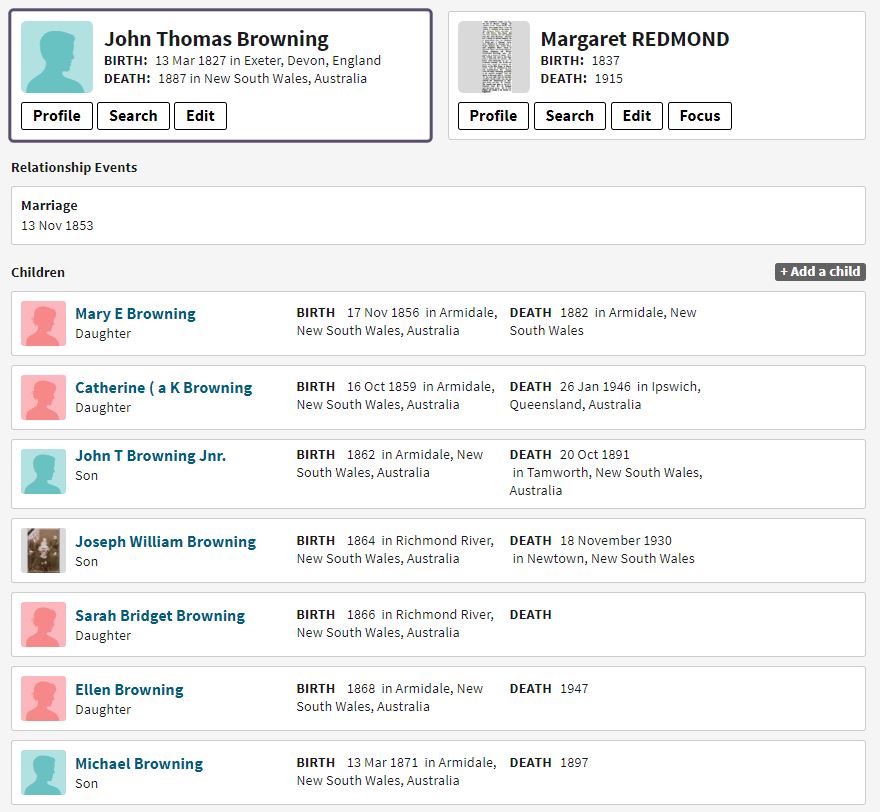
John married Margaret Redmond when he was 26 years old and she was 16.  They went on to have a family of 13 children, including one set of twins.


John and Margaret moved around a lot in the early years of their marriage, as John spent many of these years working as a cedar cutter.

Around the time that their last child was born, Margaret filed for desertion and failure on John's part for maintaining her and the children.

It seems that John had indeed left his wife and family and sadly he ended up in Bathurst gaol in 1887, committed for lunacy, and died there.  

He was survived by his wife Margaret and eleven of his children.  Margaret went on to marry John Maker when she was 63 years of age.  No, they didn't have any children!


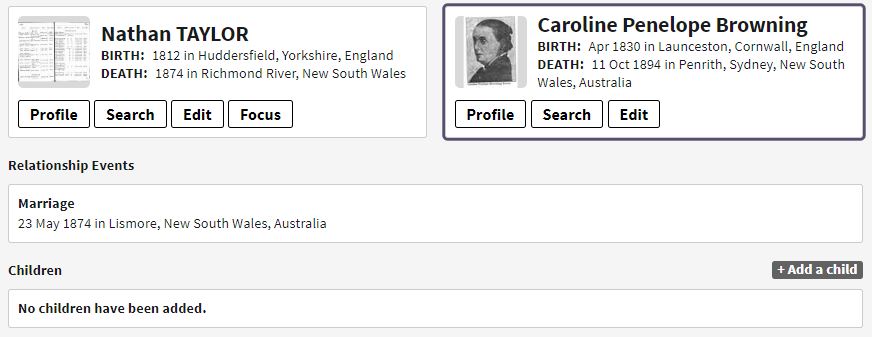
Caroline Penelope Browning   (my 2x great grandmother)
Caroline Penelope Browning married Henry Johnson Brown when she was 15 years old and he was aged 25.  They had 12 children together.


Caroline and Henry began their nomadic married and working life on Runnymede Station, then Lismore Station before leaving the Richmond River area and moving north to the Northern Tablelands.

There they worked on Maryland Station for just a couple of years before returning to the Richmond River.  At this time Henry began working as a timber dealer, cutting and selling cedar north of Lismore and family life became more settled.

Caroline's first husband, Henry Brown, died in 1868 when she was only 38 years old and she had children ranging from 20 years old to a baby of 18 months.

Caroline re-married in 1874, but sadly her second husband, Nathan Taylor, died just two months after their wedding.


Four years later, Caroline re-married again in 1878.  This time she married Thomas Collins, but was left a widow once more three years later. 


Caroline did not have any children with her second or third husband.  She died in 1894 at the age of 64 and was survived by ten of her children.

William Henry (Bill) Browning
William Henry, known as Bill, married Sarah Jane Chillingworth in 1855 when he was 22 years old and she was 15.  They went on to have 9 children.


Sadly Bill and Sarah lost their son named Francis Ernest in 1891, when he accidentally shot himself while reloading cartridges in his gun.  He was only 15 years old.  

The following year their son Henry Herbert died aged 20.  His death was recorded as the result of phthisis asthenia.  Two years later, Bill and Sarah's daughter Ann Eliza died of asthenia pulmonary phthisis, when she was 24 years old.  Both these children appear to have life-threatening conditions that affected their lungs.

Bill died in 1905 when he was 73 years old.  He was survived by his wife Sarah and four of his children.

Mary Anne Browning
Mary Anne married in 1853 when she was 16 years old.  She married convict Charles Bustard (who also used the name Bostock) who was 35 years old.  They went on to have 11 children.


Mary Anne's first husband Charles died in 1884 when Mary Anne was just 47 years old.  She re-married sixteen years later, in 1898, when she was 61 years old.  Sadly her second husband, John Cloughessy died just three years later.  Mary Anne herself passed away in 1909 at the age of 71.  She was survived by nine of her children.

James Francis Browning
James married Eliza Kennewell in 1873 when he was 32 years old and she was 26.  They had a family of 12 children, including one set of twins.


James's wife Eliza died when he was 53 years old.  James was to live for almost twenty more years, passing away in 1914, aged 72.  He was survived by at least six of his children.

Joseph Edward Browning
Joseph married Elizabeth Wilson in 1863.  He was 18 years old and she was 17.  So young!  They were married for 56 years, as Joseph died in 1919.  They had 12 children. 

 
Their daughter Mary died just days after being born.  Their son Joseph died when he was only 6 years old.  Their last son did not survive his birth.  Their second youngest son Jack went off to fight in WW1 when he was 25 years old and was killed in action in France within two years.

Joseph died in 1919 at the age of 74.  He was survived by his wife and eight of his children.  His wife Elizabeth, known as Eliza, had this verse inscribed on this headstone:
"You are always in my thoughts dear husband,
Tis sweet to breathe your name.
In life I loved you dearly,
In death I do the same."

Matthew Browning
Matthew was the last child of William and Anne (known as Nancy).  He married Ann Kennewell in 1874 when he was 27 years old and she was 29.  Ann was Matthew's sister-in-law.  Her sister Eliza had married Matthew's older brother James just the year before.

Matthew and Ann went on to have 8 children.


Matthew died in 1919, aged 72.  His wife Ann had died just eight months before.  They were survived by all of their children, who went on to live long lives.  Theodore (Ted) lived until he was 67.  Nancy Eliza lived until she was 64.  William Francis lived until he reached the age of 75.  John Thomas, known as Jack, lived until he was 72.  James Littlejohn lived until 75 years of age.  Sarah Theresa reached the age of 53.  Charles Reuben lived until he was 56, and Margaret Alice lived until she was 73 years old.

As a large family unit, the Brownings were very close and very supportive of each other.  They often lived and worked in the same places, or places quite nearby.  They were there for the family weddings and baptisms, and got together to mark the passing of relatives.  

I only have a few old photos of the Browning clan:

Children of my 3x great grandparents William Browning and Anne (known as Nancy) Littlejohns:

L-R:  my 3x great aunt Mary Anne Bustard nee Browning; my 2x great grandmother Caroline Penelope Brown nee Browning; and my 3x great uncle Matthew Browning.

Grandchildren of my 3x great grandparents William and Anne (my first cousins 3x removed, my second great uncles and aunts, and my great grandfather):

Children of Mary Ann Bustard nee Browning and her husband Charles Bustard (also Bostock) - my first cousins 3x removed.

L-R: Margaret Jane Brown nee Bustard; Martha Ann Reeves nee Bustard; Thomas Charles Bustard (and his wife Gertrude); and Sarah Ann Smith nee Bustard.


Children of Hannah Norton / Wright / Carr and her second husband Frederick James Wright, (my first cousins 3x removed).

L-R:  William Edward Wright; Harriet Matilda Thomas nee Wright.


The second eldest son of John Thomas Browning and his wife Margaret Redmond (my first cousin 3x removed).

Joseph William Browning, his wife Ellen Frances Redmond and their daughters.


Children of my 2x great grandmother Caroline Penelope Browning and her husband, my 2x great grandfather Henry Johnson Brown (my 2x great uncles and aunts, and my great grandfather).


Alexander Johnson Brown, known as Sandy Brown.


L-r: James Irving Clark Stevenson Brown and Eliza Duncan Gall nee Brown.


L-R: John Thomas Brown, my great grandfather Richard Joseph Brown, and William Norman Brown.


Children of William Henry Browning (known as Bill) and wife Sarah Jane Chillingworth (my first cousins 3x removed).

L-R:  Caroline Maria Kean nee Browning, William Henry Browning (with his mother Sarah Jane Chillingworth), Arthur John Browning and his wife Mary Ann.


Son of Joseph Edward Browning and his wife Elizabeth Wilson (known as Eliza).


Jack Browning (my first cousin 3x removed).


Children of Matthew Browning and his wife Ann Kennewell (my first cousins 3x removed).


Nancy Eliza Robertson nee Browning.


L-R:  John Thomas (known as Jack) Browning, and William Francis Browning.


L-R:  Margaret Alice White nee Browning, and Charles Reuben Browning.


The common ancestors I share with all these people are the parents of the couple William Henry Browning and Anne (known as Nancy) Littlejohns, who emigrated to Australia:

John Browning  1770-1820 and wife Elizabeth Jackett  1762-1826  
(both from Cornwall in England)

John Littlejohns  1772-1840 and wife Mary Ayears  1770-1858
(both from Devon in England)